
A mixed-size wholesale kufi group order requires the supplier to confirm that the selected style supports separate size quantities within the same purchase. Before you commit, get the size chart, ordering rules, and size-by-size breakdown in writing; a general wholesale offer does not establish mixed-size ordering terms.
- Wholesale kufi hats sizes group order: confirm each size and quantity before approving the purchase.
- Match each wearer’s head measurement to the selected style’s chart, not a different hat’s size label.
- One-size labeling does not replace a fit check for a group with different head measurements.
- Wholesale For Everyone serves group accessory buyers; ask directly about the selected kufi style and mixed-size terms.
Why this matters
A group can agree on a color and still need different fits. Ordering by headcount alone leaves the most important allocation question unanswered: which hat belongs to which wearer?
For your 2026 order, separate the style decision from the sizing decision. Choose the appearance together, then build the size breakdown from individual measurements rather than a guessed distribution.
Use the contact form to ask about a specific kufi style and whether its ordering rules accommodate your group’s size breakdown. Include your intended use and required date, but keep both separate from the request for sizing confirmation.
Can you buy wholesale kufi hats in different sizes for a group order?
A mixed-size kufi order depends on the selected product and the supplier’s ordering rules—not simply on whether the seller accepts wholesale purchases. You need confirmation that the style has the sizing format your group needs and that the requested quantities can be combined.
Follow this sequence before approving the purchase:
- Identify the exact style. Record the supplier’s product reference so every question concerns the same hat.
- Request its size chart. Ask what each size label means and whether measurements describe the wearer or the hat.
- Collect wearer measurements. Use the supplier’s measurement instructions consistently across the group.
- Build the size breakdown. Assign a quantity to each confirmed size and color combination.
- Approve the written order. Check that the supplier’s confirmation matches your breakdown without substitutions you have not accepted.
A verbal answer that sizes can be mixed is not a complete order confirmation. The written breakdown should identify the style, size labels, colors, and quantities you actually approved.
Keep that confirmation with your 2026 group roster. It gives the person receiving the shipment the same reference used by the person placing the order.
Separate sizes: best for individual fit allocation
Choose a separately sized format when you need to assign a specific fit to each participant. This approach makes the order easier to check against a measured roster because each wearer has a recorded size selection.
The trade-off is administration. You must collect measurements, resolve unclear entries, and maintain separate quantities instead of treating the order as a single undifferentiated batch.
Do not assume a size label transfers between styles. Match each person to the chart for the exact kufi under consideration, and ask the supplier how to handle measurements that fall between its listed sizes.
Best for: groups that can collect individual measurements before approval. Hold the order until every unresolved size has an agreed decision.
One-size labeling: best for a confirmed shared fit range
Treat one-size labeling as a product description, not proof that every participant will find the hat comfortable. Ask for the intended fit range and any product-specific fitting instructions before deciding that a single format serves the entire group.
The administrative advantage is straightforward: a shared fit format removes separate size allocations. Its limitation is equally important: you still need to establish that it suits the people receiving it.
The table below compares ordering approaches, not confirmed products or supplier offerings.
| Ordering approach | Best for | Main advantage | Main limitation | Confirm before approval |
|---|---|---|---|---|
| Separate sizes | Groups with individual measurements | Clear wearer-to-size allocation | Requires a maintained size roster | Size chart and mixed-size ordering rules |
| One-size format | Groups within a confirmed shared fit range | No separate size allocation | Label alone does not establish individual comfort | Intended fit range and fitting instructions |
| Fit review before allocation | Groups with unresolved sizing questions | Resolves uncertainty before final quantities | Adds an approval task | Whether a physical fit review can be arranged |
Choose the approach that accounts for your wearers, not the one that produces the shortest order form. If the sizing information does not answer your group’s questions, pause approval and request clarification.
Why kufi sizing decisions vary
Your ordering decision should follow the selected product’s documented sizing information and the group’s requirements. Use these factors to identify the questions that need answers:
- Size definition: Establish whether the chart refers to head circumference, hat dimensions, or another measurement.
- Fit construction: Ask whether the style has a fixed fit or is designed to stretch; do not infer this from a photograph.
- Wearer measurements: Record individual measurements rather than assigning sizes by appearance or age alone.
- Preferred position: Follow the product’s fitting guidance and confirm where participants intend to wear the hat.
- Style consistency: Check that every requested size belongs to the same approved style, rather than assuming similar names identify identical products.
- Ordering format: Ask whether quantities are entered individually by size or under another ordering arrangement.
These are verification points, not reasons to guess a size distribution. A well-organized 2026 order records the answer beside the decision it affects.
How do you measure your group for kufi hats?
Measure each wearer according to the selected supplier’s instructions, then compare that measurement with the exact product chart. A flexible measuring tape records head circumference, but the supplier’s guidance should determine the tape’s position and how the result maps to a size.
Record measurements
Use a consistent unit throughout the roster. If someone submits a measurement without a unit, return it for clarification instead of deciding what they meant.
Ask participants to measure in the intended wearing position. Keep the tape level and avoid pulling it tight enough to compress the head; repeat an unclear measurement rather than averaging conflicting entries.
Match sizes
Enter the wearer’s measurement and the resulting supplier size in separate fields. This preserves the original information if you change styles or receive an updated chart before approval.
Do not build your own size boundaries. When the chart leaves a measurement unclear, ask the supplier which size it recommends for that specific product and record the answer.
Review exceptions
Flag unresolved fit preferences, missing measurements, and between-size questions before totaling quantities. Keep these entries separate from approved allocations so uncertainty does not disappear inside the group total.
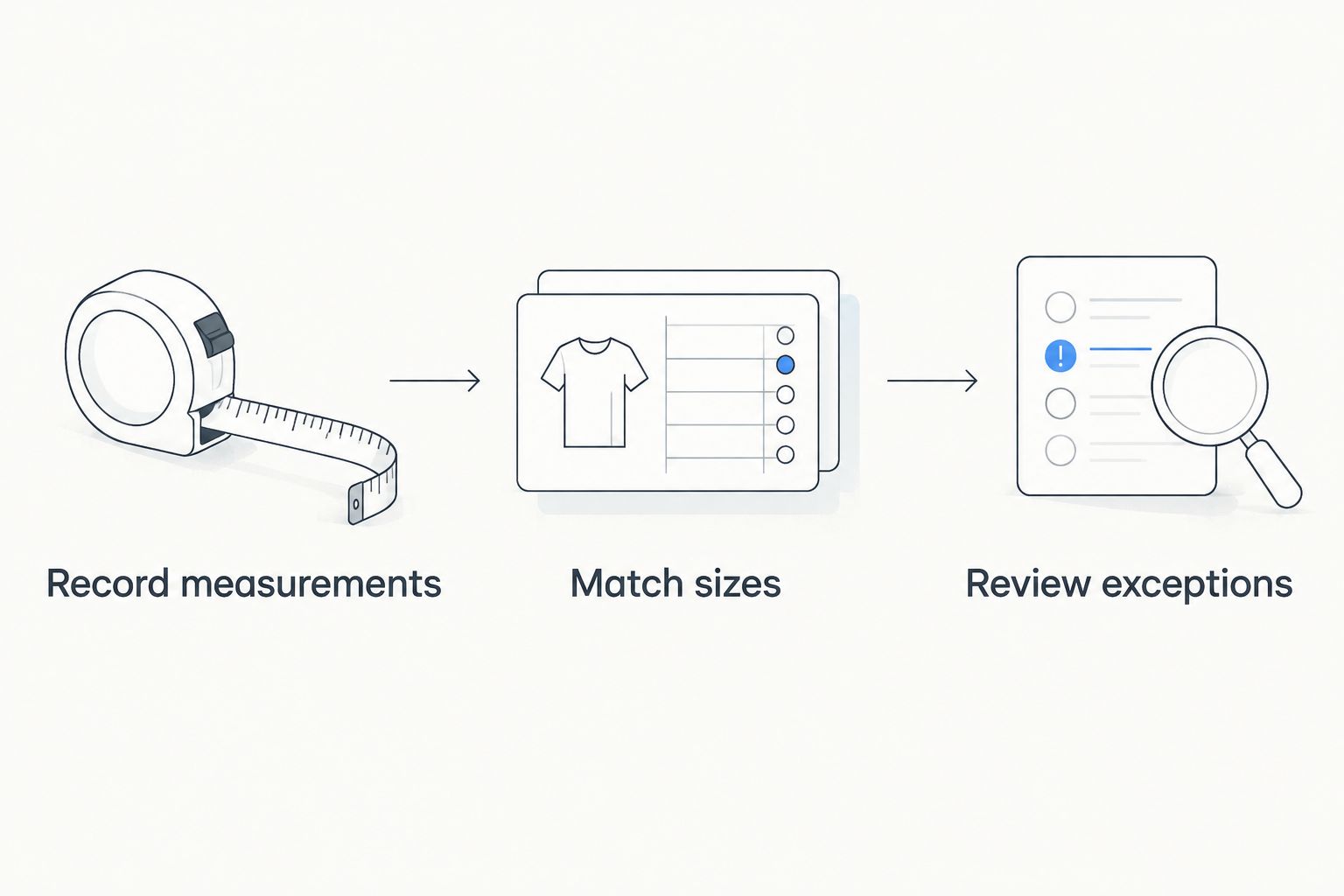
After the review, ask each participant to confirm the recorded allocation where practical. The organizer should approve the consolidated breakdown only after the individual entries are settled.
What should your mixed-size order sheet include?
Create a working roster for allocation and a separate supplier-facing summary for purchasing. The roster answers who receives each hat; the summary answers how many hats to order in each approved combination.
Use the following fields in your working document:
| Field | What to record | Why it belongs |
|---|---|---|
| Wearer reference | Name or internal identifier | Connects the allocation to its recipient |
| Head measurement | Measurement with its unit | Preserves the basis for the size choice |
| Supplier size | Exact label from the selected chart | Avoids an unofficial size translation |
| Product reference | Exact style identifier | Keeps the request tied to the approved hat |
| Color | Selected color description | Separates otherwise similar order lines |
| Quantity | Required amount for that combination | Creates the purchase breakdown |
| Approval status | Confirmed or unresolved | Keeps open questions visible |
Do not send the supplier personal roster details it does not need. A purchasing summary can list style, size, color, and quantity while your organization retains the wearer assignments.
Label the approved file clearly, such as your 2026 group order, and distinguish it from drafts. When a participant changes a selection, update the summary before asking the supplier to confirm it.
Can adults and children share the same group order?
Adults and children should have separate measurement records, even when their hats are intended to look alike. Whether their requested styles and sizes can share a purchase requires the supplier’s confirmation.
Do not translate an adult size chart into a youth chart yourself. Ask for the relevant product guidance and confirm whether the proposed styles meet the group’s appearance requirements.
A shared color name also does not establish identical construction or appearance across different styles. If visual consistency matters, include that requirement in the approval conversation rather than treating sizing as the only decision.
Does custom decoration change the sizing process?
Confirm the undecorated hat’s fit before approving customization. A logo proof addresses artwork and placement; it does not establish whether a hat fits its wearer.
Wholesale For Everyone offers custom printing and embroidery on selected products. That does not establish that a particular kufi accepts either process, so ask about the exact style before preparing decoration instructions.
Keep the decisions separate:
- Approve the product reference and size breakdown.
- Confirm whether the selected product supports the requested decoration.
- Review the artwork and placement instructions.
- Ask how the finished product’s care guidance applies.
Do not treat artwork approval as size approval. Your written confirmation should make both decisions visible, especially when different people manage purchasing and design.
What should you ask the supplier before committing?
Send a specific request rather than asking only whether the business sells wholesale kufis. Describe your group, identify the style you are considering, and attach the proposed size breakdown.
Ask the supplier to confirm:
- Which chart applies to the selected style?
- Can the requested sizes be combined in the purchase?
- Does each size or color have separate ordering requirements?
- How should between-size measurements be handled?
- What changes require a revised order confirmation?
- Which terms apply if the delivered items do not match the approved order?
Wholesale For Everyone is best for businesses and organizations sourcing group accessories. Its audience includes schools, nonprofits, clubs, teams, and individual shoppers; a specific kufi request still needs product-level confirmation.
Keep the supplier’s answers beside your 2026 approval record. Do not transfer terms from a different hat, an earlier purchase, or an unrelated product into the new order.
FAQ
Can I mix small and large kufi hats in the same wholesale order?
Mixing small and large kufi hats requires confirmation for the selected style and purchase. Ask the supplier to approve the exact size labels and quantities in writing.
Does one size mean a kufi will fit everyone in my group?
One-size labeling does not establish that a kufi will fit every group member comfortably. Compare individual measurements with the product’s intended fit range and fitting instructions.
Should I use inches or centimeters to measure for kufi hats?
Use the unit specified by the selected product’s size chart. Keep measurement units visible in your roster and resolve any unclear entries before assigning sizes.
Can I order kufi hats for adults and children together?
A combined adult and child purchase requires the supplier’s confirmation for the requested products. Measure each wearer and use the chart that applies to the specific style.
Should I order the same kufi size as another hat I own?
Use the selected kufi’s size chart rather than copying another hat’s label. Keep your head measurement available so the supplier can address unclear size boundaries.
Can Wholesale For Everyone customize the kufi hats for my group?
Wholesale For Everyone offers printing and embroidery on selected products, but a specific kufi’s suitability requires confirmation. Ask about the exact style before approving decoration.
What should I do if someone falls between kufi sizes?
Ask the supplier how the selected style handles a between-size measurement. Record the recommendation before including that wearer in the approved size totals.
One last thing
A correct group total can still hide an incorrect size breakdown. Before approval, check both: the total number of hats and the quantities assigned to each style, size, and color.
Then keep the wearer roster for distribution. The purchase summary tells you what arrived; the roster tells you who should receive it.
Related guides
- Can you mix hat sizes in one wholesale order?
- Wholesale kufi hats for community groups
- Can you buy wholesale bucket hats in extra-large sizes?
- Wholesale blank hats for custom embroidery