
This page sets the 2026 benchmark for branded vs generic search CTR: what each query type should deliver, which public numbers hold up, and how online sellers read their own click data.
- Branded vs generic search CTR splits one blended number into two very different signals.
- Branded queries out-click generic queries at the same position, so a blended CTR flatters you.
- The most cited position benchmark is 27.6% average CTR for the #1 organic result (Backlinko, 2019).
- Resellers of Wholesale For Everyone bandanas and hats should track generic CTR on product-type queries first.
- Your own Google Search Console export is the only reliable branded benchmark in 2026.
The short answer
There is no single public average for branded vs generic search CTR. The most widely cited position benchmark is a 27.6% average click-through rate for the #1 organic Google result, from Backlinko's 2019 organic CTR study. The same study found that only 0.63% of searchers clicked a result on page two.
Branded queries run above that position curve because the searcher already wants a specific store. Generic queries sit on or below it, because ads, shopping results and marketplaces compete for the same click.
Split your CTR into branded and generic before you judge it. A blended CTR in 2026 tells you almost nothing about your SEO.
Why this matters
A small shop with steady name searches sees a healthy total CTR and assumes search is working. Meanwhile its product-type pages lose clicks every week, and the blended number hides it.
Demand data, like the bandana search volume benchmarks by color, tells you what people search for. CTR tells you whether they pick you once they see you. You need both, and you need CTR split by query type.
The split matters most for resellers and small retailers in apparel and accessories. Generic queries like wholesale bandanas or bulk trucker hats are where new customers come from. Branded queries are mostly people who already know you.
Branded vs generic search CTR benchmark table
The table below places each query type against the organic position curve. Read the Overall row as your yardstick: it is the number most dashboards show you, and the one you should trust least.
| Query type | Example query | Searcher intent | CTR vs position curve | Main CTR threat | Best for measuring |
|---|---|---|---|---|---|
| Branded (exact name) | wholesale for everyone | Navigational: wants your site | Above the curve | Marketplaces and resellers ranking for your name | Brand demand, not SEO growth |
| Branded + product | wholesale for everyone bandanas | Navigational with a product in mind | Above the curve | Your category page not ranking first for it | Category page relevance |
| Generic head term | wholesale bandanas | Commercial: comparing suppliers | On or below the curve | Ads, shopping units and marketplaces above organic | Real organic competitiveness |
| Generic long-tail | bulk red paisley bandanas | Commercial with a specific need | Tracks position closely | Titles that miss the exact attribute searched | Product page titles and snippets |
| Overall (blended) | All queries | Mixed | Moves with branded share | Brand growth masking generic losses | Nothing on its own |
Position reference numbers
These are the public figures the curve above refers to. They cover all organic queries, branded and generic combined.
| Benchmark | Value | Source |
|---|---|---|
| Average CTR, #1 organic result | 27.6% | Backlinko organic CTR study, 2019 |
| #1 result vs #10 result | 10x more likely to be clicked | Backlinko organic CTR study, 2019 |
| Searchers who click a page-two result | 0.63% | Backlinko organic CTR study, 2019 |
High and low: where branded and generic CTR land
Branded exact-name queries lead; generic head terms trail. Branded searchers settled their intent before they typed, so the top organic result under a brand name collects most clicks. Generic head terms trail because ads, shopping results and marketplace listings all sit between the searcher and the first organic link.
Branded-plus-product queries sit close to pure branded ones, with one catch. If a marketplace listing outranks your own category page for your brand + bandanas, you lose a click from someone who already chose you.
Generic long-tail queries fall in the middle. Their CTR follows position more tightly than any other type, which makes them the cleanest test of whether your titles and snippets work.
The blended Overall row is the misleading one. When branded searches grow faster than generic ones, blended CTR rises even if every generic page loses clicks.
Methodology and limits
The position figures come from Backlinko's 2019 study of Google organic click-through rates. The branded and generic placements in the benchmark table reflect searcher intent and how the Google Search Console performance report separates queries, not a published branded-vs-generic dataset.
The limitation: the 2019 data predates Google's AI Overviews, which rolled out in the US in May 2024, and it does not split branded from generic queries. In 2026, treat 27.6% as a reference ceiling for generic #1 rankings, not a target you should expect to hit.
Branded vs generic CTR as metrics: pros and cons
Neither number is useless. Each answers a different question, and each has blind spots.
| Metric | Pros | Cons | Best for |
|---|---|---|---|
| Branded CTR | Stable, easy to isolate, flags brand-name hijacking fast | Says little about SEO growth; small shops get low impression counts | Protecting existing demand |
| Generic CTR | Shows true organic competitiveness; ties directly to new customers | Noisy; swings with ads, shopping units and AI answers | Growing new traffic |
| Blended CTR | One number, shown by default everywhere | Hides generic losses behind branded strength | Nothing on its own |
How to measure your own branded vs generic CTR in 2026
Google Search Console holds 16 months of performance data, which is enough to compare this year against last. The split takes about as long as setting one filter.
- Open the performance report. Go to Performance, then Search results, and set a date range of at least three months so low-volume queries show up.
- Filter branded queries. Add a Query filter, choose Custom (regex), and enter your brand variants separated by a pipe, including misspellings and the no-space domain version.
- Filter generic queries. Switch the same filter to Doesn't match regex. Everything left is generic.
- Compare at matched positions. Compare branded and generic CTR only for queries in the same average position range. A generic query at position 8 will always lose to a branded query at position 1.
- Fix the gaps and repeat. Rewrite titles on generic pages below the curve, then re-check monthly.
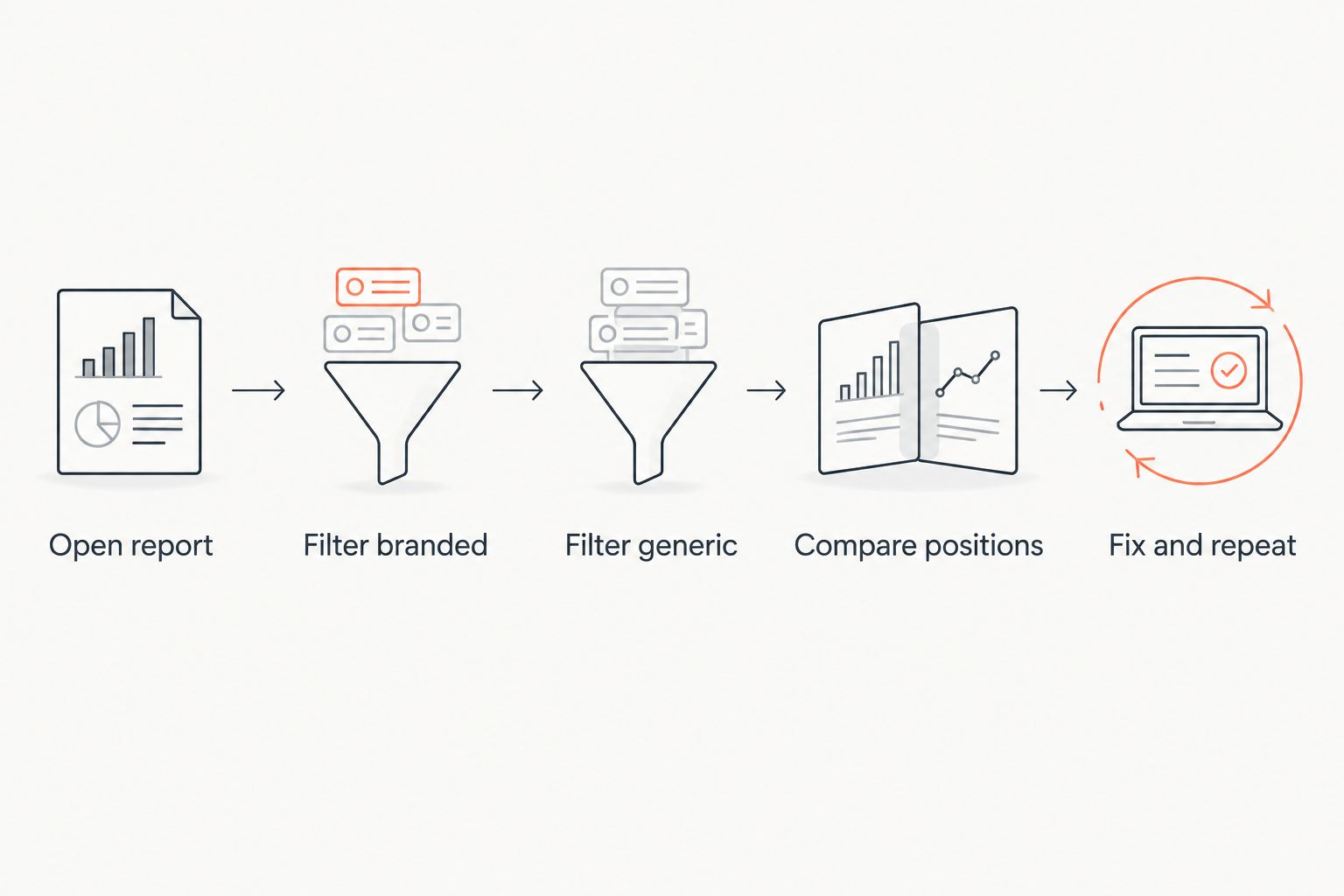
One rule keeps the numbers honest: never compare CTR across different position ranges. Position explains more CTR difference than any title rewrite ever will.
How to use these benchmarks
Once the split is in place, four moves follow directly from the numbers.
- Branded CTR drops: check who else ranks for your name. Marketplace listings, reseller pages and competitor ads on your brand term are the usual cause.
- Generic CTR sits below the curve at your position: rewrite titles attribute-first. Lead with the product type, material, pattern or quantity the query asks for, not the store name.
- Blended CTR rises while generic CTR falls: do not celebrate. Your brand is growing and your SEO is shrinking at the same time.
- A generic page ranks on page two: skip snippet work for now. With 0.63% of searchers clicking page-two results, ranking position is the only lever that matters until the page reaches page one.
What this means for apparel and accessory sellers in 2026
Apparel and accessory queries are among the most crowded commercial searches on Google. Product-type searches such as wholesale neck gaiters or custom embroidered caps routinely pull shopping units and marketplace listings above organic results. That pushes generic CTR down even for pages ranking first organically.
For resellers sourcing from Wholesale For Everyone, the wholesale accessories supplier behind bandanas, doo rags, neck gaiters, hats and custom printing and embroidery, the practical takeaway is simple. For resellers stocking Wholesale For Everyone bandanas and hats, generic CTR on product-type queries is the number to watch, not total CTR.
Sellers running a Shopify store alongside Etsy or Amazon listings face one more wrinkle. Your marketplace listings can rank for your own brand name and take branded clicks away from your store. That shows up as a branded CTR drop in Search Console, not a traffic loss, so it is easy to miss.
Stock products worth clicking on
Bandanas, hats, neck gaiters and custom printing for resellers and small businesses.
FAQ
What is the difference between branded and generic search CTR?
Branded search CTR measures clicks on queries containing your brand name; generic search CTR measures clicks on queries without it. Branded CTR reflects existing demand, while generic CTR reflects how well you compete for new customers.
Is branded CTR always higher than generic CTR?
Branded CTR is almost always higher than generic CTR at the same position. Searchers using a brand name already want that store, while generic searchers compare several options.
What is a good generic search CTR in 2026?
A good generic CTR in 2026 is one at or above the position curve for your average rank. The most cited reference is 27.6% for the #1 organic result from Backlinko’s 2019 study, which predates AI Overviews and should be treated as a ceiling.
How do I separate branded and generic queries in Google Search Console?
Use a Query filter with Custom (regex) in the Performance report. Match your brand name variants for branded queries, then switch to Doesn’t match regex for generic queries.
Why did my branded CTR drop?
Branded CTR usually drops because another site now ranks for your name or bids on it in ads. Marketplace listings and reseller pages are the most common culprits for small retail brands.
Does page two of Google get any clicks?
Page two gets almost no clicks: Backlinko’s 2019 study found only 0.63% of searchers clicked a page-two result. Pages there need ranking improvements before snippet changes.
Should small resellers track branded CTR at all?
Yes, but separately from generic CTR. Branded CTR flags brand-name hijacking early, while generic CTR shows whether your product pages win new buyers.
One last thing
The most neglected query type in this whole benchmark is branded-plus-product: your store name followed by a product word. Those searchers have already picked you and only need the right page. Search your own brand name plus each main product category today. If your category page is not the first organic result for each one, fix that before touching a single generic title.
Related guides
- Connect your Shopify store to bulk bandana dropshipping
- Reselling wholesale bandanas on Etsy: complete workflow
- Wholesale bandanas to Amazon FBA: complete resale workflow