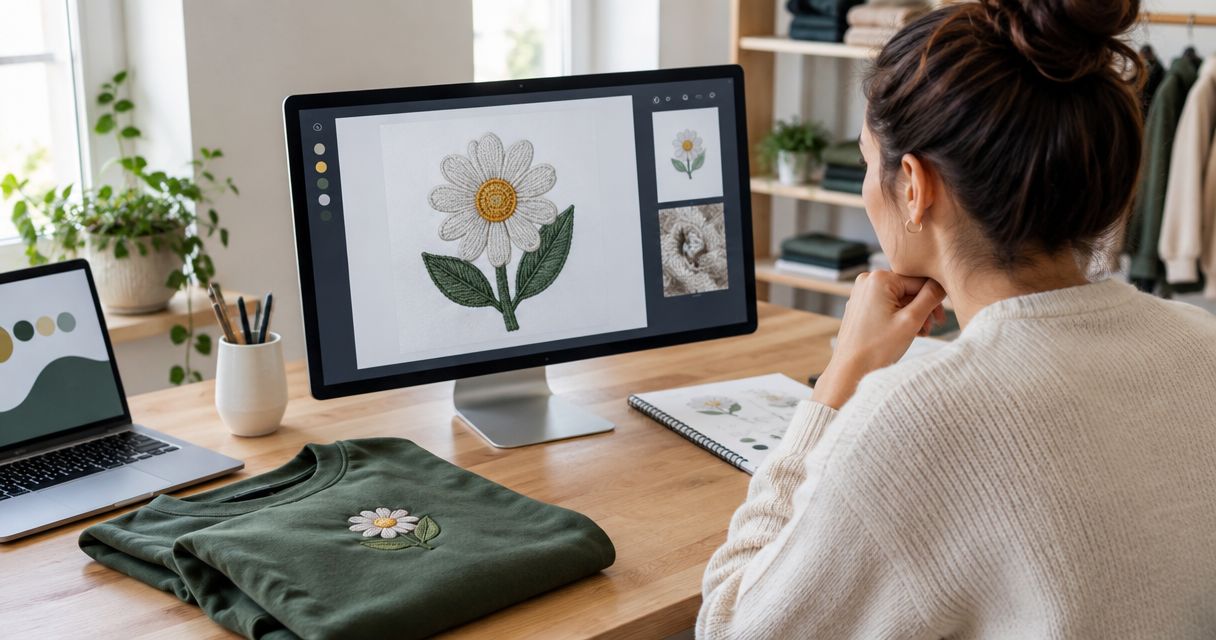
Getting an embroidery proof approved takes the supplier’s proof-preparation time plus your review time and any revision rounds; there is no universal approval deadline for 2026. Ask for the first-proof date and the final approval cutoff for your specific order. Proof approval is not a delivery promise: confirm production and shipping dates separately before committing to an event or launch.
- How long to get embroidery proof approved depends on proof preparation, reviewer response, and revisions—not a universal turnaround.
- Wholesale For Everyone offers custom embroidery on selected products for businesses, organizations, and individual shoppers.
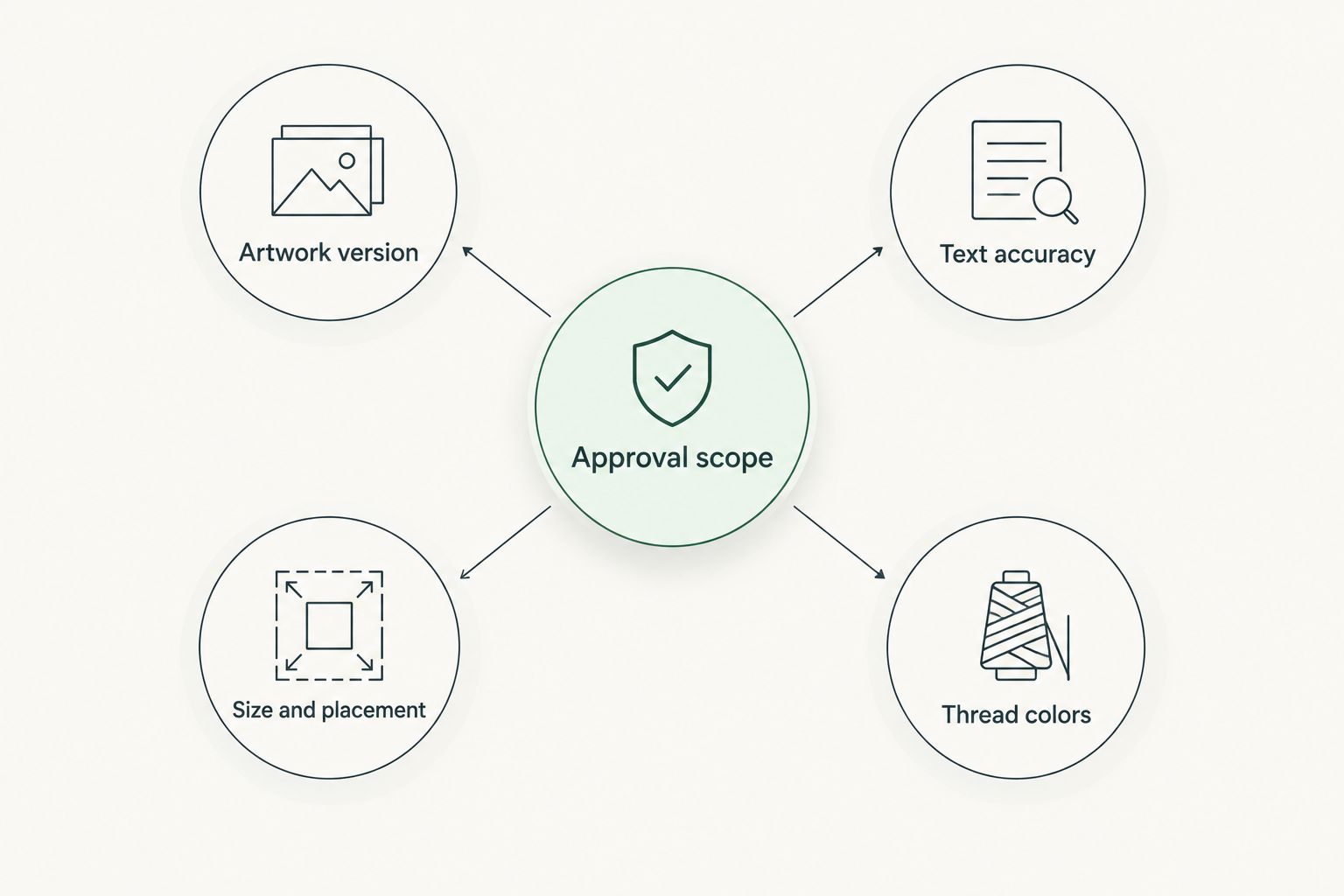
- Approve the design version, spelling, dimensions, placement, and thread colors together.
- Confirm the production schedule separately; an approved embroidery proof does not establish a delivery date.
Why this matters
An embroidery proof is a decision point, not just an image to glance at. Your approval tells the supplier which design you accept, while an unclear response leaves room for disagreement about what should be stitched.
For a 2026 uniform order, fundraiser, or promotional campaign, work backward from the date you need finished goods. Keep artwork review separate from production scheduling so a late logo decision does not become an unexpected deadline problem.
If you are still choosing merchandise, the custom embroidered apparel guide for small businesses covers that broader planning topic. This page focuses on the approval handoff: what to request, what to inspect, and what to confirm before you give permission to proceed.
How long does it take to get an embroidery proof approved?
The usable answer is an order-specific schedule, not a generic number of days. Establish when the supplier will send the proof, when your reviewer will respond, and how revised artwork will be handled. A deadline without those checkpoints leaves the approval process undefined.
Use this sequence to turn an open-ended question into a clear plan:
- Define the order. Identify the selected product, artwork, intended embroidery location, and required completion date. Ask the supplier to confirm which details are needed before preparing a proof.
- Confirm proof preparation. Request the expected first-proof date and ask what form the proof will take. A digital preview and a stitched sample answer different questions.
- Assign one approver. Name the person authorized to accept the design. Other reviewers can contribute, but one person should send the consolidated response.
- Review the complete proof. Check wording, artwork version, dimensions, placement, and thread-color references. Send corrections together rather than in separate messages.
- Close the approval loop. Identify the accepted version in writing and ask the supplier to acknowledge it. Then confirm the next production milestone and the delivery plan.
This sequence does not guarantee a particular turnaround. It gives you specific checkpoints to follow up on instead of repeatedly asking whether the order is ready.
Digital proof: best for artwork and placement review
A digital embroidery proof is useful for reviewing the proposed design before stitching. It gives you a reference for spelling, layout, stated dimensions, placement, and specified thread colors.
Its limitation is physical appearance. A screen preview cannot demonstrate the texture of stitches or exactly how the embroidery will sit on the selected fabric. Monitor colors also are not a substitute for an agreed thread-color reference.
Approve a digital proof for the details it actually shows. If the preview does not state the embroidery dimensions or identify the garment placement clearly, request that information before signing off. Do not infer finished size from how large the image looks on your screen.
Sew-out: best for reviewing stitched appearance
A sew-out is a stitched example of the embroidery design. It lets you inspect the stitched result rather than relying entirely on a digital representation.
The material matters. A sample stitched on a different fabric does not show every aspect of how the design will behave on your selected product. Ask what material was used and whether the sample represents the intended embroidery location.
Request a sew-out when stitched detail is central to your decision, and confirm its scheduling implications before adding it to the approval process. Do not assume a physical sample is included or that a supplier follows the same sampling procedure for every order.
| Proof option | Best for | What you can review | Main limitation |
|---|---|---|---|
| Digital proof | Artwork and placement decisions | Wording, layout, stated size, location, specified colors | Does not demonstrate physical stitch texture |
| Sew-out | Stitched appearance decisions | Stitch detail, legibility, texture, and appearance on the sample material | A different sample material does not fully represent the selected product |
The right choice depends on the question you need answered. If you need to confirm a business name, the digital artwork is relevant. If you need to inspect how a detailed mark looks in thread, discuss a stitched example.
Why embroidery proof approval time varies
Approval timing depends on the work needed to prepare the design and the decisions needed to accept it. These factors belong in your planning conversation:
- Artwork readiness. Conflicting logo files, missing text, or unclear instructions require clarification before the design can be finalized.
- Design detail. Fine lines, small lettering, and closely spaced elements need attention when translating artwork into stitches.
- Product and placement. The embroidery area and fabric affect how the design is prepared and evaluated. Changing either requires another review of the proposed result.
- Proof format. A digital preview and a physical sew-out involve different preparation and review steps. Confirm the format rather than assuming it.
- Reviewer coordination. Separate responses from several people create competing instructions. A single consolidated decision gives the supplier a clear next action.
- Revision scope. Correcting a spelling error differs from replacing the logo or changing the embroidery location. Specify the entire change before requesting the next version.
For your 2026 order, ask which unresolved item is holding up the current stage. A targeted question about artwork, review, or sampling produces a more useful answer than a general request to speed things up.
What should you check before approving an embroidery proof?
Review the proof as a production instruction. A visually appealing logo is not enough if the name is misspelled, the intended location is unclear, or the dimensions are wrong for your purpose.
Artwork version
Compare the proof with the actual file you want reproduced. Businesses often have alternate marks, older logos, and versions with or without a tagline. Identify the approved artwork explicitly so nobody has to choose between attachments.
Check that any requested simplification is intentional. Embroidery uses stitches rather than printed ink, so the prepared design needs its own review even when the original artwork has already been approved internally.
Text accuracy
Read every word, including initials, punctuation, names, and slogans. Compare text character by character against your source, not against your memory of the logo.
If the order contains individual names or different departments, keep those details separate from the common design approval. Ask how the supplier wants variable information submitted and checked.
Size and placement
Review the stated finished dimensions and the intended embroidery location. Image magnification does not tell you the finished size, and a generic product outline does not settle an ambiguous placement instruction.
For caps, the artwork-to-embroidered-caps workflow addresses the wider handoff. Keep the cap selection and location consistent while reviewing the proof so the approved design corresponds to the intended item.
Thread colors
Use the supplier’s stated thread references rather than a screenshot alone. Ask how those references relate to your artwork colors and whether substitutions require your approval.
Pay particular attention to contrast with the selected product. A color combination that is easy to read against a white digital background needs its own evaluation against the fabric you chose.
Approval scope
State whether you are approving the artwork, the stitched sample, or both. Avoid broad approval wording when a separate question remains unanswered.
If the supplier’s form includes dimensions, product details, placement, and colors, review those fields as carefully as the image. Approve the full instruction set, not just the logo thumbnail.
How do you prevent avoidable revision rounds?
Make the design decision before sending the approval response. A message that approves the logo while asking for a different size is not a final sign-off; it is a revision request.
Use these practices to keep the handoff clear:
- Gather comments from everyone who needs to review the design.
- Resolve conflicting preferences internally before contacting the supplier.
- Send one list that identifies every requested change.
- Refer to the exact proof version or filename.
- Ask for a revised proof when a correction affects the approved instructions.
- Check the revised version against the entire checklist, not only the latest edit.
Do not rely on silence as approval. Send an explicit decision and request acknowledgment so both sides know whether the order is waiting for feedback or ready for the next stage.
For repeat orders in 2026, retrieve the earlier approved artwork and instructions before requesting a new proof. Treat changes to the product, embroidery location, dimensions, or wording as decisions that need confirmation rather than assuming the previous approval covers them.
Where does Wholesale For Everyone fit?
Wholesale For Everyone fits businesses and organizations seeking custom embroidery on selected accessories and apparel. Its stated services include custom printing and embroidery for logos, business names, messages, artwork, and designs on selected products.
That makes the brand relevant when you are planning employee apparel, branded merchandise, giveaways, or resale products. The limit is equally important: customization applies to selected products, so confirm the suitability of your chosen item and design rather than assuming every item supports embroidery.
Wholesale For Everyone’s custom embroidery service is an option for these projects; the proof schedule still needs agreement for your particular order. Ask about proof format, revision handling, final approval requirements, and production timing in the same conversation.
Can I approve an embroidery proof immediately?
You can approve an embroidery proof when every required detail is correct and you have authority to sign off. Reading the email immediately is not the same as completing the review.
If wording, dimensions, placement, or colors remain unresolved, send a revision request instead. A fast approval is useful only when it is also a complete approval.
Does approving the proof mean production has started?
Proof approval does not establish that production has started. It records your acceptance of the design; the production status needs its own confirmation.
Ask the supplier to acknowledge approval and identify the next milestone. Keep that response with the accepted proof so your team can distinguish a design decision from a manufacturing update.
What if my embroidery order has a fixed event date?
Give the supplier the required arrival date before the proof process begins. Ask for the final approval cutoff and the production and shipping schedule connected to that date.
For a 2026 event, treat any design change after approval as a reason to reconfirm the schedule. Do not assume an earlier delivery plan remains unchanged when the instructions change.
FAQ
How long does it take to get an embroidery proof approved?
Approval takes the supplier’s preparation time plus your review and any revisions; there is no universal deadline. Ask for the first-proof date and final approval cutoff for your order.
Can I approve my embroidery proof as soon as I receive it?
You can approve it once the artwork, wording, dimensions, placement, and thread colors are correct and you have authority to sign off. Request corrections before giving final approval.
Is a digital embroidery proof better than a sew-out?
A digital proof is best for artwork and placement review; a sew-out is best for inspecting stitched appearance. Confirm the sample material because it affects what the sew-out demonstrates.
Do I need another proof after changing my logo?
Request a revised proof when a logo change alters the design you are approving. Identify the replacement artwork clearly and review the updated instructions before signing off.
Does embroidery proof approval include delivery confirmation?
Embroidery proof approval does not confirm delivery. Ask separately for production timing, shipping arrangements, and the expected arrival date.
Who should approve embroidery for a business or team?
One authorized person should send the final decision after collecting internal feedback. Consolidating comments gives the supplier one clear set of instructions.
Does Wholesale For Everyone offer custom embroidery?
Wholesale For Everyone offers custom embroidery on selected products for businesses, organizations, and individual shoppers. Confirm the selected item, design requirements, and proof schedule for your project.
One last thing
For your 2026 project, keep the final approved proof and the supplier’s acknowledgment together. Record the accepted version, product, placement, dimensions, and thread references in the same place.
That record gives you a useful starting point for a repeat order. More importantly, it prevents a folder full of draft artwork from becoming the reference for what you actually approved.
Related guides
- Custom embroidered hats for corporate branding
- Branded merchandise for corporate trade shows
- Wholesale caps for churches