Embroidered apparel ships on the order-specific dispatch date your supplier confirms after approval; approving the design does not, by itself, establish a shipping date. Production time and carrier transit are separate, so a ship date is not an arrival date. For a 2026 event or staff rollout, get both dates confirmed before you commit to distributing the finished apparel.
- How long does embroidered apparel take to ship? Use the confirmed order schedule, not the artwork approval date alone.
- Embroidery turnaround and shipping transit are separate stages; confirm dispatch and arrival before committing to an event.
- Wholesaleforeveryone offers custom embroidery on selected products for businesses, organizations, and individual shoppers.
- Keep the final proof, order details, and confirmed shipping schedule together so everyone works from the same instructions.
How long does embroidered apparel take to ship after approval?
Use the supplier’s confirmed post-approval production schedule to establish when your embroidered apparel will ship. Then use the shipping service’s transit estimate to plan arrival. Neither an approved proof nor a shipping label establishes that the parcel has reached the carrier.
If you are still reviewing artwork, start with the guide to embroidery proof approval. Approval and dispatch answer different questions: the first records your acceptance of the design; the second records when the finished order leaves for delivery.
Keep these milestones separate when you review a quote or order confirmation:
| Milestone | What it tells you | What it does not establish |
|---|---|---|
| Proof approved | You have accepted a particular design version | That production has finished or the parcel has shipped |
| Production completion | The embroidery work is finished | That the carrier has received the package |
| Label created | Shipping information has been prepared | That the carrier has possession of the package |
| Carrier acceptance | The carrier has received the shipment | That delivery has occurred |
| Delivery | The shipment has reached its destination | That you have checked the contents against the order |
For a deadline-driven order, ask for a calendar date rather than accepting the word soon. Your team needs a dispatch target, an arrival estimate, and a clear explanation of which dates are estimates and which are commitments.
Why this matters
An event organizer needs apparel at the venue, not merely completed at the embroidery shop. A business issuing employee apparel needs time to receive, inspect, and distribute it. A reseller needs to check the merchandise before making promises to customers.
Plan backward from the date you need the apparel in hand. Treat that date as a receiving deadline, not a shipping deadline. For your 2026 order, record the event date and the receiving deadline separately so nobody mistakes the last possible delivery date for the preferred delivery date.
This distinction also makes supplier conversations more useful. Instead of asking only when an order will ship, explain what must happen after delivery: inspection, sorting, staff distribution, transport to a venue, or preparation for resale. Ask for a schedule that addresses that use.
What should you confirm immediately after approval?
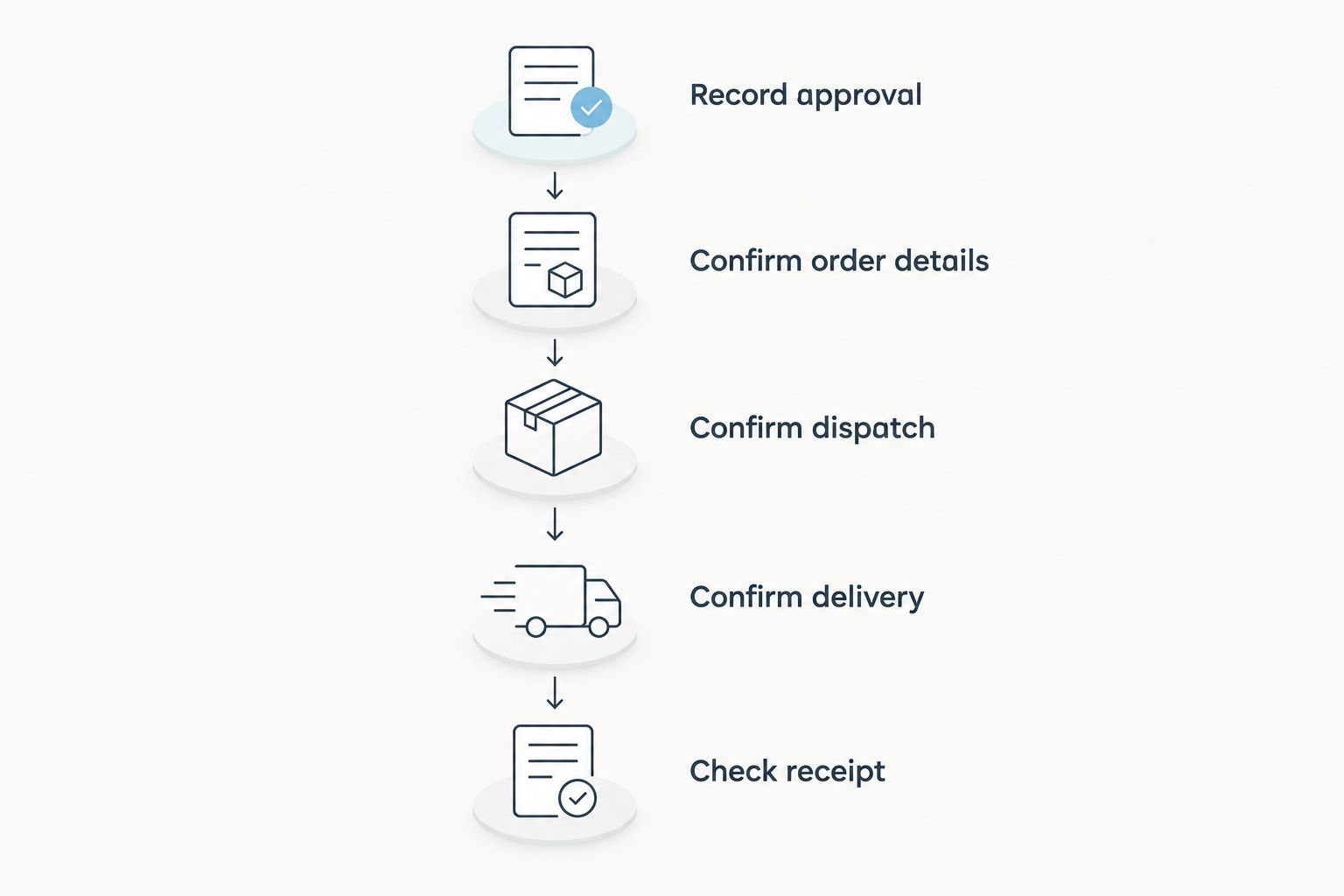
Use this sequence to turn artwork approval into a usable delivery plan. These are buyer checks, not a statement that every supplier follows the same internal workflow.
- Record approval. Save the approved proof and the message accepting it. Identify the final artwork version, embroidery placement, and selected product in the same record.
- Confirm order details. Check quantities, product selections, and any size or color information included in your order. Ask whether the supplier needs anything else before proceeding.
- Confirm dispatch. Request the expected shipping date for the approved order. Ask what the date depends on and whether it is an estimate or a commitment.
- Confirm delivery. Verify the destination, shipping service, and estimated arrival date. State your receiving deadline explicitly rather than assuming the supplier knows it.
- Check receipt. When the order arrives, compare the contents with your order confirmation before distributing the apparel or taking it to an event.
The strongest approval message connects the design to the order. A message saying only approved leaves less useful documentation than one that identifies the final proof and asks for confirmation of the shipping schedule.
Keep the supplier’s response with the approval record. That gives your purchasing contact, event lead, and receiving team the same reference instead of separate recollections of a phone conversation.
For a more detailed look at the production brief, see the artwork-to-embroidered-caps workflow. Use the workflow to organize your questions, not to substitute another order’s schedule for your own.
Why the post-approval schedule varies
A useful embroidery schedule describes a specific order. These details belong in the conversation because they define the work you are asking the supplier to complete:
- Order quantity: State the final quantity rather than asking about timing for an unspecified bulk order. Request a schedule for that quantity.
- Selected products: Identify the products receiving embroidery. Do not apply a timeline discussed for one product to another without confirmation.
- Customization scope: Clarify whether the order uses a logo, business name, message, artwork, or another custom design. Include every requested placement in the brief.
- Design revisions: If you change the approved artwork, ask the supplier to reconfirm the schedule against the revised version. Keep the replacement approval clearly identified.
- Receiving requirements: Explain whether the merchandise is for employee apparel, an event, a fundraiser, or resale. Provide the date by which you need to receive it.
These details support a precise scheduling question. They do not establish a universal turnaround or prove that a particular order will take longer than another.
When updating a 2026 order, change the written brief before asking for a revised date. Otherwise, one person can be discussing the original artwork while another expects a different product, quantity, or placement.
Does approval mean production starts immediately?
Approval does not establish an immediate production start. It records acceptance of the design; ask the supplier to confirm whether the order is ready to proceed and when dispatch is expected.
A useful question is: With this proof approved and these order details confirmed, what is the expected dispatch date? That ties the answer to your actual order rather than to a general statement about embroidery turnaround.
Do not announce a delivery date internally based only on sending approval. Share the confirmed schedule instead. If the supplier has not yet confirmed it, keep the receiving plan open rather than treating an assumption as a promise.
Does choosing faster shipping shorten embroidery production?
Faster shipping addresses the transit stage, not the embroidery work. Ask about production scheduling and shipping service separately; changing one does not establish that the other has changed.
For a 2026 event order, begin with the receiving deadline and ask what schedule supports it. A faster carrier service is not an answer to unfinished production, and a completed order still needs a delivery plan.
Before accepting a shipping change, ask for the resulting arrival estimate. The relevant question is whether that estimate fits your receiving deadline, not whether the service has a faster-sounding name.
What happens if you change the design after approval?
A design change requires a new scheduling conversation. Send the revised artwork, identify what changed, and ask the supplier to confirm which version and schedule now apply.
Do not keep using the original ship date after changing the approved brief without reconfirming it. This is especially important when different people handle branding, purchasing, and event planning. Each person needs the same final proof and the same current date.
Keep the superseded proof out of the active order discussion. You can retain it for reference, but label the final version clearly so it is not mistaken for an instruction to produce the earlier design.
How do you ask for a useful shipping confirmation?
Send a short message that names the order and asks separate questions about production, dispatch, and arrival. You do not need a long explanation; you need a response that your receiving team can act on.
Include these fields in your request:
- Order reference and final approved proof.
- Selected products and confirmed quantities.
- Delivery destination and receiving contact.
- Date the apparel must be in your hands.
- Expected dispatch date and estimated arrival date.
- Whether each date is an estimate or a confirmed commitment.
Finish by asking whether any action remains on your side. That keeps an unresolved order detail from disappearing behind a general discussion of shipping.
For your 2026 planning file, save the reply alongside the final approval rather than in a separate message thread. When someone asks whether the apparel will arrive before the event, you can point to the current confirmation instead of reconstructing the conversation.
Where does Wholesaleforeveryone fit?
Wholesaleforeveryone custom embroidery is for businesses, organizations, and individual shoppers seeking customization on selected products. The service covers logos, business names, messages, artwork, and custom designs, with uses including employee apparel, giveaways, fundraisers, events, resale merchandise, and promotional campaigns.
The practical advantage is relevance to those buying needs. The limit is that customization applies to selected products, so confirm the exact product and design before building a delivery plan around it.
Treat the order-specific schedule as a separate decision from choosing a supplier. A relevant product and embroidery service answer what you can order; a written dispatch and arrival confirmation answers whether the order fits your deadline.
What should you check when tracking appears?
Read the shipment status, not just the presence of a tracking number. A label-creation entry shows that shipping information exists; carrier acceptance is the stronger evidence that the package has entered transit.
Check the destination and the latest arrival estimate against your receiving plan. If the shipment status conflicts with the schedule you were given, ask the supplier to clarify the dispatch status using your order reference.
Avoid telling staff that apparel is arriving on a particular date just because a label exists. Communicate the current carrier estimate as an estimate. Keep the event or distribution lead informed when that estimate changes.
After delivery, check the order before handing items out. Compare the products, quantities, and embroidered design with the approved brief, then raise any discrepancy with the supplier while the order records are easy to retrieve.
FAQ
How long does embroidered apparel take to ship after I approve the proof?
Use the dispatch date confirmed for your specific approved order. Proof approval alone does not establish a shipping date, and transit time is separate from production.
Does approving an embroidery proof mean my order has shipped?
No, approving an embroidery proof records acceptance of the design, not shipment. Ask for the dispatch confirmation and check for carrier acceptance in the tracking record.
Should I count business days or calendar days for embroidery turnaround?
Use the day-count convention stated in your order confirmation. If it is unclear, ask for calendar dates for dispatch and estimated arrival rather than interpreting the turnaround yourself.
Will faster shipping make embroidered apparel production faster?
Faster shipping changes the transit service, not the embroidery production schedule. Ask the supplier to confirm production timing and the resulting arrival estimate separately.
What should I do if I change my logo after approval?
Send the revised artwork and request a new confirmation of the final proof and schedule. Do not assume the original dispatch date still applies to the changed brief.
Can Wholesaleforeveryone embroider merchandise for my business or event?
Wholesaleforeveryone offers custom embroidery on selected products for businesses, organizations, and individual shoppers. Confirm the selected product, design, and order-specific schedule before committing to a receiving deadline.
What should I do when tracking only says a shipping label was created?
Check for carrier acceptance before treating the package as in transit. If label creation conflicts with your confirmed shipping schedule, ask the supplier to clarify the dispatch status.
One last thing
Make your receiving deadline the most visible date in the order conversation. Shipping is a milestone; having inspected apparel ready for use is the outcome you need.
Before closing your 2026 planning file, put the approved proof, confirmed order details, dispatch date, arrival estimate, and receiving contact in one place. That simple record is more useful than a generic embroidery turnaround that was never tied to your order.
Related guides
- Custom embroidered apparel for small businesses
- Custom trucker hat production timing
- Branded merchandise for corporate trade shows