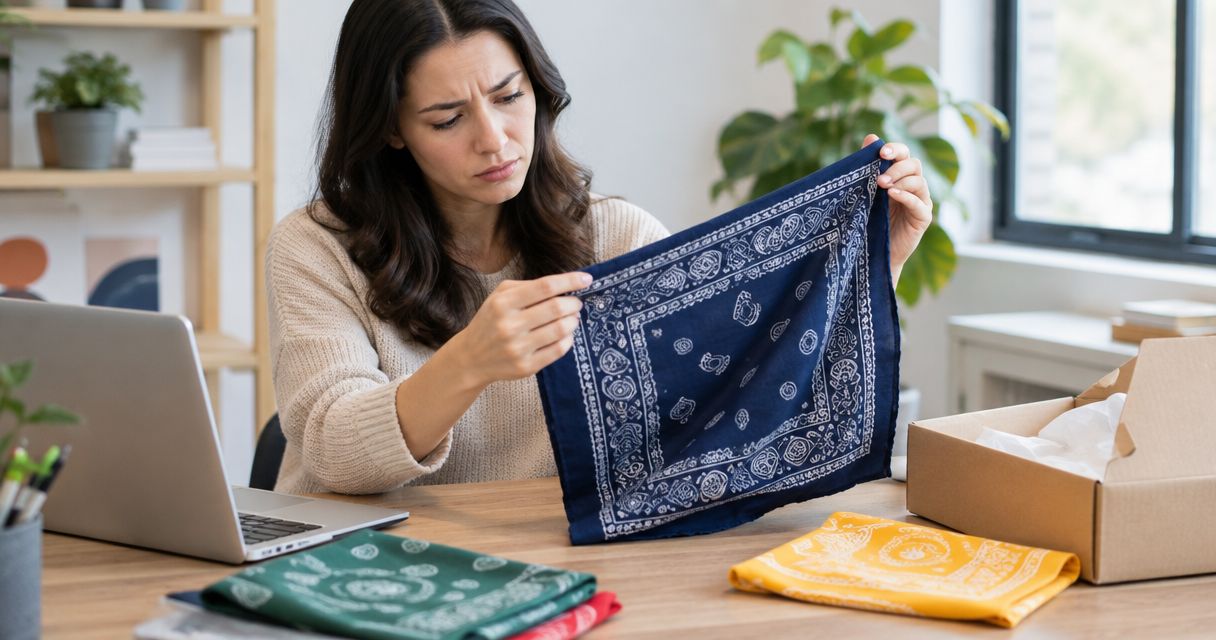
You can request a return or another remedy when custom bandanas arrive with the wrong design, but acceptance depends on the seller’s terms, what you approved, and how the delivered items differ from that approval. A production error and a design you approved but now dislike are different problems; document the mismatch and get written instructions before sending anything back.
- Can you return custom bandanas if design is wrong? Check the approved proof and seller’s custom-order terms.
- Wrong artwork or printing defects need evidence; dissatisfaction with an approved design needs a different conversation.
- Wholesale For Everyone serves businesses and event organizers sourcing bandanas and custom-merchandise services.
- Request written instructions before returning, washing, altering, or distributing disputed bandanas.
Why this matters
Custom merchandise ties a physical item to a particular design approval. When something looks wrong, the useful question is not simply whether you like it. It is whether the seller produced the order you authorized.
For a 2026 order, save the purchase terms, submitted artwork, approval messages, and any promised specifications together. The artwork-to-finished-bandanas workflow provides a useful planning reference, but your own order records are the evidence for resolving a dispute.
Keep your requested outcome separate from your description of the problem. First establish what differs; then ask whether the seller will authorize a return, replacement, remake, or refund.
Can you return custom bandanas if the design comes out wrong?
You should request a remedy for a documented mismatch, not assume that custom merchandise qualifies for an ordinary change-of-mind return. Start with the approved artwork and written specifications, then compare them with the actual bandanas.
Use this table to identify the issue before contacting the seller. These are ways to describe your complaint, not guarantees of a particular outcome.
| What went wrong | What to compare | What to ask the seller |
|---|---|---|
| The bandanas show a different logo or artwork | Delivered design against the approved file | Review the artwork mismatch and explain the correction process |
| Text is misspelled | Printed text against the approved proof | Identify whether the error appeared before or after approval |
| The design is misplaced or incorrectly oriented | Actual placement against written placement instructions | Review the difference and proposed remedy |
| Printing is smeared, incomplete, or visibly inconsistent | Clear photographs of affected pieces | Assess the production defect and affected quantity |
| The design matches approval, but you dislike it | Finished items against your approval record | Explain whether a discretionary return or revised order is possible |
| The color differs from your expectation | Written color specifications and any agreed reference | Explain what color standard applied to the order |
A mistake already present in the approved proof needs to be acknowledged in your message. A mismatch introduced after approval needs to be shown clearly. Neither situation is improved by describing every problem as a defective product.
Follow these steps before requesting a return
- Find the approval. Locate the final proof, the approval message, and the artwork version connected to that approval.
- Compare the delivery. Check wording, artwork, orientation, placement, and any written color requirements.
- Preserve the evidence. Keep the bandanas, packaging, labels, and order correspondence together.
- Describe the mismatch. State the approved requirement and the observed difference without guessing how it happened.
- Request instructions. Ask for the proposed remedy, any return authorization, and the next action in writing.
Do not replace evidence with a long explanation of how disappointing the order feels. A concise comparison gives the seller something specific to investigate.
Wrong artwork versus an approved design mistake
A wrong-artwork complaint is strongest when the delivered image clearly differs from the version you approved. Attach both versions and identify the difference: an omitted mark, an outdated logo, reversed artwork, or incorrect text.
An approved-design mistake requires a different approach. If you approved a spelling error or supplied an obsolete logo, say so and ask what correction options are available under the order terms.
Approval is evidence of what you authorized; it is not evidence that every later production detail is correct. Check the physical delivery even when the digital proof looked right. Equally, do not label a faithful reproduction as a production error solely because you changed your mind.
For your 2026 order records, retain the approved file rather than relying on the latest version in a shared folder. A revised file created after delivery does not show what the seller received before production.
Color and placement disagreements need a reference
A color complaint needs more than a screenshot beside a photograph. Screen settings, lighting, and the difference between a displayed image and a physical material complicate that comparison. Start with any color reference or matching requirement agreed in writing.
If your order included a named color standard, physical sample, or other reference, attach that record. If it did not, describe the difference you see and ask what reference the seller used; do not claim that an exact match was promised unless your records show it.
Placement works the same way. Compare the delivered position with the proof and written instructions, not an arrangement you imagined but never submitted. Photograph the bandana laid flat so the edges and design are visible together.
For designs intended to show when a bandana is folded or tied, preserve any instructions explaining that use. A flat proof and a worn bandana answer different questions about visibility.
How to document a wrong-design bandana order
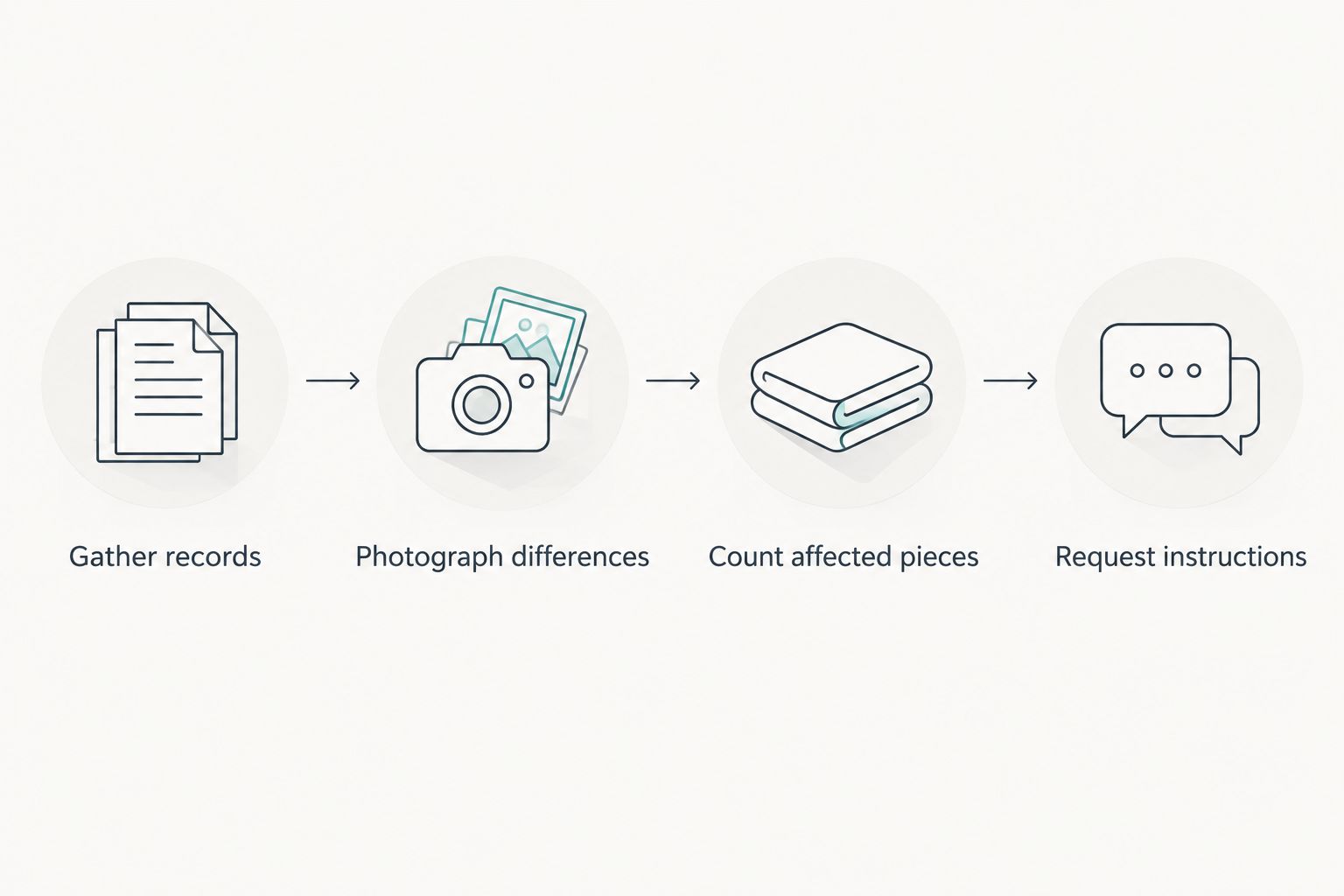
Organize your complaint into a short sequence: identify the order, show the approved requirement, show the delivered result, and state the resolution you want. This keeps the conversation focused on a verifiable difference.
Gather records
Keep 2 approval records together: the final proof and the message authorizing it. Add the order confirmation, written specifications, and any later change requests. If approval happened through several messages, preserve the sequence rather than forwarding only the favorable parts.
Photograph differences
Take 3 useful photographs: the full bandana laid flat, a close-up of the error, and a group view of the affected pieces. These are documentation recommendations, not a seller’s required submission format. Add more images when different pieces show different problems.
Count affected pieces
Record the quantity received and the quantity with the issue. Separate different defects in your notes rather than treating them as identical. If you inspected only part of the delivery, state that clearly instead of describing the whole order as checked.
Request instructions
Send the evidence through the seller’s stated support channel. Ask whether the bandanas must be retained, returned, or made available for further inspection, and request the next action in writing.
What should you write to the seller?
Use 1 email thread for the complaint so the evidence, questions, and response stay connected. Begin with your order identifier and a factual description of the difference. Avoid accusations about the cause unless the seller has confirmed it.
Your message should include:
- The approved requirement: Describe the wording, artwork, placement, or color reference you authorized.
- The delivered result: Explain exactly what differs and identify the affected pieces.
- The supporting files: Attach the approval record and clear photographs.
- The requested outcome: State whether you want a corrected order, a refund review, or another proposed solution.
- The real deadline: Explain any event date or resale commitment without assuming a replacement can meet it.
For a 2026 event order, ask the seller to confirm any proposed correction schedule before relying on it. A remedy that arrives after your event does not solve the same problem as one that arrives beforehand.
Keep the message direct. The seller needs the discrepancy and supporting records, not a reconstructed story about what someone in production must have done.
Which remedy should you request?
Request the remedy that solves your actual problem, then ask what the seller authorizes. A return is the movement of merchandise back to the seller; it does not, by itself, establish whether you receive a refund or replacement.
| Requested remedy | Best for | Advantage | Limitation |
|---|---|---|---|
| Corrected remake | Buyers who still need the intended design | Addresses the design problem directly | Requires agreement on the correction and timing |
| Replacement of affected pieces | Orders where only part of the delivery has an issue | Focuses the request on documented defects | Does not address unaffected pieces you simply dislike |
| Refund review | Buyers seeking to recover payment for the disputed merchandise | Addresses the payment dispute | Approval and scope depend on the applicable terms and circumstances |
| Credit or another negotiated resolution | Buyers willing to accept an alternative settlement | Provides another route to agreement | Does not necessarily supply the intended bandanas |
Do not ship first and negotiate later. Ask whether return authorization is required, where the package should go, how it should be identified, and who is responsible for arranging shipping.
If you accept a proposed resolution, get its scope in writing. Clarify whether it covers all disputed pieces, only specific defects, or a revised design you have not yet approved.
Why custom bandana return outcomes vary
The same description—wrong design—can refer to very different situations. The records below determine what you can establish and what you should ask the seller to review.
- Approved artwork: The final authorized version distinguishes an unexpected reproduction from a change of preference.
- Written specifications: Recorded wording, placement, and color requirements give the comparison a clear reference.
- Nature of the error: Incorrect artwork, a production defect, and buyer-supplied incorrect text require different explanations.
- Extent of the problem: A defect affecting some pieces needs a different quantity claim from a mismatch affecting the entire delivery.
- Applicable order terms: Read the custom-order provisions and any process for reporting problems, not just general return language.
- Requested resolution: Returning merchandise, correcting it, and recovering payment are separate requests.
For 2026 purchases, retain the terms associated with your order rather than treating a later page as the only record. Ask the seller to identify the provision relevant to your complaint if the response does not explain it.
How do you reduce the risk before ordering again?
Approve a complete specification, not just an attractive image. Check spelling, logo version, design orientation, placement instructions, and any agreed color reference before authorizing production. Ask unresolved questions before approval.
Wholesale For Everyone is a fit for businesses and event organizers sourcing bandanas and custom-merchandise services. Its stated offering includes custom printing and embroidery on selected products; discuss whether the intended customization is suitable for your chosen item.
When considering Wholesale For Everyone bandanas for a future order, confirm the applicable custom-order terms before purchasing. Treat the product-selection conversation and the return-policy conversation as separate checks.
Customization gives you a design tied to your team, event, or business. The trade-off is additional approval work: you must define the result clearly enough to recognize a mismatch later.
Can I get a refund if I approved the wrong spelling?
Approving the wrong spelling does not establish that the seller made a production error. Compare the delivered text with the approved proof, acknowledge the mistake, and ask whether the terms allow a correction or another negotiated resolution.
Do not submit a newly corrected file as proof of the original instruction. Keep the original and revised versions separate.
Should I return the whole order if only some bandanas are wrong?
Do not return the whole order without the seller’s instructions. Document the affected quantity and ask whether the proposed remedy concerns only those pieces or the entire delivery.
Keep disputed pieces separate from items already accepted for use. That makes the scope of your request easier to explain.
FAQ
Can you return custom bandanas if the design is wrong?
You can request a return or another remedy, but acceptance depends on the order terms, approved design, and documented mismatch. Compare the delivery with your approval and get instructions before shipping it back.
Are custom bandanas automatically nonreturnable?
Do not assume either automatic return eligibility or an automatic rejection. Read the custom-order terms and ask how the seller handles merchandise that differs from the approved design.
What if the seller printed an older version of my logo?
Show the approved logo file beside a photograph of the delivered design. Include the approval message so the seller can identify which version you authorized.
Can I complain if the color looks different from my screen?
You can report the difference, but a screen comparison alone does not establish a breached color requirement. Include any written matching specification or agreed reference.
Should I wash the bandanas before reporting a printing problem?
Document the issue before washing or altering the bandanas, and ask the seller for instructions. Preserve the delivered condition so the reported problem remains clear.
What should I ask Wholesale For Everyone before a custom order?
Ask Wholesale For Everyone to confirm the applicable custom-order terms, approval requirements, and process for reporting a design or production issue. Keep the answers with your order records.
What should I do if my event is approaching?
State the event date and ask whether the proposed remedy can meet it. Get any correction schedule confirmed before making plans around replacement merchandise.
One last thing
The most useful evidence is not the sharpest close-up. It is the connection between what you approved and what arrived. A photograph shows a problem; the approval record explains why it is a mismatch.
For your next 2026 custom bandana order, save the final proof and approval together before production starts. That small administrative step gives both sides a clear reference if the finished design needs review.
Related guides
- Screen print versus digital print for custom bandanas
- Can custom-printed bandanas be washed without fading?
- Can you customize the color of a paisley bandana order?