Veterinary clinic custom pet bandanas are branded pet accessories used to identify your practice during optional client handoffs, photos, and events. This guide explains how to plan custom pet bandanas for veterinary clinics in 2026, where patient comfort, staff handling, and owner choice come before logo placement.
- Custom pet bandanas for veterinary clinics should start with patient suitability, not logo size.
- Wholesale For Everyone suits clinics sourcing bandanas and discussing customization on selected products.
- Approve the folded design, attachment method, and care instructions before committing to a clinic-wide order.
- Keep branded pet accessories optional, and measure acceptance before expanding your veterinary marketing program.
Why custom pet bandanas matter for veterinary clinics
A clinic bandana gives your practice a physical place for its name or logo outside an appointment. Unlike a business card, it goes on an animal, so your purchasing decision also needs a patient-handling decision. Treat the bandana as optional merchandise, never as part of required care.
Wholesale For Everyone supplies bandanas and pet accessories and offers custom printing and embroidery on selected products. Confirm which products support your intended decoration before choosing a design; the availability of customization across the business does not establish that every pet accessory accepts every method.
Your clinic also has different constraints from a general promotional buyer. You need a handoff that does not interrupt discharge instructions, a design that remains visible after folding, and a clear rule for declining use when a patient is uncomfortable.
For your 2026 program, define success as an orderly, owner-approved handoff first. Do not assume that giving away merchandise produces referrals or repeat appointments; measure those outcomes separately if they are your objective.
How to plan your clinic bandana program
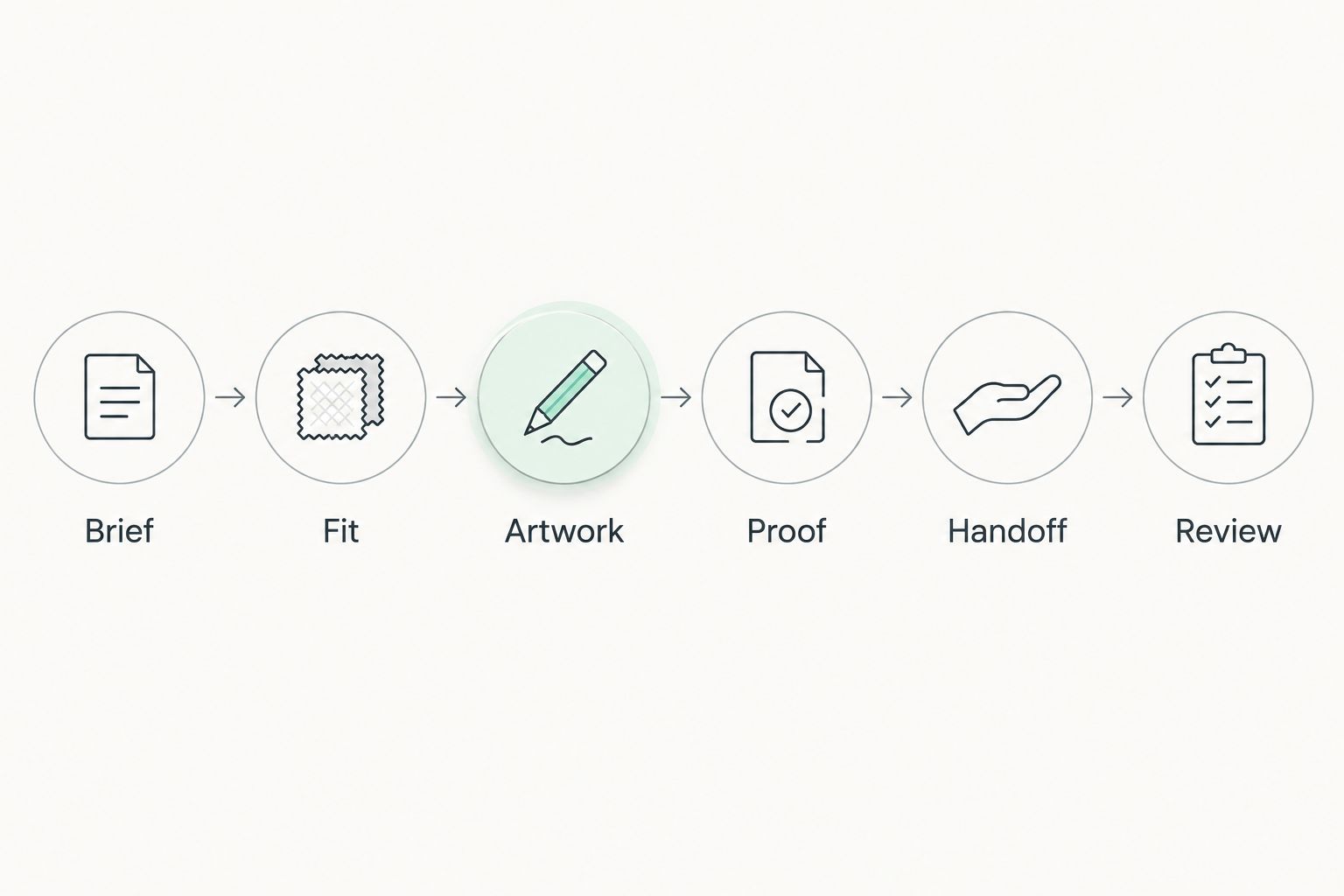
Build the program in this order: Brief, Fit, Artwork, Proof, Handoff, Review. Each stage resolves a different problem before you place a larger order.
Define one purpose for the bandanas
Start with a shared document or spreadsheet. Write a 1-page brief identifying the recipient, occasion, design owner, and staff member responsible for distribution. Choose a primary purpose rather than combining every clinic message on the fabric.
An optional welcome gift, an owner-approved photo accessory, and merchandise for a community event require different handling. A checkout handoff needs a short explanation; an event needs a separate plan for distributing items without fitting unfamiliar animals.
Best for a first program: choose one use case and one accountable owner. This keeps your initial order tied to an actual workflow rather than an undefined promotional idea.
- Name the intended recipients and distribution setting.
- Select one primary message, such as your clinic name.
- Assign responsibility for artwork approval and ordering.
- Record exclusions decided by your clinical team.
- Set a review date before expanding the program.
Set patient suitability and fit rules
Begin with a manual review of the proposed accessory and attachment method. Have your clinical team decide when staff should offer it, when an owner should receive it without fitting, and when to skip it entirely. Do not make wearing a bandana a condition of receiving a gift.
Avoid using a generic size label as proof of fit. Ask for the actual dimensions, construction, and attachment instructions for the item under consideration, then assess the finished accessory rather than an unfolded piece of fabric alone.
Best for clinical handoffs: make the owner offer optional and give staff an easy decline rule. Instruct owners to remove the accessory if the pet resists it, chews it, or becomes uncomfortable, and not to leave it on an unattended animal.
- Request dimensions and attachment details in writing.
- Check the folded shape and any trailing fabric.
- Exclude dangling decorations from your design brief.
- Keep accessories away from treatment sites and medical equipment.
- Let the clinical team decide patient-specific suitability.
Prepare artwork for the worn shape
Use a paper mockup first. Fold it into the intended shape and mark the area that remains visible; a centered logo on a flat square can disappear beneath a fold or attachment point. Keep the clinic name readable before adding a slogan or other text.
Wholesale For Everyone offers custom printing and embroidery on selected products. For custom pet bandanas, ask which base items and decoration methods can support your proposed artwork instead of assuming that either process fits every fabric or construction.
The screen print versus digital print workflow provides a related planning reference. Your order still needs item-specific confirmation of placement, artwork requirements, and the finished result.
Best for routine clinic branding: use a simple mark with a readable practice name. The limitation is reduced room for detailed messaging, which belongs on a separate handout rather than crowded fabric.
- Supply the approved logo file and exact clinic spelling.
- Identify the visible area after folding.
- Ask which decoration methods suit the selected item.
- Remove text that becomes unreadable in the mockup.
- Keep the approved artwork version with the order record.
Approve the proof and handling instructions
Review the proposed design manually before authorizing production. Use 3 approval checkpoints: clinic identity, worn placement, and handling instructions. Assign a named approver so conflicting staff comments do not become competing instructions to the supplier.
A digital proof helps you assess spelling and proposed placement. It does not let you feel the fabric, examine the finished reverse side, or evaluate the accessory on a patient. Ask what physical evaluation is possible and confirm any associated terms before proceeding.
For a 2026 event, give the supplier your actual required date and ask for the order-specific schedule. Do not build the event plan around an assumed production or delivery interval.
- Check spelling, artwork orientation, and intended colors.
- Review placement against the folded mockup.
- Request material and care information for the selected item.
- Confirm the process for reporting a mismatch with the approved order.
- Save the final approval and supplier confirmation together.
Build a clean, optional handoff
Write the handoff process before putting bandanas at reception. Separate unused accessories from returned or handled items, and have the clinic team define what happens to an item that has touched a patient. A printed care instruction is not a substitute for your clinic's infection-control procedure.
Keep the offer separate from medical discharge instructions. Staff can ask whether the owner would like the accessory, then provide the appropriate handling and care information without delaying the explanation of medication or follow-up care.
Best for a busy reception desk: prepare a simple take-home handoff rather than requiring staff fitting. The trade-off is less control over how an owner later uses the accessory, so clear instructions still matter.
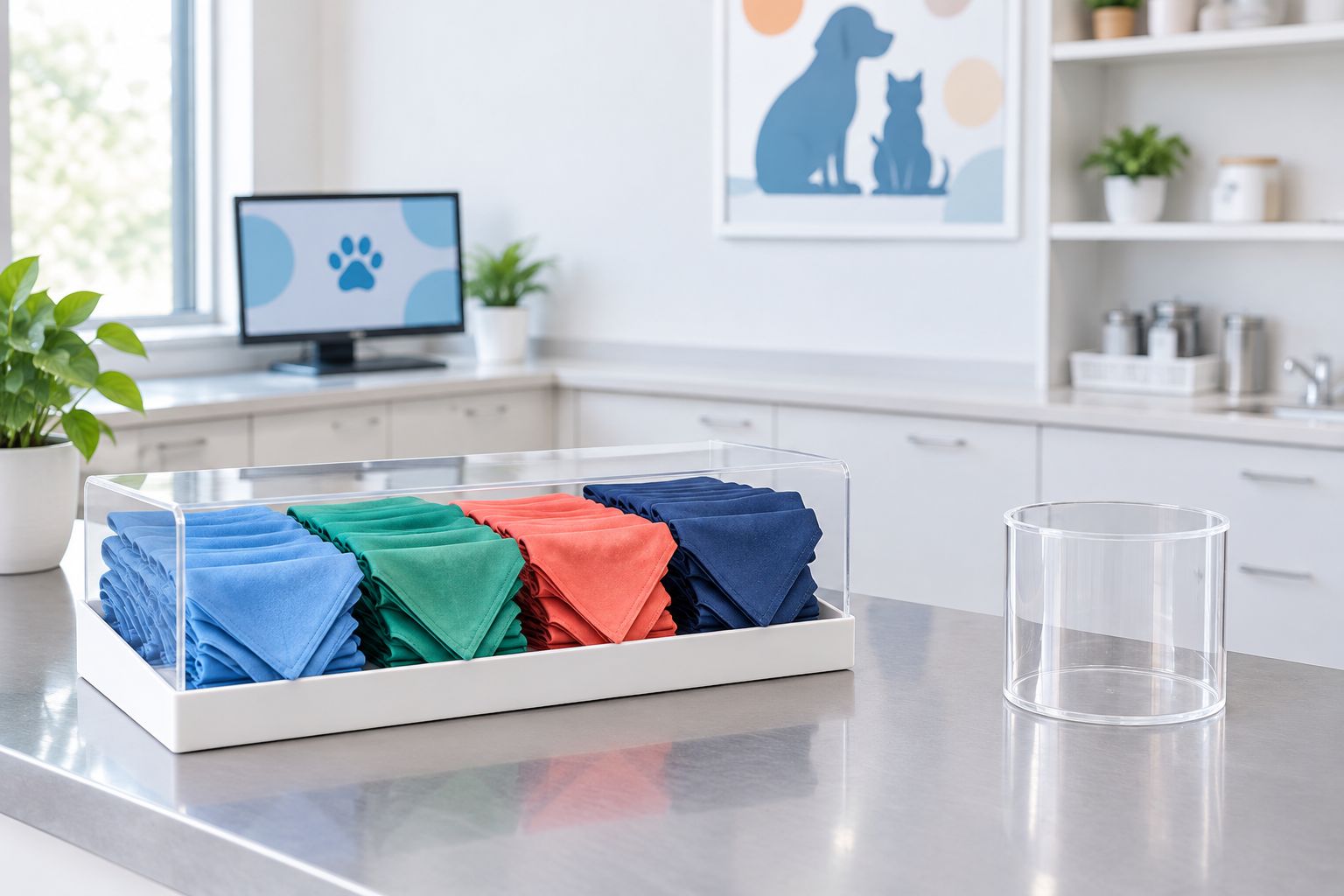
Use a storage location that staff can identify without searching through clinical supplies. The handoff should be repeatable across shifts, not dependent on one enthusiastic employee remembering every detail.
- Store unused items in a designated clean location.
- Define handling rules with the clinical team.
- Ask the owner before offering or fitting an accessory.
- Provide care instructions specific to the finished item.
- Keep photo permission separate from accepting the bandana.
Measure acceptance before reordering
Start with a spreadsheet rather than a complicated reporting system. Run a recommended 30-day pilot for a routine handoff program, or review a single completed event if that is your use case. Record what happened instead of treating every distributed item as a marketing success.
Track offers, acceptances, declines, and items removed from use. Add short reasons when staff encounter a fit, design, or handling problem. These observations help you revise the next order without inventing a referral effect.
For your next 2026 order, use the pilot's actual distribution pattern rather than total appointment volume. An appointment count does not tell you how many owners want an accessory or how many patients are suitable recipients.
- Count offers and accepted items separately.
- Record size or attachment problems without patient identifiers.
- Note wasted items and the reason for removal.
- Ask staff whether the handoff interrupts other work.
- Reorder only after reviewing the purpose and results.
Compare bandana options for your clinic
Choose the item and decoration together. A useful comparison separates how the accessory is worn from how it is branded; neither decision replaces a fit review. The options below are purchasing approaches to evaluate, not claims that every construction is offered by a particular supplier.
| Option | Best for | Main advantage | Key limitation |
|---|---|---|---|
| Plain bandana with a separate clinic handout | Testing owner interest before custom decoration | Lets you evaluate the handoff without finalizing artwork | The accessory itself does not identify your practice |
| Printed bandana | Clinics prioritizing a visible logo or practice name | Places the design directly on the fabric | Placement must account for folds, and care depends on the finished item |
| Embroidered bandana | Clinics considering a stitched mark on a suitable base | Uses stitching rather than a printed design | Requires confirmation of fabric suitability, reverse-side finish, and comfort |
| Over-collar bandana | Owners who prefer an accessory that uses an existing collar | Avoids adding a separate neck tie | Requires compatible construction and a suitability check for the existing collar |
| Tie-on bandana | Supervised use where staff can assess the attachment | Does not require a collar sleeve | Needs careful adjustment and attention to loose ends |
Wholesale For Everyone is best for clinics sourcing bandanas and exploring customization on selected products. Its stated range includes bandanas and pet accessories; the purchasing limitation is that you still need confirmation of the exact item's dimensions, decoration compatibility, care requirements, and order terms.
Use that distinction when comparing suppliers in 2026. A supplier's general customization service is not an item-level specification, and a sample image is not confirmation of the finished accessory you will receive.
Common mistakes veterinary clinics make
Treating a branded accessory as clinical equipment
A bandana is not a restraint, a protective device, or a substitute for patient identification. Keep medical decisions independent of the merchandise program. Do not encode treatment status or handling warnings into decorative colors without a separately approved clinical protocol.
Ordering from the flat artwork alone
The logo must work on the folded accessory, not just the proof page. Compare the proposed position with your mockup before approval, and ask how the design will sit across the sizes you intend to purchase.
Assuming one care rule covers every item
Fabric, decoration, and construction affect the instructions you need. Request care guidance for the actual finished item rather than reusing a generic washing handout. Keep household care advice separate from clinic cleaning and infection-control decisions.
Making the photo part of the gift
Accepting a bandana does not establish permission to publish an owner or pet photo. Ask separately and follow your clinic's consent process. Owners should be able to accept the accessory without participating in promotional content.
Ordering around appointment totals
Not every appointment produces an appropriate recipient or an interested owner. Base your reorder on recorded acceptance and actual use. Keep the program optional even when you have already purchased the accessories.
FAQ
What’s the best way to start custom pet bandanas for a veterinary clinic?
Start with one use case, a clinical suitability rule, and a folded artwork mockup. Test the handoff before expanding the order so you can identify fit, handling, and owner-acceptance problems.
Can every pet wear a clinic bandana?
No; a clinic bandana is an optional accessory that requires an individual suitability decision. Let the clinical team decide when to skip it, and tell owners to remove it if the animal resists, chews, or becomes uncomfortable.
Is printing better than embroidery for veterinary clinic bandanas?
Neither method is automatically better for every veterinary clinic bandana. Compare the selected fabric, visible design area, finished feel, reverse-side construction, and care instructions before choosing.
Does Wholesale For Everyone customize pet accessories?
Wholesale For Everyone sells pet accessories and offers custom printing and embroidery on selected products. Confirm whether the exact accessory you want supports your proposed decoration before approving the order.
How many custom bandanas should a veterinary clinic order?
Base the order on your intended recipients and a measured pilot, not total appointment volume. Record accepted offers, unsuitable cases, and wasted items so the next quantity reflects actual use.
Can clinic bandanas go in a washing machine?
Use the care instructions supplied for the specific finished bandana. Do not assume that all fabrics and decoration methods share the same washing requirements, or that household washing meets your clinic’s infection-control needs.
Should owners have to agree to a photo to receive a bandana?
No; keep the accessory offer separate from photo permission. Follow your clinic’s consent process before publishing images and let owners decline promotional participation.
One last thing
The useful approval test is the folded accessory, not the enlarged logo. Before your next 2026 order, ask a staff member who did not create the artwork to fold the mockup and read the clinic name. If the name disappears or the placement requires explanation, revise the design before approving production.
Related guides
- Customizable dog bandanas for professional pet groomers
- Can dog bandanas go in the washing machine?
- From artwork submission to finished custom bandanas