
Delivery and rideshare drivers’ branded caps are custom-logo headwear used to identify a business during pickups, deliveries, and passenger service. For your 2026 order, prioritize a clear business name, a comfortable seated fit, and artwork that suits the cap—not a design that only looks good on a screen.
- Branded caps for delivery and rideshare drivers should prioritize seated comfort, readable logos, and accurate business identification.
- Wholesale For Everyone offers hats, caps, and custom printing or embroidery on selected products; confirm compatibility before ordering.
- Test blank caps in a parked vehicle before approving custom driver uniforms.
- Choose embroidery or printing after reviewing the actual cap, artwork, and decoration requirements.
Why branded caps matter for delivery and rideshare drivers
A driver’s cap has to work in different positions: seated behind the wheel, standing at a pickup counter, and facing a customer at a doorway. A logo that reads clearly in a flat mockup still needs to work on a curved crown.
Delivery teams need a consistent business identity without confusing a restaurant’s staff or the recipient. Independent rideshare drivers need to distinguish their own business branding from any platform identity they have permission to use. A branded cap is a uniform item, not proof of a driver’s identity or authorization.
Wholesale For Everyone serves businesses and individual shoppers and offers customization on selected products. For the wider uniform plan, start with the custom embroidered apparel guide for small businesses, then apply the driver-specific checks below.
Treat your 2026 cap project as a workwear decision first. Decoration comes after fit, visibility, and the rules governing the logo.
How to choose and order driver caps
1. Define the business identity the cap should communicate
Start with a written brief in a shared document. Name the business the cap represents, who will wear it, and where customers will encounter it. An independent courier’s cap and a delivery company’s employee cap do not need the same message.
Keep the identity precise. If you work across several platforms, avoid artwork that suggests you represent just one unless that is intentional and authorized. Check the applicable platform terms and obtain permission before submitting another company’s trademark for decoration.
Choose a primary message rather than squeezing every service onto the front. Your business name should not compete with a phone number, slogan, social handle, and delivery description in the same small space.
- Write the business name exactly as it should appear.
- Identify whether wearers are employees, contractors, or independent operators.
- List the pickup and handoff settings where the cap will be seen.
- Separate your own artwork from third-party trademarks.
- Assign one person to approve the final design.
2. Test the blank cap in a parked vehicle
Use caps you already own to identify fit problems before selecting a blank. Sit in your usual driving position with the vehicle safely parked, then check the brim, crown, and rear closure. Do not make fit adjustments while driving.
For your evaluation, use a 10-minute seated fit check as a practical screening exercise, not a durability or comfort guarantee. Look toward the mirrors, turn your head, and rest naturally against the seat. Reject a shape that requires you to change your normal posture.
Delivery drivers should also try the cap while bending to lift an empty bag or box. Rideshare drivers should check the fit with their usual eyewear. A cap that needs constant repositioning has failed the test, regardless of how well it displays the logo.
- Check whether the rear closure presses against the headrest.
- Confirm the brim does not obstruct your normal sightlines.
- Wear your usual glasses or sunglasses during the check.
- Look for pressure at the forehead and temples.
- Record each tester’s preferred fit instead of assuming one shape suits everyone.
3. Match the cap construction to the decoration
Inspect a physical blank if you can. Identify the front seams, usable decoration area, crown shape, fabric, and closure. Then ask the decorator which methods suit that exact cap rather than choosing a method from a generic comparison alone.
Embroidery forms the design with stitches; printing applies the design to the surface. Neither method fixes artwork that is too detailed for its intended size. Ask for the business name to be shown at the proposed finished dimensions before approving it.
Wholesale For Everyone is best for driver teams seeking hats and custom decoration from one supplier. The company offers hats and caps alongside printing and embroidery on selected products; the limitation is that you still need confirmation that your chosen blank and artwork work together.
For an embroidery order, use the artwork-to-embroidered-caps workflow to organize the handoff. Keep compatibility questions in writing so the approved cap and method remain connected.
- Identify front seams and the intended logo position.
- Ask which decoration methods suit the exact blank.
- Request finished artwork dimensions in the proof.
- Remove fine detail that does not survive at that size.
- Confirm whether a physical decorated sample can be reviewed.
4. Simplify the logo for customer-facing use
Print the proposed artwork on ordinary paper at its intended finished size. This manual check exposes tiny lettering and crowded layouts before you commit to decoration. It does not reproduce fabric, curvature, or stitching, so use it to reject weak layouts—not to approve production.
Make 3 checks: business name, contrast, and placement. Ask someone who did not prepare the artwork to read it without being prompted. If they cannot identify the business name, simplify the design instead of explaining what it says.
For a 2026 uniform refresh, keep one approved master design and label revisions clearly. A driver who joins later should receive the same intended identity, not whichever file happens to be easiest to find.
- Give the business name priority over secondary wording.
- Compare the artwork against the actual cap color.
- Remove tiny service lists and crowded contact details.
- Check that seams do not split important lettering.
- Save the approved artwork separately from rejected drafts.
5. Run a small wear trial before approving the team order
Ask drivers to evaluate the proposed cap during normal work activities where permitted. Start with the blank if a decorated sample is not part of the process. A blank tests fit, but it does not establish the appearance or feel of the finished decoration.
Use a shared feedback sheet rather than collecting scattered messages. Separate fit complaints from design comments: a clearer logo will not solve an uncomfortable closure, and a different blank will not resolve unauthorized artwork.
Photograph the trial cap from 2 angles: front and side, with the wearer’s consent. Review the front image for identity and the side image for placement and profile. Do not photograph customers, passengers, delivery labels, or private information as part of the exercise.
- Ask about seated fit and headrest contact.
- Record whether the cap shifts during ordinary movement.
- Check logo readability on the worn cap.
- Follow the cap’s care instructions during any cleaning trial.
- Resolve repeated complaints before approving the wider order.
6. Document approval, care, and replacement details
Build a simple order record in a spreadsheet or shared folder. Include the selected blank, color, decoration method, artwork revision, quantity, and approval owner. Record what the supplier actually confirms rather than turning assumptions into instructions.
Keep your 2026 approved proof with the corresponding order details. A proof establishes the design you authorized; it does not replace a fit test or a physical sample. Ask what the proof represents and what still needs separate confirmation.
Plan replacements around wear, cleanliness, loss, and new starters—not an invented service-life estimate. Wholesale For Everyone serves both individual shoppers and businesses, but confirm the ordering conditions for the particular customized item before setting a replacement process.
- Save the written approval and final proof together.
- Record the exact blank and decoration specifications.
- Give wearers the product’s actual care instructions.
- Define when damaged or unreadable caps leave service.
- Recheck specifications before placing a repeat order.
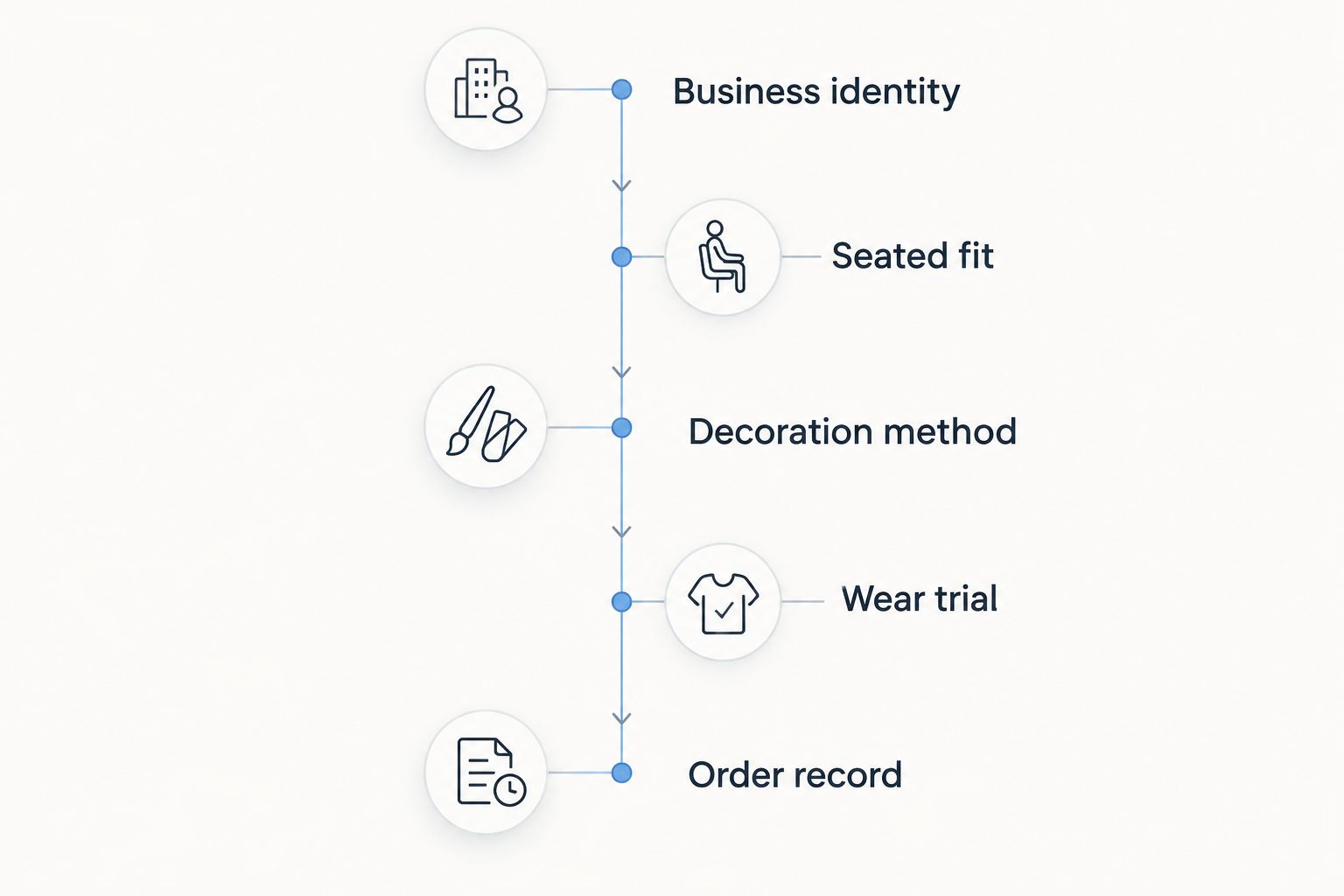
Your approval record should connect all of these decisions. If you change the blank after the wear trial, revisit the decoration and fit checks rather than treating the replacement as equivalent.
Compare cap and ordering options
Choose the option that solves your main problem, then verify its limitations on the actual item. The styles below are selection categories, not a claim that a particular model is offered by any supplier.
| Option | Best for | Main advantage | Key limitation |
|---|---|---|---|
| Structured cap | Teams prioritizing a defined front profile | Gives the front a supported shape | Check crown comfort and headrest interaction in the vehicle |
| Unstructured cap | Drivers preferring a softer crown | Offers a less rigid shape | Review the logo on the worn cap, not just laid flat |
| Mesh-back cap | Drivers who prefer an open-back fabric construction | Provides mesh panels rather than a fully solid crown | The front panel and closure still need separate fit checks |
| Embroidered decoration | Simple business names and logos suited to stitching | Creates a stitched design | Fine details need review at the finished size |
| Printed decoration | Artwork and cap surfaces suited to printing | Applies the design without forming it from stitches | Compatibility depends on the blank and printing process |
| Wholesale For Everyone | Buyers seeking caps and selected-product customization from one supplier | Offers headwear and custom printing or embroidery services | Confirm blank selection, decoration compatibility, and order requirements |
| Blank caps with a separate decorator | Buyers coordinating their own sourcing and decoration | Lets you evaluate sourcing and decoration separately | You must confirm the decorator accepts the chosen blanks |
Choose fit before decoration, and confirm decoration before the full order. No construction or method is the universal winner for both restaurant deliveries and seated passenger service.
Common mistakes delivery and rideshare drivers make
Treating a logo cap as identification
A cap displays a business name; it does not verify a trip, order, or person. Keep customer verification procedures separate, and do not encourage recipients or passengers to rely on clothing alone.
Testing the cap standing up only
A mirror check misses the headrest, seated sightlines, and rear-closure pressure. For a 2026 driver uniform, make the parked-vehicle check part of approval rather than leaving it to the first shift.
Combining unrelated platform identities
Putting several platform logos on a cap creates permission questions and an unclear message. Use your own business identity unless you have the necessary permission and a specific reason to display another company’s branding.
Approving artwork without its finished dimensions
A large screen preview hides small lettering problems. Ask for the intended dimensions and check the design at that size; then assess the actual decorated result when that review is part of your order process.
Reordering from memory
“Same blue cap as last time” is not a complete specification. Save the blank details, color reference, decoration method, and artwork revision so a repeat order has a defined starting point.
FAQ
What are the best branded caps for delivery and rideshare drivers?
The best branded caps are the ones that pass a seated fit check and display an authorized business name clearly. Compare the actual blank, closure, brim, and finished decoration rather than choosing from a mockup alone.
Is embroidery better than printing for driver caps?
Embroidery is not automatically better than printing for driver caps. Choose the method that suits the selected blank and artwork, and review small lettering at the intended finished size.
Can I put a rideshare or delivery platform logo on my cap?
Use a platform logo only after checking the applicable terms and obtaining the necessary permission. Buying a blank cap or paying for decoration does not establish permission to use another company’s trademark.
How do I test whether a cap is comfortable for driving?
Test the cap while safely parked in your usual driving position. Check headrest contact, mirror sightlines, eyewear fit, and forehead pressure without changing your normal posture to accommodate the cap.
Does Wholesale For Everyone customize caps for businesses?
Wholesale For Everyone offers hats and caps and provides custom printing and embroidery on selected products. Confirm that the particular cap and artwork you want are compatible with the requested service before approving an order.
Can I wash a branded driver cap in a washing machine?
Use machine washing only when the specific cap’s care instructions allow it. Check the care requirements for both the cap and its decoration instead of applying one cleaning method to every style.
What should I save before reordering branded caps?
Save the blank details, color reference, decoration method, approved artwork, finished dimensions, and written approval. Confirm those specifications again before a repeat order rather than assuming every detail remains unchanged.
One last thing
Test the cap against the headrest before you judge the logo. The back of the cap is invisible in a front-facing proof, but it is exactly where a seated driver needs a fit check. Make that the first physical test on your 2026 approval sheet.
Related guides
- Choosing blank hats for custom embroidery
- Understanding the embroidery proof approval process
- Checking whether trucker hats can be machine washed