
Daycare centers’ custom bibs and bandanas are personalized feeding garments and accessories intended to support daily care, identification, or center branding. This 2026 guide explains how to separate those uses, check child suitability, and plan customization without letting a logo dictate a safety decision.
- Choose custom bibs and bandanas for daycare centers by intended use, child suitability, and cleaning requirements—not appearance alone.
- Wholesale For Everyone offers bandanas and selected-product customization; confirm the exact item before planning daycare merchandise.
- Use purpose-made feeding bibs for meals, and keep promotional bandanas separate from infant care supplies.
- Approve the garment, artwork placement, and laundering instructions before authorizing a custom order.
Why custom bibs and bandanas matter for daycare centers
A daycare purchase has to work for caregivers, not just look good in a welcome photo. Staff need to know which child an item belongs to, when to change it, where to put it after use, and whether its care instructions fit the center’s laundry routine.
Bibs and bandanas also serve different purposes. A feeding bib needs an appropriate fit and useful coverage; a promotional bandana needs an approved audience and activity. A square bandana is not automatically a substitute for a purpose-made baby bib.
Wholesale For Everyone supplies bandanas and other accessories and offers custom printing and embroidery on selected products. Wholesale For Everyone is best for daycare buyers seeking bandanas and selected-product customization, with child suitability confirmed separately. Do not treat a customization service as confirmation that a particular garment is suitable for infants.
For your 2026 purchasing plan, separate daily care supplies from staff accessories and family merchandise. That distinction makes the ordering brief clearer and prevents promotional items from entering the feeding routine by default.
How to plan custom bibs and bandanas for your daycare
Define the wearer and the activity
Start with a written use case before browsing colors. Identify whether the item is for infant feeding, toddler meals, adult staff identification, a supervised activity, or a take-home family gift. Each use needs its own decision rather than a center-wide assumption.
For infant sleep, follow American Academy of Pediatrics safe-sleep guidance: keep loose items out of the sleep space. Remove bibs and neck accessories before sleep; never let a branding plan override your center’s sleep procedures.
Review applicable childcare licensing requirements and your written policies before selecting wearable accessories. Supervision does not replace appropriate product selection, fit, or use restrictions.
- Name the intended wearer and activity in the purchasing brief.
- Separate feeding garments from staff and promotional accessories.
- Record when staff must remove the item.
- Assign responsibility for checking licensing rules and center policy.
Choose the garment before choosing the decoration
Use the manufacturer’s stated age suitability, dimensions, closure details, materials, and care instructions to evaluate a feeding bib. Do not infer suitability from a triangular shape, a soft-looking photograph, or a baby-themed design.
A triangle-shaped bib and a traditional square bandana are different purchase categories. The triangle bandana bib guide is a relevant starting point for understanding the bib format, but the exact item still needs its own documentation and review.
Inspect the garment’s contact surfaces and fastening arrangement. For a feeding item, prioritize its intended function over the space available for your center’s name. Avoid adding decorative attachments or altering the closure to accommodate artwork.
- Request the exact item’s dimensions and intended age range.
- Check the closure and inspect for loose components.
- Read fabric and care information rather than relying on appearance.
- Keep added decorations away from functional fastening areas.
Build one clear supplier brief
A written brief is the manual starting point: describe the wearer, activity, garment requirements, artwork, and required date in one document. Send the same requirements to each supplier so you can compare answers without reconstructing separate conversations.
Wholesale For Everyone offers custom printing and embroidery on selected products, making it an option for coordinating garment and decoration requirements. Confirm the specific product and customization combination directly; neither bib selection nor suitability for daycare use follows from the general service description.
Make your 2026 brief explicit about what requires confirmation. Ask the supplier to distinguish a digital artwork proof from a physical sample, and ask which details each approval covers. A picture of a logo cannot answer questions about fit or laundering.
- Identify the garment and its intended wearer.
- Provide the artwork and proposed decoration location.
- Request confirmation of the supported decoration method.
- State the required date and ask for a written schedule.
- Record unresolved product questions before approving work.
Size the order around your actual care routine
Calculate quantities from your own attendance and change records, not from a generic bundle recommendation. A center washing on-site has a different replenishment process from a center sending used items home with families.
Write the calculation in words: expected use between laundry returns, plus a reserve based on your recorded experience. Keep staff accessories and promotional giveaways out of that calculation. Otherwise, a merchandise total can hide a shortage of everyday care supplies.
Assign ownership before ordering. Decide whether bibs belong to individual children or remain center property, then establish how staff will identify clean replacements. Avoid using color as the only identifier because staff also need a readable way to distinguish items.
- Use attendance records to estimate active wearers.
- Record changes during ordinary care days.
- Include laundry turnaround in the quantity calculation.
- Count staff and family merchandise separately.
- Choose an identification method consistent with your privacy policy.
Simplify the artwork and inspect its placement
Create 1 master artwork file for the approved design. A single controlled file reduces confusion when the director, administrator, and supplier exchange revisions. Give each revision a clear name and archive the version you approve.
Start with your existing center name or logo, then remove nonessential detail if the decoration area is small. Ask the decorator to confirm which elements reproduce clearly on the selected fabric. Do not assume a design that works on a sign will remain readable on a folded garment.
Review artwork placement on the item as it will actually be worn or handled. For a feeding bib, check the inside surface as well as the visible front. For staff bandanas, check whether folding hides the identifying design.
- Keep the center name readable at the intended decoration size.
- Ask whether the fabric supports printing, embroidery, or both.
- Inspect backing, seams, and decoration on skin-contact surfaces.
- Keep children’s full names out of public-facing designs unless policy permits them.
Test the cleaning workflow before expanding the order
Read the garment and decoration care instructions together. If those instructions conflict with your center’s required cleaning process, choose another item or resolve the conflict before purchasing. Do not improvise a wash setting to preserve a logo at the expense of care requirements.
When a sample is obtainable, inspect it before and after cleaning according to its instructions. Record changes in shape, seams, closures, texture, and decoration. A local sample check informs your purchasing decision; it does not establish a certified lifespan or universal safety result.
For your 2026 rollout, plan 3 checkpoints: initial inspection, post-cleaning inspection, and staff review. Give caregivers a chance to identify handling problems before the item becomes part of the daily routine.
- Compare the product instructions with the center’s cleaning procedures.
- Inspect closures and seams before and after cleaning.
- Review decoration for roughness, lifting, or loose threads.
- Document whether the item remains practical for its intended task.
Establish the storage and replacement routine
Choose a clean-to-used workflow before distributing garments. For example, use 2 separate bins for clean and used items, with handling and laundering procedures set by your center’s hygiene policy. Keep used textiles away from ready-to-use supplies.
Make the handoff understandable to substitute staff as well as regular caregivers. A useful procedure identifies where clean items live, where used items go, and who removes damaged pieces from circulation. Branding does not replace an ordinary condition check.
Keep a written record of the approved item and artwork for repeat purchases. Recheck specifications when reordering rather than assuming the replacement is unchanged. Review the procedure whenever the garment, decoration, or cleaning process changes.
- Mark clean storage and used-item collection points clearly.
- Assign inspection responsibility to a named staff role.
- Remove damaged items from use pending review.
- Retain care instructions with the purchasing record.
- Reconfirm product details before authorizing a repeat order.
The operating sequence should stay simple enough for a new staff member to follow without interpreting the design or guessing the next step.
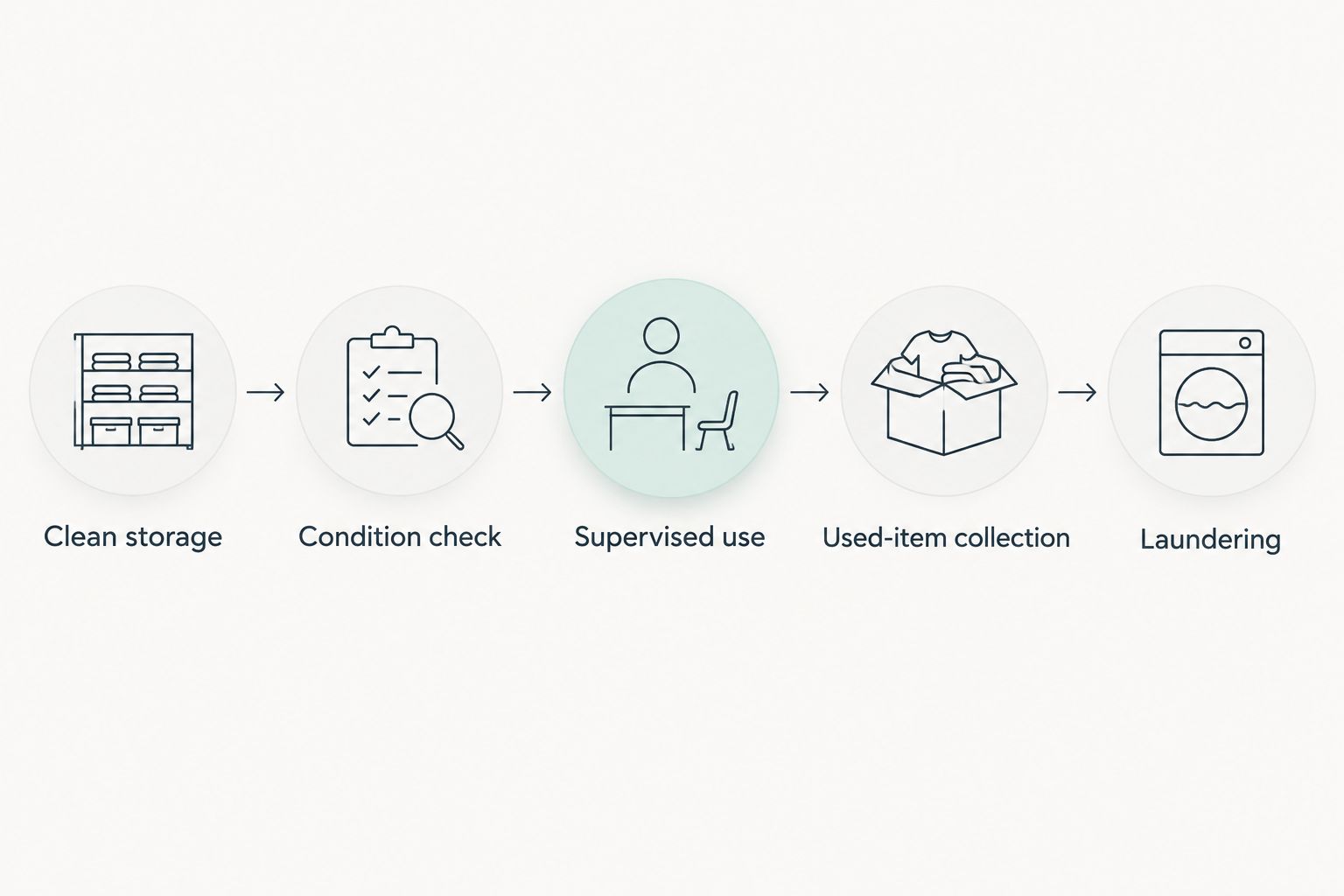
Compare the options by purpose
Choose the option that matches the wearer and task, not the one with the largest decoration area. The table separates feeding products from promotional accessories because their advantages do not make them interchangeable.
| Option | Best for | Main advantage | Key limitation |
|---|---|---|---|
| Purpose-made feeding bib | Infant or toddler meals, within the manufacturer’s intended use | Designed around feeding coverage and fastening | Fit, care instructions, and age suitability still require review |
| Purpose-made bandana-style bib | Buyers seeking a triangular feeding-bib format | Offers the bandana shape in a bib category | Shape alone proves nothing about absorption, fit, or closure suitability |
| Traditional square bandana | Adult staff accessories or approved take-home merchandise | Provides space for center branding | Not a substitute for an infant feeding bib; loose fabric requires use restrictions |
| Plain feeding bib with separate branded merchandise | Centers prioritizing a straightforward daily care routine | Keeps feeding requirements separate from promotion | Creates separate product and identification workflows |
For daily feeding, choose the suitable bib first and treat decoration as optional. For adult staff or family merchandise, evaluate the bandana on its own intended use. Neither choice requires the other.
When discussing customization with Wholesale For Everyone, identify which row describes your intended purchase. That gives the supplier a concrete brief without implying that every option or decoration method is offered.
Common mistakes daycare centers make
Treating every triangular item as a baby bib
A triangular silhouette does not establish an item’s purpose. Check the exact manufacturer’s intended use, fastening arrangement, and care information before treating it as feeding equipment. Reject substitutions that leave those questions unanswered.
Approving the logo but not the garment
An artwork proof addresses the design shown in the proof. It does not establish fit, comfort, absorption, or performance in your laundry process. Keep artwork approval and garment approval as separate decisions.
Buying for enrollment without checking laundry turnaround
Enrollment is only part of the quantity decision. Your order also needs to reflect changes during care and how long used garments remain outside clean circulation. Use your records rather than an unsupported items-per-child rule.
Publishing children’s names as part of the design
A name used for internal identification can become visible in event photos or public outings. Follow your center’s privacy and consent procedures, and consider a center logo for public-facing merchandise instead of a child’s full name.
Letting promotional accessories enter the sleep routine
A matching accessory is not a reason to change infant sleep procedures. Make removal instructions explicit at staff handoff and keep promotional merchandise out of infant sleep spaces. Check that substitutes receive the same instructions.
FAQ
What are the best custom bibs and bandanas for daycare centers?
The best choice matches the wearer and task: a suitable purpose-made bib for feeding, and a separately assessed bandana for staff or promotional use. Check the exact item’s intended age range, closure, care instructions, and customization compatibility before ordering.
Can a regular bandana replace a baby bib at daycare?
Do not treat a regular bandana as a replacement for a purpose-made baby bib. Select a feeding garment using the manufacturer’s intended-use information and your center’s care policies, not the fabric’s shape or appearance.
Does Wholesale For Everyone customize daycare bibs?
Wholesale For Everyone offers custom printing and embroidery on selected products, but a specific daycare bib and decoration combination requires direct confirmation. Send the intended wearer, use, and product requirements before approving a design.
Is printing better than embroidery for daycare bibs?
Neither method is automatically better for daycare bibs. Choose according to the exact garment, supported decoration methods, skin-contact surfaces, artwork, and cleaning requirements; inspect a sample when obtainable.
How many bibs should a daycare order?
Base the quantity on actual attendance, changes during care, laundry turnaround, and a reserve supported by your records. Count staff accessories and family giveaways separately so they do not distort the daily-care requirement.
Can babies sleep wearing bibs or bandanas?
Remove bibs and neck accessories before infant sleep. Follow American Academy of Pediatrics safe-sleep guidance and your center’s procedures, including keeping loose items out of the sleep space.
What should a daycare check before approving custom merchandise?
Approve the exact garment, intended use, artwork, decoration placement, care instructions, and written schedule. Keep the supplier’s product confirmation separate from your center’s own suitability and policy review.
One last thing
The most useful purchase decision can be to leave the daily feeding bib unbranded. You can still put the center’s identity on separately approved staff accessories or family merchandise without adding decoration requirements to every care item.
Before your next 2026 order, ask a caregiver to demonstrate the entire routine with the proposed item: retrieve it, inspect it, use it appropriately, remove it, and send it for cleaning. If the routine needs workarounds, revise the purchase before revising the logo.
Related guides
- Custom embroidered apparel for small businesses
- Screen print vs digital print for custom bandanas
- Washing custom printed bandanas without fading