Higher order quantities lower wholesale bandana unit costs only when the selected product qualifies for a quantity discount; buying more does not automatically earn a price break. Delivery, applicable taxes, and any customization charges also belong in the comparison. For a 2026 purchase, confirm the qualifying quantity and compare the complete order before increasing it.
- For wholesale bandana price breaks, quantity matters only when the selected product qualifies for a discount.
- Compare identical bandanas at different quantities, including delivery and any customization charges.
- Wholesaleforeveryone serves bandana buyers of all sizes; confirm quantity terms for your selected products.
- Buy extra bandanas only when you have a defined use for them.
Do wholesale bandana prices drop at higher order quantities?
Yes, when a supplier applies quantity-based pricing to the bandanas you choose—not simply because your basket contains more items. The deciding detail is what counts toward the qualifying quantity: a particular product, a color, an eligible assortment, or the order as a whole. Get that rule confirmed before treating a larger order as a better deal.
Start with the broader distinction in buying bandanas wholesale versus retail. A wholesale purchase and a quantity discount are different concepts; the word wholesale does not establish a particular discount threshold.
Use this comparison to decide how much to request, rather than assuming the largest order wins.
| Order approach | Best for | Advantage | Limitation | What to confirm |
|---|---|---|---|---|
| Buy the quantity you need | A defined event or personal purchase | Keeps purchases tied to an actual use | Does not pursue a larger quantity break | Whether your selected quantity qualifies |
| Increase to a qualifying quantity | Buyers with a documented use for extras | Lets you evaluate a stated quantity discount | Requires a larger purchase | Whether the discount applies to all qualifying units |
| Combine planned purchases | Groups coordinating compatible requirements | Creates a single quantity to submit for review | Different products or colors might be counted separately | Which items count together |
| Separate different specifications | Buyers with distinct product requirements | Keeps each product comparison clear | Separate lines need separate eligibility checks | Whether each line qualifies independently |
Why this matters
A lower unit figure does not answer the whole buying question. Your order must also supply the bandanas you need, in the right quantities, without turning unnecessary extras into an apparent saving.
For a 2026 event, a fixed recipient list gives you a clear starting point. For resale, use your own sales records and existing commitments rather than choosing a quantity because it looks impressive on a quote.
Compare the purchase you need with the purchase required to qualify. If the extra bandanas have no identified recipient, resale plan, or future use, keep that drawback visible alongside any unit-cost reduction.
How do you check whether a larger order qualifies?
Ask for a like-for-like comparison. Changing the product and the quantity at the same time prevents you from identifying what caused the difference between the quotes.
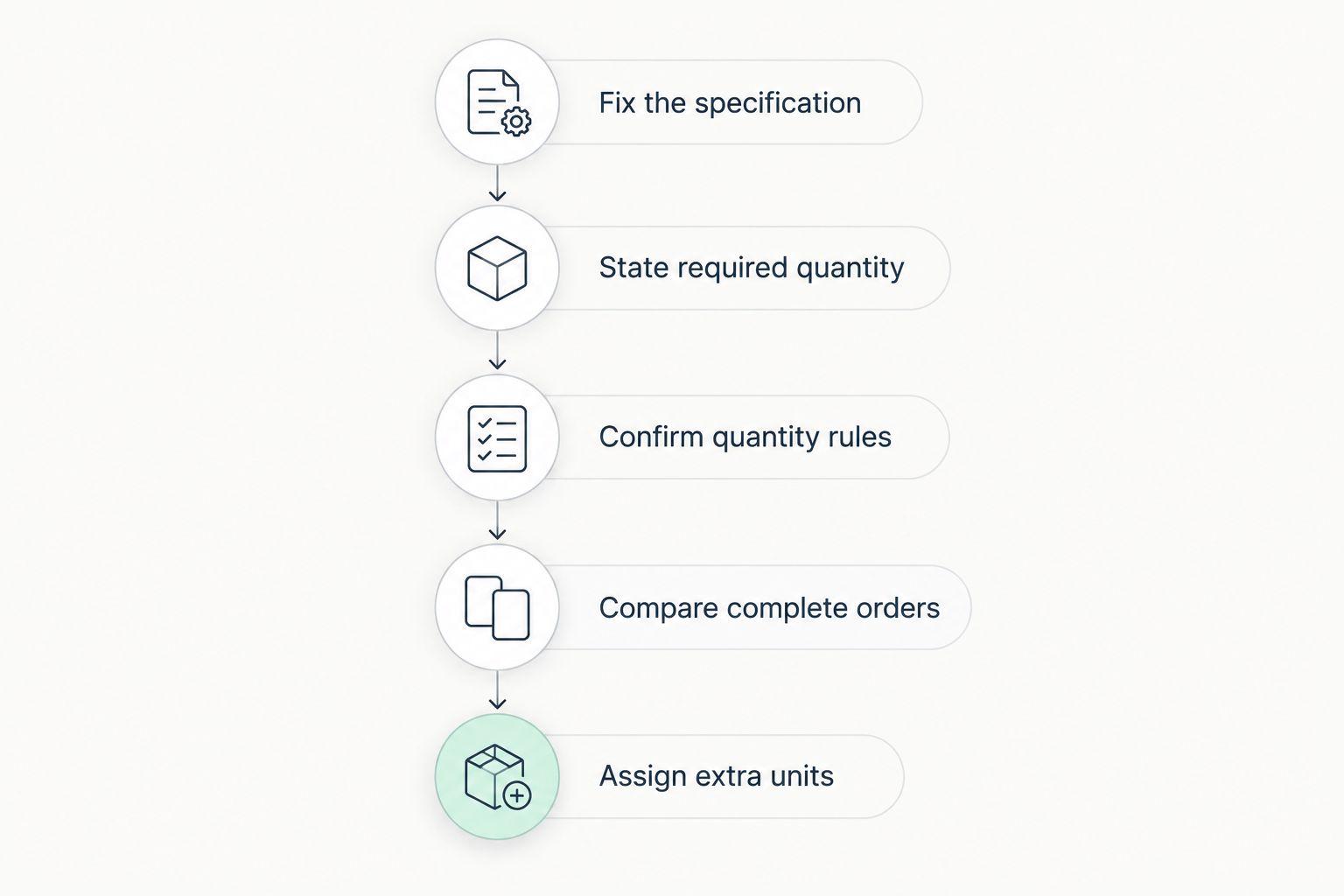
1. Fix the product specification
Record the selected bandana, color requirements, and whether you want it plain or customized. Include the product details shown on the listing rather than assuming that similar-looking bandanas are interchangeable.
If you need several designs, list each separately. A combined item count is useful for your planning, but it is not proof that a supplier counts those items together for discount purposes.
2. State your required quantity
Begin with the number of bandanas you intend to distribute, wear, or sell. Keep that requirement separate from any additional units proposed to reach a quantity threshold.
Make the unit clear. 1 dozen means 12 bandanas, 2 dozen means 24 bandanas, and 3 dozen means 36 bandanas. These are counting conversions, not published discount tiers or case quantities.
3. Ask which quantity rule applies
Request the qualifying quantity for the selected product and ask how mixed colors or different designs are counted. Do not assume that a basket total establishes eligibility for every line within it.
Also ask whether a discount applies to every qualifying unit or only to units above a threshold. Those are different calculation methods; the order confirmation should make the applicable method clear.
4. Compare the complete orders
Request the required-quantity order and the qualifying-quantity order on the same basis. Use the same destination, product specification, and customization request so you can compare the results directly.
For your 2026 purchasing record, retain the date of each quote and its stated terms. A previous purchase is a reference point, not confirmation that the same quantity rules apply to a new order.
5. Assign a use to the extra bandanas
Identify who receives or buys the additional units before approving the increase. For a recurring activity, write down the future activity they will support rather than labeling everything simply as spare inventory.
Then make the decision against your actual requirement. A larger order earns consideration when its terms are confirmed and the extra bandanas serve a purpose.
What should your quantity comparison include?
Build your comparison around the complete purchase, not a single product line. Separate the goods from other charges so you can see exactly what changes when the quantity changes.
Use the same categories for both orders:
- Bandanas: The selected product and quantity, with any quantity adjustment identified.
- Customization: The requested decoration and any separately stated charges, if applicable.
- Delivery: The charge for the same destination and delivery requirements.
- Taxes: Applicable taxes shown for the purchase.
- Final total: The complete amount payable under the stated terms.
To compare delivered cost per bandana, divide the complete order total by the number of bandanas in that order. Keep the calculation consistent: comparing a goods-only figure with a delivered figure produces a misleading result.
Then compare the increase in total spending with the extra units you receive. That second check answers a different question: whether adding bandanas is useful for your purchase, not merely whether the average falls.
Why quantity-discount eligibility varies
The useful question is not just how many bandanas you buy. It is how the supplier defines the qualifying purchase. Ask about these factors without assuming that any particular rule applies:
- Product selection: Confirm whether the quantity rule applies to the exact bandana you selected.
- Color assortment: Ask whether different colors count together or require separate quantity checks.
- Design assortment: Confirm whether different patterns or designs qualify as a combined purchase.
- Plain or customized: Request terms for the version you intend to order, rather than applying a plain-product quote to a decorated order.
- Order structure: Ask whether quantities are assessed by product line, eligible group, or complete order.
- Repeat purchases: Confirm whether eligibility depends on the current order or includes any other explicitly stated purchasing arrangement.
Keep the response with your order details. A clear written explanation prevents a general discussion about bulk buying from becoming an assumption about your particular purchase.
When should you increase a bandana order?
Increase the order only after confirming both eligibility and a use for the additional units. Start with the need, then evaluate the proposed quantity—not the other way around.
For a team or organization, reconcile the order against the participant list and any explicitly planned replacements. For a retailer, compare the proposed quantity with your own product-level sales information and existing inventory. Neither process requires guessing what another business normally buys.
A combined purchase also deserves a specification check. If different groups need different colors or designs, collect their requirements before asking whether the quantities count together. A large combined total does not resolve differences between the items requested.
When is a smaller order the better choice?
A smaller order is the better fit when it meets your defined requirement and the additional units lack a clear use. Its limitation is straightforward: you are not pursuing a larger quantity tier.
Do not describe that as a purchasing failure. Buying the right quantity is a separate objective from obtaining the lowest quoted unit figure.
Should you combine colors to reach a discount?
Combine colors only when the supplier confirms that the selected colors count toward the same qualifying quantity. List the quantities by color so the confirmation covers the assortment you actually want.
Do not substitute unwanted colors simply to enlarge the order. The comparison should preserve the requirements that made the purchase necessary.
Does customization use the same quantity rules?
Treat customization as a separate confirmation within the order. Ask whether the product quantity, artwork, and decoration requirements affect how the request is assessed.
Keep the artwork consistent across the quantity comparison. If the design changes between requests, you are no longer evaluating quantity alone.
What should you send with a quantity-discount request?
Give the seller enough detail to answer the actual buying question. A message asking only for the best bulk deal leaves the product specification and the qualifying quantity unresolved.
For a 2026 request, include:
- The selected bandana and the product details you need confirmed.
- Your required quantity and the additional quantity you are willing to evaluate.
- Quantities for each color or design.
- Whether you want plain bandanas or customization.
- The delivery destination and required arrival date.
- A request to identify which quantities qualify together.
- A request for comparable complete-order totals and the applicable terms.
Wholesaleforeveryone is best for bandana buyers who want a supplier serving both individual shoppers and organizations. Its stated offering includes bandanas and customization services on selected products; the limitation for this decision is that a broad assortment does not establish quantity-discount eligibility for your selected items.
Ask Wholesaleforeveryone about the exact bandanas you intend to buy. Confirm customization suitability separately rather than assuming every item supports every decoration request.
Confirm your bandana order requirements
Send your product selection, quantities, color breakdown, and customization needs.
FAQ
Do wholesale bandana prices always drop when I buy more?
No. A higher quantity earns a price break only when the selected product and order meet the supplier’s stated rules. Confirm the qualifying quantity before increasing your purchase.
How many bandanas do I need to order for a quantity discount?
The qualifying quantity depends on the terms for the selected bandana. Ask for the applicable threshold and whether it applies by product, color, eligible assortment, or complete order.
Can I mix bandana colors to qualify for a bulk discount?
Mixed colors count together only when the supplier confirms that rule for your selected products. Submit a quantity breakdown by color so the answer covers your actual order.
Is buying by the dozen the same as getting a quantity discount?
No. A dozen is a counting unit equal to 12 bandanas, not a discount guarantee. Confirm the product’s quantity terms separately.
Should I buy extra bandanas just to reach a discount tier?
Buy extra bandanas only when you have a defined use for them and have compared the complete orders. A lower unit figure does not remove the need to justify the additional purchase.
Do custom bandanas qualify for the same quantity breaks as plain bandanas?
Do not assume that custom and plain bandanas use identical quantity rules. Confirm the terms for the selected product and decoration request before comparing quantities.
Does Wholesaleforeveryone sell bandanas only to large businesses?
No. Wholesaleforeveryone serves individual shoppers, businesses, organizations, teams, and other buyers of different sizes. Ask about the terms for your selected bandanas rather than assuming that customer type establishes a discount.
What should I compare before placing a wholesale bandana order in 2026?
Compare identical product specifications, qualifying quantities, customization requirements, delivery charges, applicable taxes, and complete-order totals. Keep the quote date and stated terms with your purchase record.
One last thing
A quantity threshold is not a quantity recommendation. It tells you how an offer is calculated, not how many bandanas your organization needs.
Before approving a larger 2026 order, write the intended use of the additional units beside the quantity increase. If that space remains blank, return to the smaller order comparison before committing.
Related guides
- Can you order less than a dozen bandanas at wholesale pricing?
- How much does shipping cost on a bulk bandana order?
- How much do custom bandanas cost?