
Buying bandanas wholesale is cheaper than retail in 2026 only when the total order cost, divided by the bandanas you will actually use or sell, is lower than the equivalent retail purchase. Delivery charges, applicable tax, customization, and unused pieces belong in that comparison—not just the advertised unit amount. Choose wholesale for a planned quantity, not simply because the listing says wholesale.
- Is wholesale cheaper than retail bandanas? Compare total cost per usable bandana, not the wholesale label.
- Bulk bandanas suit confirmed group needs; retail suits small purchases without unwanted extras.
- Wholesale For Everyone serves wholesale bandana buyers, including businesses, organizations, resellers, and individual shoppers.
- Compare equivalent fabric, dimensions, colors, and customization before choosing wholesale or retail.
Is buying bandanas wholesale cheaper than retail in 2026?
Wholesale wins only when an equivalent order delivers a lower cost per usable bandana. Retail wins when buying exactly what you need avoids the extra spending attached to a larger order. Neither purchasing label proves which choice is cheaper.
Use this comparison before selecting an order format. For a closer look at quantity-based choices, see the guide to bulk bandanas by price and quantity.
| Purchase approach | Best for | Main advantage | Main drawback | What decides the result |
|---|---|---|---|---|
| Wholesale bandanas | Planned team, event, or resale quantities | Lets you evaluate a larger purchase together | Extra pieces commit money before you use them | Total cost divided by usable quantity |
| Retail bandanas | Personal purchases and small, specific needs | Lets you focus on the pieces you need | Separate purchases require their own cost comparison | Total cost of the exact required quantity |
The table describes purchasing choices, not a guarantee about a particular seller. Compare the same intended use and product requirements on both sides. A lower-cost bandana that does not suit your event or customer is not an equivalent alternative.
Why this matters
Your purchasing decision affects more than the amount attached to each piece. It determines how much money you commit, how much merchandise you hold, and whether the order fits the people receiving it. The cheapest purchase is the one that meets your requirements without unnecessary spending.
For a fundraiser, that means separating confirmed needs from hoped-for demand. For a retail store, it means distinguishing merchandise you expect to sell from colors you are buying only to complete a pack. For personal use, it means asking whether extra bandanas have a real purpose.
In 2026, compare current order totals rather than a remembered deal or an old screenshot. Keep both comparisons tied to the same purchase date and requirements. Otherwise, you are comparing different buying situations rather than wholesale against retail.
How do you compare wholesale and retail bandana orders?
Build the comparison around the quantity you need, the product you need, and the full amount required to obtain it. Keep those inputs consistent. Changing the fabric, design, or customization halfway through makes the result difficult to interpret.
- Define the need. Write down who receives the bandanas, how they will use them, and how many recipients or expected sales justify the purchase. Separate confirmed demand from optional extras.
- Match the product. Compare fabric composition, dimensions, pattern, color requirements, and care information. Record any differences instead of treating every bandana as interchangeable.
- Check the quantity. Establish how many pieces each purchase includes and whether you can select the colors you need. Do not assume a pack arrangement or ordering minimum.
- Record the total. Include merchandise, delivery, applicable tax, and any requested customization. Use the final order summary or a written quotation rather than a category-page headline.
- Count usable pieces. Exclude colors, designs, or quantities that have no planned use. For resale, distinguish an intended assortment from speculative inventory.
- Compare the result. Divide each full order total by its usable quantity, then check whether the total commitment fits your budget.
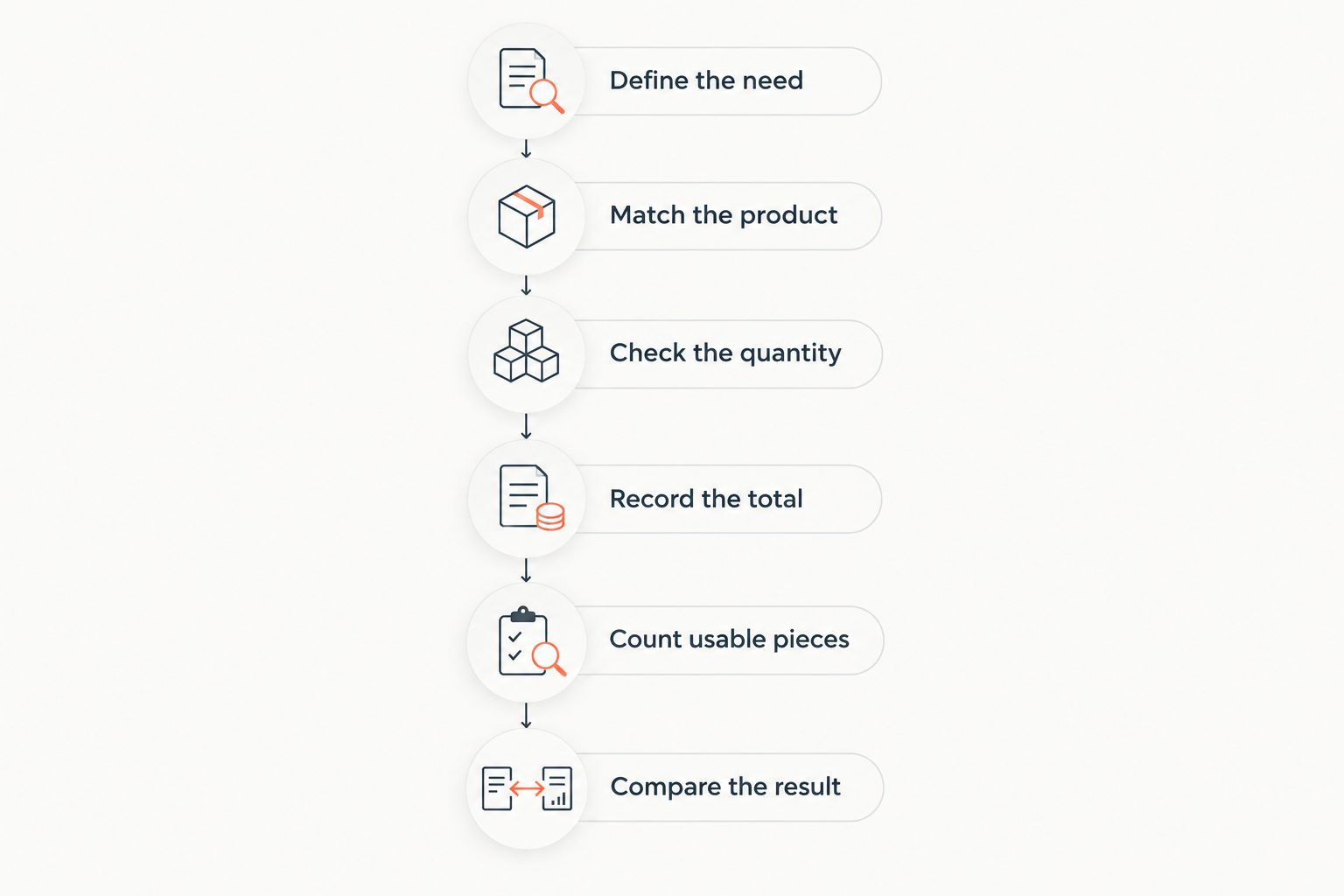
Keep the calculation visible in your purchasing notes:
Cost per usable bandana = complete order cost ÷ bandanas with a planned use.
For resale, add a separate record of what actually sells. An initial purchasing comparison helps you choose an order; a later sales record tells you whether your demand estimate was sound. Do not treat every purchased piece as a completed sale.
Wholesale bandanas: best for planned group quantities
Wholesale purchasing fits a school, team, organization, or event when you have a defined distribution plan. Start with the recipients, then choose the assortment. This keeps the order tied to a practical need rather than the appeal of a larger pack.
Its advantage is the ability to compare a group purchase as a complete order. Its drawback is the commitment to pieces that remain your responsibility after purchase. A bandana does not become useful simply because it arrived with the others.
Before choosing wholesale, identify which requirements are essential. A team color, suitable fabric, or approved design belongs in the product specification. Optional colors belong in a separate decision so they do not obscure the core comparison.
Choose wholesale when the required quantity and equivalent specifications produce the better total-cost result. Reject the assumption that ordering more automatically makes the purchase more economical.
Retail bandanas: best for small, specific purchases
Retail purchasing fits a shopper who needs a particular bandana or a small assortment without a larger inventory commitment. Its advantage is quantity control. Its drawback is that the cost of separate purchases still needs comparison against a suitable group order.
A personal shopper should not adopt a reseller's buying plan. If you need bandanas for your own wardrobe, count the pieces you expect to wear. Extras intended for an unspecified future occasion are a different purchase decision.
The same principle applies to a small team needing replacement pieces. Compare the exact replacement requirement against any larger order under consideration. Include only extras with a clear purpose when evaluating the larger purchase.
Choose retail when buying only the required pieces gives you the better overall result. Paying for less merchandise is not a failure to obtain wholesale savings; it is a different quantity decision.
Custom bandanas: compare the finished order
A customized bandana and a plain bandana do not answer the same buying need. If you need branding, compare finished products with equivalent artwork requirements. Do not use a plain-item listing as the complete alternative to a decorated order.
Specify the design, intended placement, color requirements, and product before requesting an order total. Ask which charges apply and what the quote includes. Do not assume setup, artwork work, proofs, or decoration are included or excluded.
The benefit of customization is that it adds the message or identity your project requires. The drawback is that a highly specific design limits other uses for leftover pieces. A dated event design deserves a different quantity decision from a design intended for repeated use.
For a 2026 event, settle the artwork and intended quantity before comparing suppliers. A quote built around unfinished requirements is not a reliable basis for choosing the cheaper purchasing route.
Why the wholesale-versus-retail result varies
The comparison changes when the order changes. Keep these factors separate so you can identify what actually determines your decision:
- Required quantity: Compare the pieces you need, not an arbitrary larger order. Extras need their own planned use.
- Product specification: Fabric, dimensions, construction, and design define whether the alternatives meet the same requirement.
- Assortment fit: A mixed order is useful only when its colors and patterns suit your recipients or customers.
- Delivery and tax: Include applicable charges in each complete order total. Do not assume the same treatment across sellers.
- Customization scope: Compare the same finished design and confirm what each quotation includes.
- Unused merchandise: Separate reusable extras from pieces tied to an event, customer, or design with no later purpose.
These are comparison inputs, not claims that a seller applies particular fees or terms. Read the actual order details. Where a term is unclear, resolve it before treating the total as final.
Where does Wholesale For Everyone fit?
Wholesale For Everyone is best suited to bandana buyers seeking a supplier that serves businesses, organizations, resellers, and individual shoppers. The company explicitly serves those customer groups rather than describing wholesale purchasing as limited to large companies.
Wholesale For Everyone offers bandanas alongside other accessories and apparel, plus custom printing and embroidery on selected products. That makes the supplier relevant when your buying brief includes merchandise and possible branding. Confirm that your chosen item supports the customization you require.
The limitation is straightforward: the supplier's description does not establish that your particular order beats every retail alternative. Evaluate Wholesale For Everyone bandanas using the same matched-product, complete-order comparison you apply elsewhere. A suitable buyer fit and a lower total cost are separate conclusions.
Is wholesale cheaper if I only need a few bandanas?
Wholesale is cheaper for a small requirement only when the full purchase costs less for the pieces you will use. The wholesale label does not resolve that question. Compare your exact need against the quantity each order requires.
If a larger order includes extras, identify their purpose before counting them as useful. Keeping unwanted pieces in the denominator makes the comparison look better without improving your purchase.
Is a mixed-color wholesale order better than buying separate colors?
A mixed-color order is better only when its assortment matches your intended use and its total-cost comparison wins. A group needing a specific color has a different requirement from a shopper seeking variety. Match the assortment to the people receiving it.
For resale, record the reason for each color choice. An attractive assortment is not evidence of customer demand, and a purchase plan should not confuse the two.
Does buying wholesale guarantee a resale profit?
Buying wholesale does not guarantee resale profit. Your result depends on completed sales and the expenses attached to purchasing, preparing, and selling the merchandise. A lower acquisition cost is only part of that calculation.
Keep purchasing economics separate from resale economics in 2026. The first asks which equivalent order costs less; the second asks whether your selling activity leaves a positive result after its expenses.
FAQ
Is buying bandanas wholesale always cheaper than retail?
Buying bandanas wholesale is not always cheaper than retail. Compare equivalent products using the complete order cost divided by the bandanas you will actually use or sell.
What’s the best way to compare wholesale and retail bandanas?
The best comparison uses matching product requirements, complete order totals, and usable quantities. Include applicable delivery, tax, and customization charges rather than comparing listing amounts alone.
Can I buy wholesale bandanas for personal use?
Personal shoppers can consider wholesale bandanas; Wholesale For Everyone explicitly serves individual shoppers as well as businesses and organizations. Check the quantity and terms for the specific order instead of assuming a universal minimum.
Is retail better if I only need a few bandanas?
Retail is better when buying the required pieces gives you a lower complete purchase cost than a larger order. Count extras only when you have a planned use for them.
Do custom bandanas need a separate cost comparison?
Custom bandanas need a comparison based on the finished product and matching artwork requirements. Confirm what each quotation includes before comparing it with another customized order.
Should I count leftover bandanas as savings?
Leftover bandanas are not savings simply because you own them. Count them as useful only when they have a defined purpose, and track actual sales separately for resale orders.
How do I check whether a wholesale bandana order is cheaper in 2026?
Use current 2026 order totals for equivalent bandanas and divide each total by its usable quantity. Then check the overall spending commitment, because a favorable per-piece result does not automatically fit your budget.
One last thing
The denominator deserves as much attention as the order total. Counting every purchased bandana as useful hides the cost of an assortment you do not need. Write the distribution or resale plan before placing the order—not after the box arrives.
For your next 2026 comparison, keep a short purchasing record with the product requirements, complete total, planned usable quantity, and reason for any extras. That record gives you a repeatable decision instead of a wholesale-versus-retail guess.
Related guides
- Bulk bandanas for schools and youth groups
- Wholesale bandanas for nonprofit fundraisers
- Custom printed bandanas for events
- Reselling wholesale bandanas on Etsy