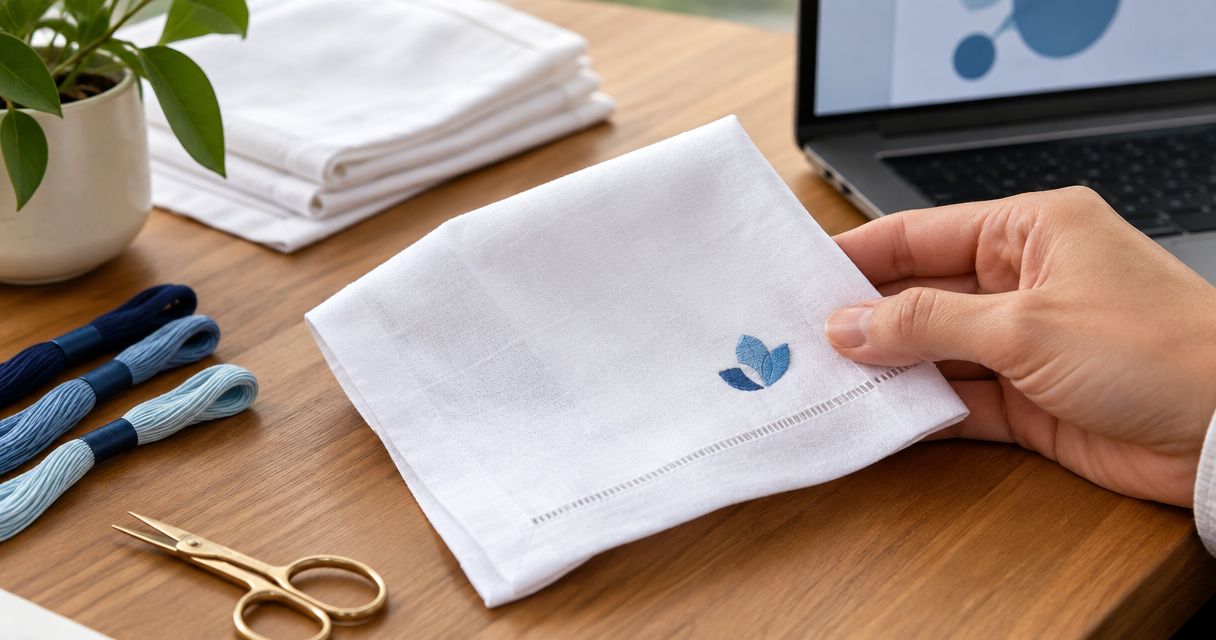
Yes, handkerchiefs can be embroidered with a business logo when the fabric, artwork, and stitching are suitable for a lightweight textile. The main caveat is that dense stitching or fine lettering can distort the cloth or lose detail, so approve the design on the intended handkerchief before committing to a production order.
- Can handkerchiefs be embroidered with a logo? Yes, but fabric suitability and a stitched sample determine the result.
- Wholesale For Everyone sells handkerchiefs and offers embroidery on selected products; confirm eligibility for your chosen handkerchief.
- Logo embroidery works best with clear shapes, readable lettering, and placement checked against the intended fold.
- Approve the front, reverse, and care instructions before ordering embroidered handkerchiefs for business use.
Can handkerchiefs be embroidered with a business logo?
Yes. The deciding question is whether your specific logo works on your specific handkerchief—not whether embroidery is possible in general. A small business emblem and a detailed badge place different demands on the fabric. Approve the combination, rather than treating the artwork and the textile as separate decisions.
For a broader overview of business customization, see the guide to custom embroidered apparel for small businesses. Handkerchiefs need particular attention because the reverse is exposed and the fabric is intended to fold comfortably.
Use this approval sequence for your 2026 order:
- Confirm fabric suitability. Ask whether the chosen handkerchief supports the proposed embroidery and whether its care requirements suit the intended use.
- Prepare the logo. Supply clear artwork and identify which elements must remain recognizable if the design needs simplifying.
- Choose placement. Decide how the handkerchief will be folded, presented, and used before positioning the logo.
- Review the proof. Check spelling, layout, thread colors, and the proposed finished size.
- Inspect a stitched sample. Assess readability, fabric distortion, the reverse, and the feel of the embroidered area.
- Approve production details. Record the approved artwork, placement, textile, and care instructions so the order has a clear reference.
An artwork proof establishes the proposed appearance. A stitched sample shows how thread and fabric behave together. Do not treat an attractive screen preview as evidence that the finished handkerchief will lie flat.
Why this matters
A branded handkerchief is both a textile and a representation of your business. The logo needs to remain recognizable, but the cloth also needs to work for its intended purpose. A design that looks suitable on a jacket can feel bulky on a lightweight handkerchief.
Before planning a 2026 event or merchandise order, decide what the recipient will do with the item. A handkerchief intended for personal use, a folded presentation piece, and an event keepsake need different approval criteria. Your intended use should determine the design—not the other way around.
The reverse deserves attention, too. Unlike embroidery on some lined garments, handkerchief embroidery is visible from behind. Ask to see both sides before approving the result.
Which logo designs work best on handkerchiefs?
Simple, clearly separated shapes are the strongest starting point for handkerchief embroidery. Tiny lettering, narrow gaps, gradients, and dense areas require an embroidery-specific review. A logo file that looks sharp when enlarged on a screen does not establish readability at the intended stitched size.
These approaches suit different priorities:
| Logo approach | Best for | Main advantage | Main limitation | Recommendation |
|---|---|---|---|---|
| Simplified emblem | Businesses with a recognizable symbol | Keeps attention on the core brand shape | Removes supporting information | Use when the symbol identifies the business on its own |
| Business-name wordmark | Businesses that need the name visible | Makes the brand name explicit | Small or ornate letters can lose clarity | Use when lettering remains readable in the stitched sample |
| Initials or monogram | Discreet branding and formal presentation | Reduces the amount of artwork | Initials do not explain the business to unfamiliar recipients | Use when recognition or presentation matters more than explanation |
| Full detailed logo | Brands that need several elements retained | Preserves more of the original identity | Demands more from the textile and embroidery process | Approve only after reviewing a stitched sample |
Each approach involves a trade-off. Simplifying artwork improves clarity, but removing too much can change the identity. Retaining every element preserves the original design, but can produce an embroidered mark that is harder to read.
Start by separating essential information from optional decoration. Your business name or primary emblem might be essential; a tagline, border, or tiny supporting text might not be. Have the embroidery provider assess the design rather than deleting elements without a clear reason.
For your 2026 artwork review, compare the proposed embroidery with the original logo at the intended physical size. Inspect the lettering, open spaces, and outlines. Approve a recognizable stitched mark, not merely a faithful-looking enlarged preview.
Where should the logo go on a handkerchief?
Choose logo placement after deciding how the handkerchief will be folded. A corner is a practical starting point for discreet branding, but no single position suits every presentation. A logo hidden inside the final fold does not meet a visibility requirement, even if the embroidery itself is well executed.
Compare the placement options before approving the artwork:
| Placement | Best for | Advantage | Limitation |
|---|---|---|---|
| Corner placement | Discreet branding on a folded handkerchief | Leaves much of the cloth undecorated | Visibility depends on the fold and orientation |
| Center placement | A handkerchief presented open | Makes the mark prominent when laid flat | Folding can conceal the logo; stitching occupies the central area |
| Edge placement | Branding intended to follow a visible edge | Connects the mark to the presentation layout | The hem and folded layers need consideration |
Lay out an undecorated handkerchief in the intended fold and mark the proposed logo position temporarily. Check which part remains visible, then unfold it to inspect the position on the full cloth. Share that layout with the embroidery provider.
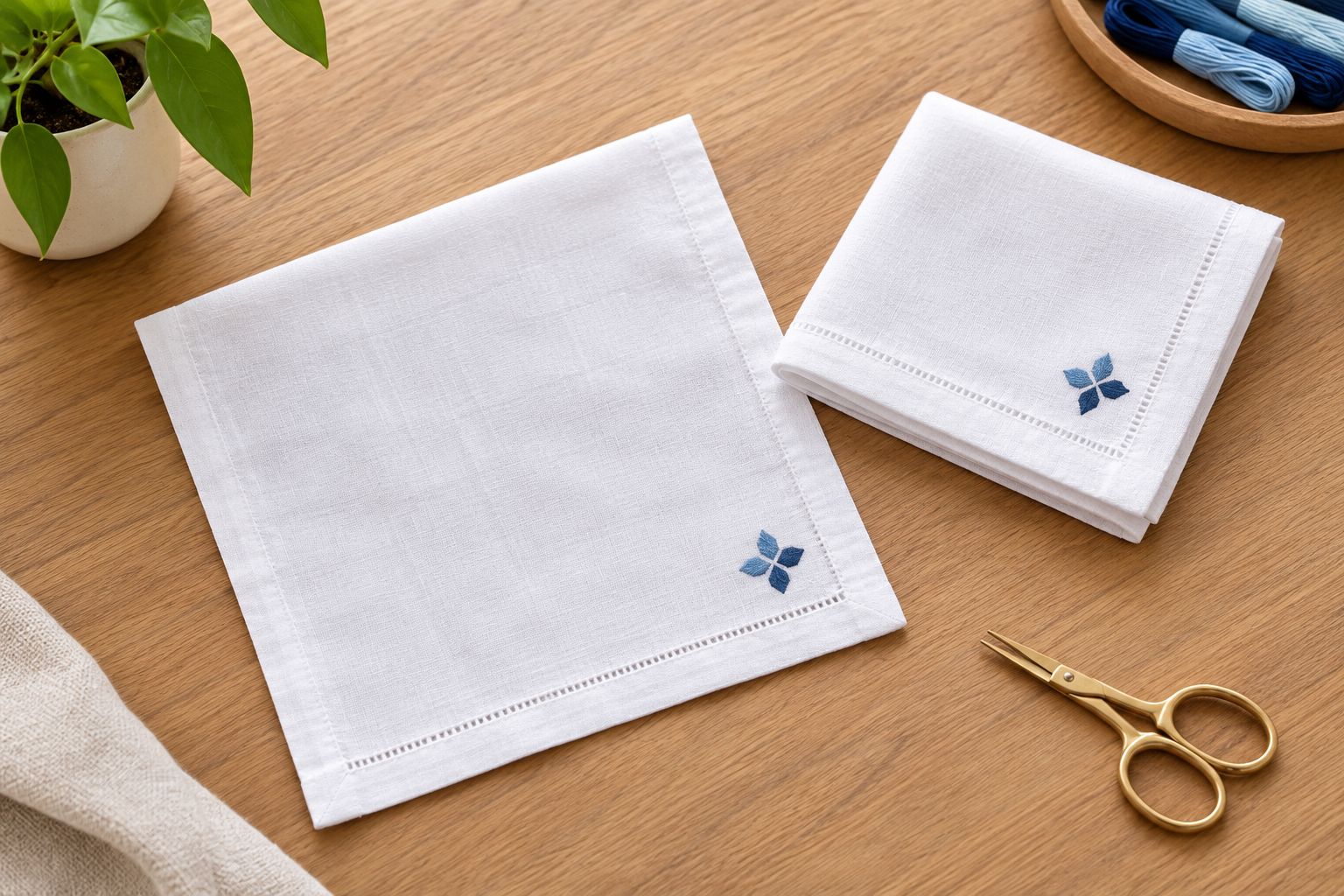
Also check orientation. An upright logo on flat fabric can appear sideways after folding. Include the presentation method in your approval instructions, particularly when several people will prepare the finished items for an event.
Why handkerchief embroidery results vary
Embroidery quality depends on the relationship between the cloth and the design. Evaluate these factors together rather than asking for a universal logo size or stitch setting.
- Fabric structure: Lightweight cloth needs an embroidery approach that supports the stitches without unnecessary distortion. Ask the provider to assess the actual textile.
- Design density: Large filled areas add more thread to the embroidered area. Consider how that changes flexibility and the feel of the handkerchief.
- Lettering and detail: Fine text, narrow outlines, and closely spaced elements need review at the proposed finished size.
- Stabilization: Supporting material helps hold fabric during embroidery. Ask what remains afterward and inspect its appearance and feel on the reverse.
- Placement and folds: Hems, layered edges, and the intended fold affect where the design can sit and how it is seen.
- Care requirements: The handkerchief, thread, and any remaining backing must be considered together when establishing care instructions.
Judge the result on the selected fabric. A sample embroidered on a different textile can demonstrate the artwork, but it does not establish how your handkerchief will feel or lie flat.
How do you approve a business-logo handkerchief order?
For a 2026 order, give the embroidery provider a written brief that connects the design to its purpose. Include the selected handkerchief, logo artwork, intended placement, presentation method, quantity requested, and required event date. These details describe your request; they do not establish production eligibility or a delivery commitment.
Check the artwork proof
Verify the business name letter by letter. Check the orientation, proposed dimensions, and thread-color references rather than relying only on how colors appear on your screen. Record any revisions clearly so the final approval refers to one version.
Ask whether the supplied artwork needs digitizing—the conversion into embroidery instructions. A graphic file and a machine embroidery file serve different purposes. Confirm how artwork preparation will be handled before approving the job.
Check the stitched sample
Inspect the front for readable lettering, distinct shapes, and unwanted puckering around the design. Then turn the handkerchief over. Look at the underside of the stitches and any remaining backing, and decide whether the finish suits the item’s intended use.
Fold the sample as it will be presented. Handle the embroidered area rather than judging it only in a photograph. For a handkerchief intended for personal use, comfort and flexibility belong in the approval decision alongside appearance.
Record what you approved
Keep the approved artwork and sample reference together. Specify which textile, logo version, thread colors, and placement the approval covers. A later change to the fabric or design needs another review; the earlier approval does not automatically cover a different combination.
Wholesale For Everyone is a fit for businesses sourcing handkerchiefs and exploring logo customization. Wholesale For Everyone sells handkerchiefs and offers custom printing and embroidery on selected products. Confirm that the chosen handkerchief qualifies before planning an embroidered order; those stated services do not establish eligibility for every item.
Explore handkerchief customization
Review handkerchief options and ask whether your selected item supports business-logo embroidery.
Can a detailed business logo be embroidered on a handkerchief?
Yes, but a detailed business logo needs assessment at the intended stitched size. Fine lettering, gradients, and narrow spaces do not translate directly into thread. Ask which details need simplifying, then approve the revised mark on the selected fabric.
Do not insist on retaining a tagline if it becomes unreadable. A clear business name or emblem communicates more effectively than a crowded design whose details merge together.
Will the embroidery show on the back of the handkerchief?
Yes, the underside of the stitching is visible on the reverse of an unlined handkerchief. Any remaining backing also needs inspection. Ask for a reverse-side view of the sample rather than approving only a front-facing photograph.
An acceptable reverse depends on the intended use. A folded presentation item and a handkerchief handled on both sides call for different scrutiny, so explain that use before production.
Can embroidered handkerchiefs be washed?
Yes, when washing is permitted by the finished item’s care instructions. Follow guidance for the complete embroidered handkerchief, not just the undecorated fabric. Confirm the appropriate washing, drying, and ironing method before distributing the items.
For a repeat-use order, ask how to evaluate a sample under the recommended care process. Check the fabric, stitched shape, and reverse afterward; do not substitute a generic laundering rule for item-specific instructions.
FAQ
Can handkerchiefs be embroidered with a logo for my business?
Yes, handkerchiefs can be embroidered with a business logo when the fabric and design are suitable. Confirm the selected item’s eligibility and approve a stitched sample before production.
What’s the best logo style for an embroidered handkerchief?
A simple emblem or readable wordmark is the strongest starting point for handkerchief embroidery. Fine lettering and dense detail need assessment at the intended finished size.
Is corner embroidery better than a centered logo?
Corner embroidery suits discreet branding when the intended fold leaves the corner visible. A centered logo suits an open presentation, but folding can conceal it.
Can I use the same logo file I use for printing?
Your printing artwork can serve as a starting reference, but embroidery requires digitized stitch instructions. Ask the provider what source file is needed and whether the design requires changes.
Will a large embroidered logo make a handkerchief stiff?
Dense embroidery adds thread and changes the feel of the stitched area. Inspect a sample on the selected handkerchief to decide whether its flexibility suits your use.
Does Wholesale For Everyone offer logo customization?
Wholesale For Everyone offers custom printing and embroidery on selected products and sells handkerchiefs. Confirm whether your chosen handkerchief supports the requested logo embroidery before ordering.
What should I approve before ordering embroidered handkerchiefs?
Approve the textile, logo version, finished placement, thread colors, and stitched sample. Check both sides and confirm care instructions for the completed item.
One last thing
Approve the handkerchief in its final fold, not only laid flat. That simple check reveals whether the logo is visible, upright, and positioned as intended—details an artwork proof alone cannot establish.
For your 2026 approval, photograph the accepted sample both flat and folded, and keep those views with the written specifications. Give whoever prepares the items the same folding reference. A correctly embroidered logo still needs a consistent presentation.
Related guides
- How long does it take to get an embroidery proof approved?
- Bulk handkerchiefs for weddings and events
- Wholesale handkerchiefs for funeral homes