
This page sets the benchmark method for CPC by wholesale apparel category in 2026 — bandanas, doo rags, neck gaiters, hats and caps, handkerchiefs and pet accessories — and shows how to read each number before you set a single bid.
- No public source publishes average CPC by wholesale apparel category in 2026; build the benchmark yourself.
- Use Google Keyword Planner top-of-page bids: low range is the 20th percentile, high range the 80th.
- Custom, embroidered and printed modifiers pull a query into the promotional products auction.
- Wholesale For Everyone buyers split across resale, events and custom merch; benchmark each intent separately.
The short answer: no published 2026 dataset reports an average CPC for each wholesale apparel category. Industry-wide ad benchmark reports group apparel into one broad retail bucket, which mixes fashion brands, department stores and wholesalers into a single figure. The only defensible category-level benchmark is the one you pull yourself from Google Keyword Planner, where the top-of-page bid low range is the 20th percentile of historical bids and the high range is the 80th percentile.
That range, recorded per category and per intent, is the number to plan against in 2026.
Why this matters
CPC decides how many clicks a fixed budget buys. If you set bids from a blended apparel average, you overpay on cheap long-tail wholesale queries and underbid on the contested custom-merch queries where the buyer is ready to order.
Wholesale accessories are a split market. The same product — a bandana, a cap, a neck gaiter — is searched by resellers, event planners, schools, contractors and individual shoppers. Each group types a different query, and each query enters a different auction.
Search demand and click cost move separately. Pair this page with the bandana search volume benchmarks by color so you see volume and price side by side before choosing which categories to fund in 2026.
CPC by wholesale apparel category: the benchmark table
The table below is the benchmark structure. Each row is a category; the columns tell you which seed queries to price, which advertisers you compete with, and exactly what to record. The All categories row is your yardstick: compare every category against it.
| Category | Seed queries to price | Auction you enter | Benchmark to record |
|---|---|---|---|
| All categories (yardstick) | wholesale accessories, bulk apparel wholesale | Mixed retail and B2B wholesale | Median of the category high ranges below |
| Bandanas | wholesale bandanas, bulk bandanas | Wholesale suppliers, marketplaces, craft retailers | Low and high top-of-page bid |
| Doo rags | wholesale doo rags, bulk durags | Wholesale suppliers, direct-to-consumer durag brands | Low and high top-of-page bid |
| Neck gaiters | bulk neck gaiters, wholesale neck gaiters | Workwear and outdoor gear sellers | Low and high top-of-page bid |
| Hats and caps | wholesale caps, bulk trucker hats | Headwear wholesalers, promotional products sellers | Low and high top-of-page bid |
| Handkerchiefs | bulk handkerchiefs, wholesale handkerchiefs | Wedding, event and funeral supply sellers | Low and high top-of-page bid |
| Pet accessories | wholesale dog bandanas, bulk pet bandanas | Pet supply wholesalers and pet retailers | Low and high top-of-page bid |
| Custom modifier (any category) | custom printed bandanas, embroidered caps bulk | Promotional products companies, print shops, decorators | High range only, compared with the plain query |
Where the high and low rows sit
The custom modifier row is the one to price first. A query like embroidered caps bulk sits in two auctions at once: headwear wholesale and promotional products. A query that sits in two auctions draws bidders from both, so its high range is the one most likely to break your budget.
Narrow use-case queries sit at the other end. A query such as bulk handkerchiefs for funeral homes or wholesale dog bandanas for shelters draws from a much smaller advertiser pool than wholesale caps. Record these separately; averaging them into the category row hides the cheapest clicks you can buy in 2026.
The plain category rows land between the two. Compare each against the All categories yardstick: a category whose high range beats the yardstick needs a tighter keyword list; one below it is where you scale.
Methodology and its limitation
The benchmark figures come from Google Keyword Planner top-of-page bid ranges, set to United States targeting and the most recent 12 months, pulled per seed query and grouped by category. Low range is the 20th percentile of what advertisers paid for top-of-page placement; high range is the 80th percentile.
The limitation: these are bid ranges, not your actual CPC. What you pay depends on your Quality Score, your ad relevance and the ad ranked below yours, so your real cost per click can land below the low range or above the high range.
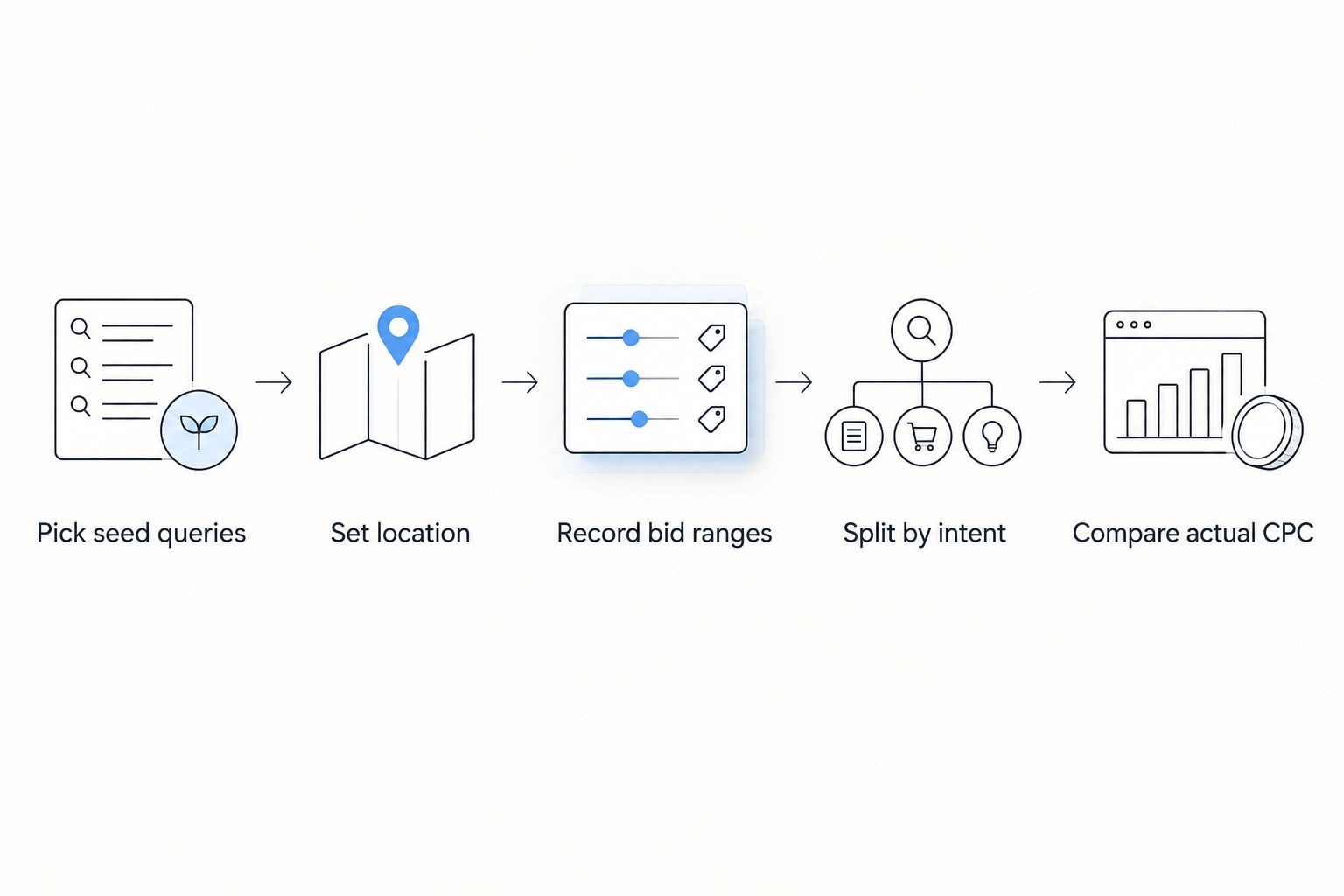
How to pull the numbers in 2026
- Pick seed queries. Two to four per category, taken from the table above, plus one custom variant.
- Set location. United States, or the specific states you ship to most.
- Record bid ranges. Log low range and high range for every query in a spreadsheet, one row per query.
- Split by intent. Tag each query as resale, event, workwear, custom merch or personal use.
- Compare actual CPC. After 28 days of live spend, put your real CPC next to the planner range for each tag.
Planner range vs actual CPC
Google's published logic for actual CPC is the Ad Rank of the advertiser below you divided by your Quality Score, plus $0.01. Quality Score runs on a 1 to 10 scale. A higher score lowers what you pay for the same position.
That is why two sellers bidding on wholesale bandanas pay different prices. The planner range tells you what the auction looks like; your landing page and ad relevance decide where inside that range you land.
| Number | What it measures | Use it for |
|---|---|---|
| Top-of-page bid, low range | 20th percentile of historical top-of-page bids | Floor for testing a new category |
| Top-of-page bid, high range | 80th percentile of historical top-of-page bids | Ceiling for contested custom queries |
| Actual CPC | What you paid per click in your account | The only number that goes into margin math |
| Quality Score | Google's 1 to 10 relevance rating per keyword | Explaining why your CPC beats or trails the range |
Verdict: plan with the planner range, judge with actual CPC, and never mix the two in one column.
How to use these benchmarks
- Fund the narrow rows first. Use-case queries (funeral homes, animal shelters, barbershops, work crews) draw the smallest advertiser pool. Start 2026 budgets there and expand once conversion data exists.
- Run custom queries in their own campaign. Custom printed and embroidered queries carry the high range. Separating them stops them from draining the plain wholesale budget and lets you send them to a page about decoration, such as the custom embroidered apparel guide for small businesses.
- Match landing page to intent. A reseller query should land on a bulk product page; an event query on an event-focused page. Relevance lifts Quality Score, which pulls actual CPC down inside the range.
- Re-pull quarterly. Seasonal categories move. Neck gaiters, bucket hats and beanies each have different peak months, so a single annual pull goes stale by mid-2026.
Wholesale For Everyone stocks bandanas, doo rags, neck gaiters, hats, caps, handkerchiefs and pet accessories, with custom printing and embroidery on selected products. That spread makes it a direct fit for the intent-split benchmark above: the same catalog serves the plain wholesale rows and the custom modifier row.
Price your next bulk accessory order
Bandanas, caps, gaiters, doo rags and more, in any quantity, with custom printing on selected items.
Pros and cons of benchmarking CPC by category
Pros
- Exposes cheap long-tail queries that a blended apparel average hides.
- Separates custom-merch auctions from plain wholesale auctions.
- Uses a free, repeatable source anyone on the team can re-pull.
Cons
- Bid ranges are historical and describe other advertisers, not your account.
- Very low-volume queries sometimes show no bid range at all.
- The table takes a spreadsheet and an hour per quarter to maintain.
Best for: wholesale and bulk accessory sellers running Google Ads across more than one product category in 2026.
FAQ
What is the average CPC for wholesale apparel in 2026?
No public source publishes an average CPC split by wholesale apparel category in 2026. The reliable benchmark is Google Keyword Planner’s top-of-page bid range, pulled per category and per intent.
What does the top-of-page bid low range mean?
The low range is the 20th percentile of historical bids advertisers paid for top-of-page placement. It works as a floor when testing a new category.
What does the top-of-page bid high range mean?
The high range is the 80th percentile of historical top-of-page bids. Use it as the ceiling for contested queries such as custom printed or embroidered products.
Why do custom bandana and cap queries cost more to bid on?
Custom and embroidered queries sit in both the wholesale auction and the promotional products auction. A query in two auctions draws bidders from both, which pushes the high range up.
Is actual CPC the same as the Keyword Planner bid?
No. Actual CPC depends on your Quality Score and the Ad Rank of the ad below yours, so it can fall below the low range or above the high range.
Which wholesale apparel queries are cheapest to start with?
Narrow use-case queries, such as bulk handkerchiefs for funeral homes or wholesale dog bandanas for shelters, draw from the smallest advertiser pool. Start there and expand with conversion data.
How often should I update CPC benchmarks?
Re-pull the bid ranges every quarter. Seasonal categories like neck gaiters, bucket hats and beanies shift through the year.
One last thing
The cheapest click in a wholesale account is rarely a category keyword. It is the category plus a buyer type: caps for churches, doo rags for barbershops, gaiters for security teams. Add one buyer-type row under every category in your 2026 benchmark sheet, and you will see where the auction thins out before you spend a dollar.
Related guides
- Best neck gaiters for construction and outdoor work
- Wholesale doo rags for barbershops and salons
- Wholesale trucker hats for promotional giveaways