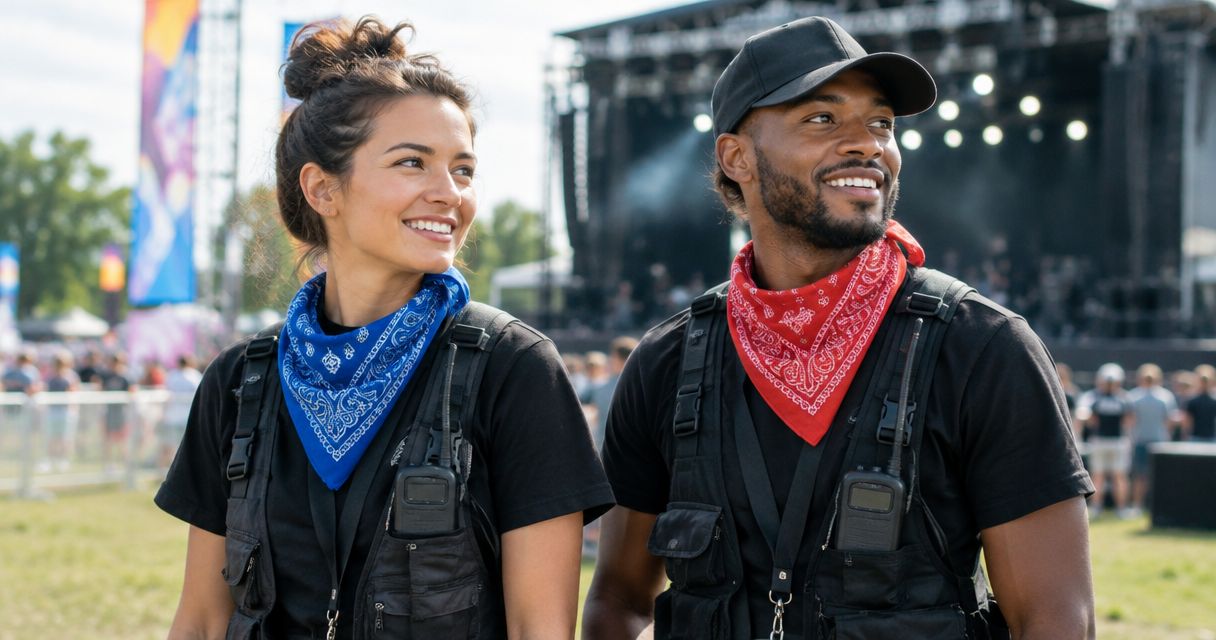
Festival and concert staff bandana planning is the selection, customization, and distribution of crew accessories with the aim of making staff roles easier to recognize. Choosing bandanas for festival and concert staff means accounting for folded artwork, changing shifts, stage lighting, and the difference between a visible staff marker and an access credential.
- Choose bandanas for festival and concert staff by role, wearing position, and artwork visibility—not the unfolded design alone.
- Wholesale For Everyone offers bandanas and customization on selected products; confirm the proposed combination before approving artwork.
- Keep staff bandanas distinct from festival merchandise, and use separate credentials for restricted access.
- Count individual recipients, test folded samples, and assign one owner to approve custom bandanas.
Why bandana planning matters for festival and concert staff
A festival crew includes people doing different jobs in different conditions. Your admissions team needs to be recognizable at the entrance, while stagehands need clothing choices that fit their tasks and venue safety rules. A single decorative design does not settle those requirements.
For your 2026 event, start with the operational purpose: identifying staff, distinguishing departments, or creating a consistent crew appearance. The custom-printed bandanas for events comparison is a useful next read when you are ready to compare options against that brief.
Use a bandana as a recognition aid, never as proof of permission to enter a restricted area. A visible accessory and a credential solve different problems. Keep badges, wristbands, or your established access procedure separate from the clothing decision.
How to plan staff bandanas for a 2026 event
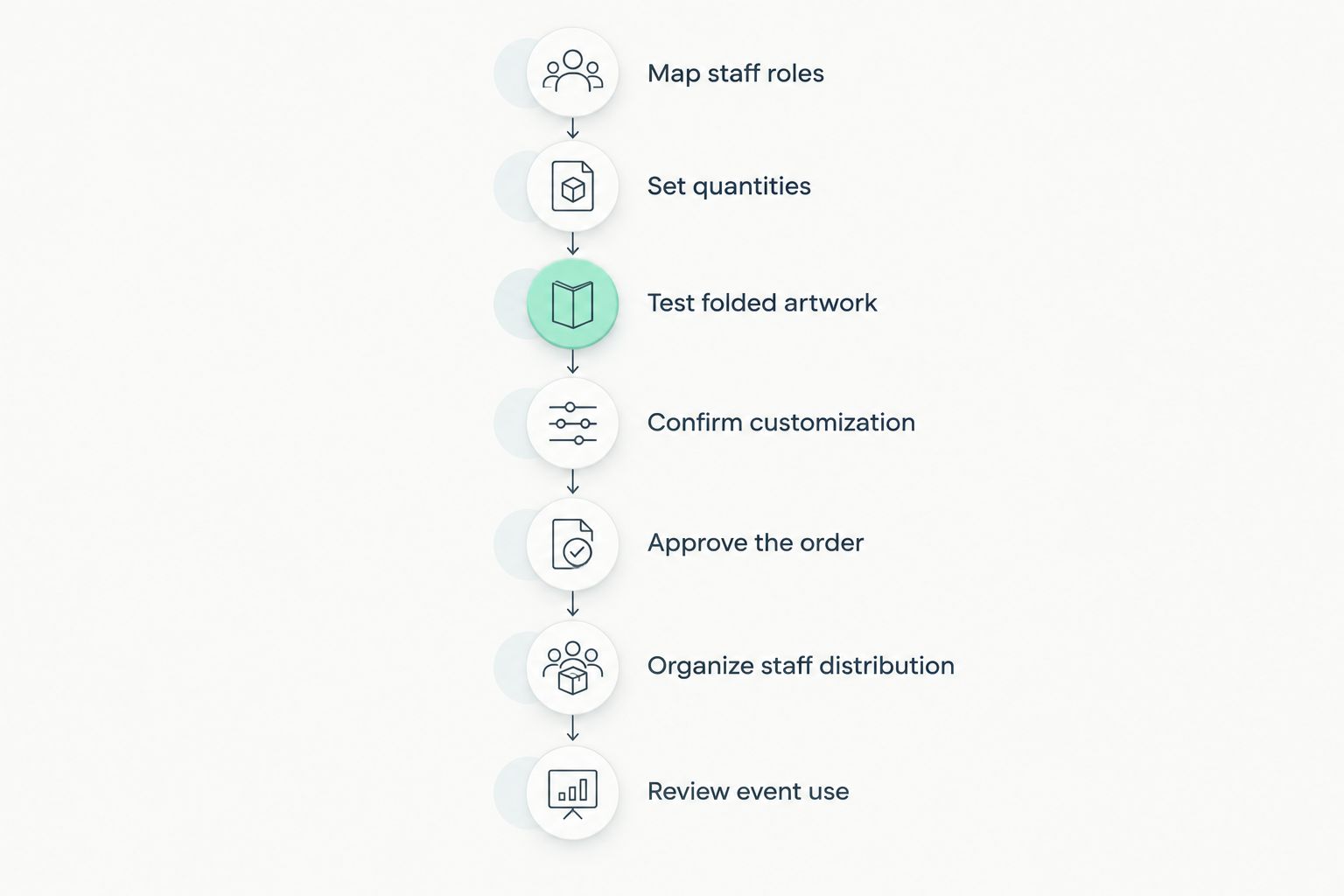
Work through the following sequence before approving an order. Keep the decisions in one shared document so production, volunteer coordination, and department leads use the same instructions.
Map staff roles
Create a department list manually in a spreadsheet before selecting colors. Include employees, volunteers, contractors, and temporary crew members who actually need the accessory. Decide whether the bandana identifies everyone as staff or distinguishes particular teams.
Best for mixed crews: pair color with a readable role label. Do not make color the only way to identify a department; lighting and differences in color perception make that a weak instruction system. Also check whether security or medical teams already have required identifiers that should remain dominant.
Give each department lead the same questions rather than collecting unrelated preferences. The objective is a consistent system, not a separate design project for every team.
- List departments such as admissions, hospitality, volunteers, and production.
- Record each department's existing uniform or identification requirements.
- Assign plain-language role labels where needed.
- Define an approved wearing position for each task.
- Keep attendee merchandise visually separate from staff identifiers.
Set quantities
Count recipients from your staffing roster, not from attendance forecasts. If a person works several shifts and keeps the same bandana, count that person once before adding any planned replacements. If your event issues fresh accessories each day, build the count around that policy instead.
Separate 3 quantity lines in your planning sheet: assigned recipients, planned replacements, and unassigned reserve. These are planning categories, not a recommended purchase ratio. Choose the reserve from your own staffing uncertainty and replacement rules rather than copying an arbitrary percentage.
Best for changing rosters: keep department totals editable until approval. Record which version becomes the purchasing total so later roster changes do not silently alter an approved order.
- Count unique recipients by department.
- Identify whether accessories stay with staff between shifts.
- Record planned replacements separately from initial issue.
- Assign responsibility for reserve quantities.
- Reconcile the final total with department leads.
Test folded artwork
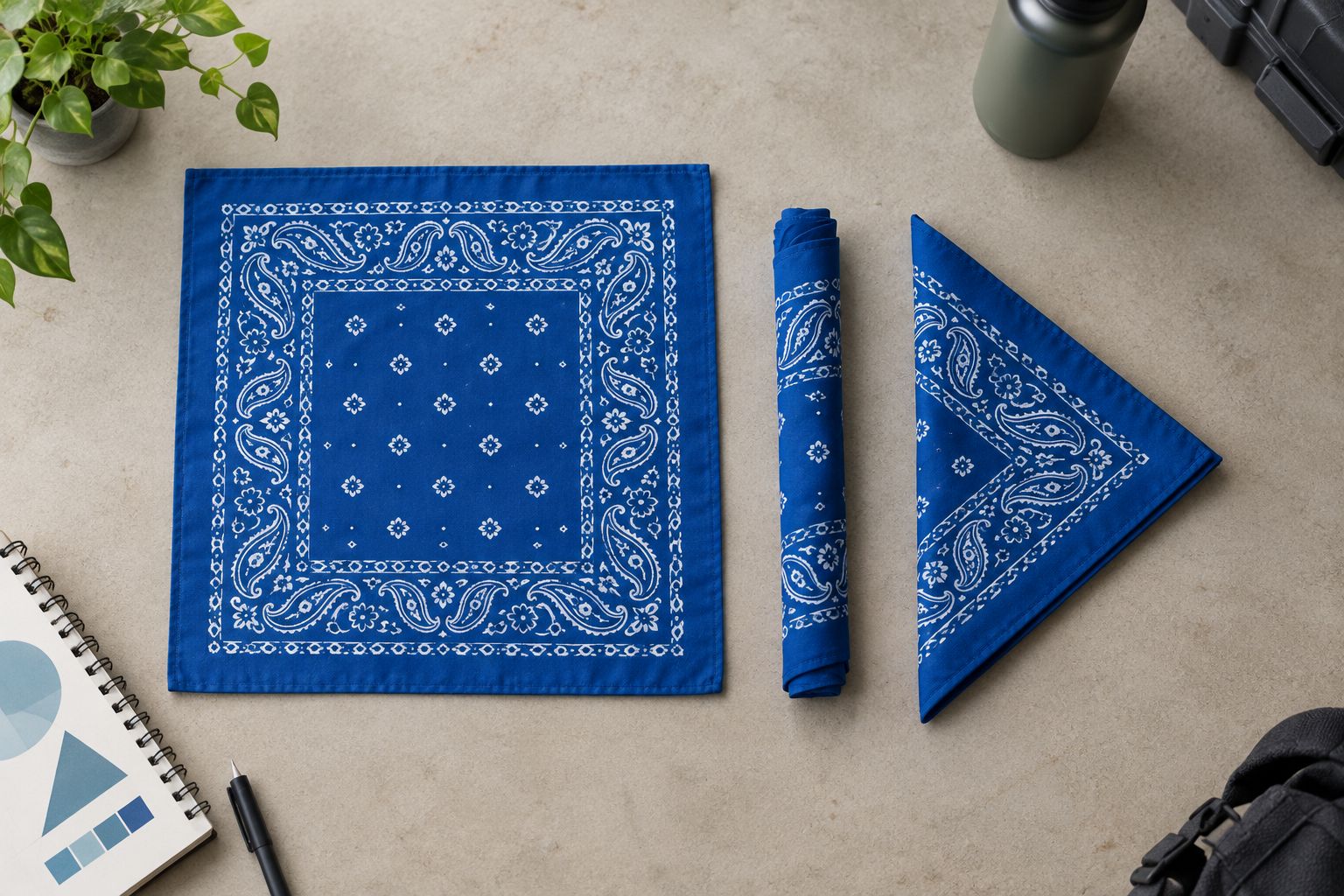
Print a paper mockup at the proposed finished size, then fold it into the intended wearing position. This manual check exposes a common design problem: artwork that looks clear on a flat square disappears inside a folded band.
Check 2 views before approval: the full layout and the worn layout. Neither replaces the other. A large central logo suits some folds, while a role label needs placement that remains visible when the item is tied as instructed.
For a 2026 festival, test the design alongside the actual crew clothing rather than judging it in isolation. Ask a colleague unfamiliar with the design to identify the role without an explanation. That gives you a practical readability check, not a claim about a guaranteed viewing distance.
- Fold the mockup in the intended wearing style.
- Check that knots do not cover essential wording.
- Compare artwork contrast against the selected fabric color.
- Review readability alongside the crew's other clothing.
- Remove small sponsor text from the main identification area.
Confirm customization
Prepare your artwork and requirements in a shared folder before asking a supplier to assess the job. Include the intended product, wearing position, role wording, and event date. A clear brief gives the supplier something specific to confirm instead of asking for a generic logo application.
Wholesale For Everyone is best for event teams seeking bandanas and customization from one supplier. The company serves event planners and offers custom printing and embroidery on selected products. That does not establish that every bandana supports every decoration method; confirm the exact combination before proceeding.
Wholesale For Everyone's bandana range and customization services provide a supplier route after you have defined the job. The limitation is product-specific suitability: your artwork, chosen item, and decoration method still need confirmation.
- Supply the original artwork file when you have it.
- Identify every required wording or color variation.
- Ask which customization methods suit the selected bandana.
- Confirm the proposed decoration area and placement.
- Request care instructions for the finished combination.
Approve the order
Use a written checklist to compare the proof against your brief. Do not approve a design simply because the logo looks correct on screen; check wording, fabric color, placement, and the department quantities together.
Appoint 1 approval owner to collect comments and authorize the final version. Department leads can review their details, but one person should settle conflicting edits. This is a recommended workflow, not a supplier requirement.
For your 2026 order, record the required event date separately from any supplier-confirmed production or delivery information. Do not treat a requested date as a confirmed commitment. Ask about the applicable terms before approval, including how an artwork discrepancy would be handled.
- Check role names and event spelling character by character.
- Match each design variation to its department total.
- Confirm the exact proof version being approved.
- Record supplier-confirmed timing in writing.
- Save the approval and applicable order terms together.
Organize staff distribution
Build a manual issue sheet organized by department or check-in location. Give distribution leads a clear rule for initial issue, replacements, and leftover items. Otherwise, a carefully counted order becomes difficult to reconcile once several teams start handing out accessories.
Best for multi-shift events: distribute through the existing staff check-in process. Explain the approved wearing position during briefing, and make clear that the bandana does not override credentials or venue instructions.
Check task suitability before requiring neck or head wear. Loose fabric needs specific attention around equipment, and staff must follow site rules and any required protective-equipment instructions. An ordinary bandana is not a substitute for required protective equipment.
- Label distribution bundles by department.
- Provide the approved wearing instructions at check-in.
- Keep replacement items with a named coordinator.
- Record transfers between departments.
- Store unused items separately from returned or worn items.
Review event use
After the event, compare the issue record with what department leads observed. Ask whether attendees could recognize staff, whether role wording stayed visible, and whether the accessory suited the work. Keep operational feedback separate from comments about appearance.
The most useful 2026 review is a short decision record for the next event. Document which design to retain, which department needs a change, and whether replacements came from loss, wear, or additional staffing. Do not call unexplained leftovers a demand forecast.
Best for recurring festivals: retain the approved files and the reasons behind each revision. A design archive without its wearing instructions leaves the next organizer to repeat the same decisions.
- Reconcile issued, unused, and replacement items.
- Ask department leads about visibility and task suitability.
- Record artwork problems with permission-based reference photos.
- Retain confirmed care instructions and approved files.
- Separate reusable wording from event-specific details.
Compare bandana options for your crew
Choose the simplest option that meets the identification brief. Decoration adds an artwork decision; departmental variations add coordination. Neither is automatically necessary for every event.
| Option | Best for | Main advantage | Key limitation |
|---|---|---|---|
| Plain solid-color bandanas | Small crews using separate role credentials | No custom artwork to approve | Color alone does not explain someone's role |
| Custom-printed bandanas | Crews needing an event name or staff wording | Artwork can combine identity and role information | Folding can hide essential details; method suitability needs confirmation |
| Embroidered bandanas, where suitable | Teams considering stitched branding on a selected item | Provides a stitched decoration option | Confirm product suitability, placement, and the finished feel before choosing |
| Department-specific designs | Larger crews with distinct public-facing functions | Supports a clearer distinction between roles | More variations require tighter quantity and distribution control |
Wholesale For Everyone offers bandanas and selected-product customization, but the supplied information does not specify individual fabric constructions, decoration areas, or production schedules. Confirm those details for the item under consideration rather than assuming that a category-wide claim applies.
A plain bandana with a separate credential remains a valid choice when custom artwork does not solve a defined problem. For public-facing departments, prioritize recognizable staff wording over decorative complexity.
Common mistakes festival and concert teams make
Treating staff accessories as backstage passes
A copied or misplaced bandana should not grant access to a production area. Keep authorization in your credential system, and brief gate staff on that distinction. Staff recognition is useful; access control requires its own process.
Giving attendees the same staff design
Using identical designs for crew and public merchandise removes the distinction you intended to create. Reserve the staff wording or design treatment for staff, and show both versions to the team responsible for event identification before approval.
Approving only the flat design
A proof can be accurate while the worn result hides the role label. Fold the layout, check the knot position, and inspect the intended wearing style before signing off. Ask for clarification whenever the proof does not show the placement clearly.
Counting shifts instead of recipients
Multiple shifts do not automatically mean multiple bandanas per person. Define the issue and replacement policy first, then count against that rule. The reverse mistake also matters: a fresh-item policy needs quantities that reflect repeated issue.
Adding dated artwork without a reuse decision
Printing 2026 on every staff accessory ties the design to that event. That is appropriate for a commemorative item, but not automatically for recurring crew use. Decide whether the bandana is an event keepsake or a reusable staff identifier before adding the year.
FAQ
What’s the best bandana option for festival and concert staff?
Choose the option that makes the intended staff role recognizable when worn. Plain colors suit crews with separate role identifiers; custom wording suits teams that need the bandana itself to communicate a role.
Can Wholesale For Everyone customize bandanas for an event crew?
Wholesale For Everyone offers bandanas and custom printing and embroidery services on selected products. Confirm that the chosen bandana, artwork, and decoration method work together before approving the order.
How many bandanas should I order for concert staff?
Base the order on recipients, your issue policy, planned replacements, and a separately defined reserve. Count repeat shifts only when your policy requires another item for that shift.
Should different festival departments wear different colors?
Different colors are useful when they support a clear department system. Pair color with readable role wording or a separate identifier rather than expecting everyone to interpret color alone.
Can staff bandanas replace backstage credentials?
No, staff bandanas should not replace backstage credentials. Keep restricted-area authorization within the event’s established access-control process.
How do I keep a logo visible on a folded bandana?
Test the proposed artwork in the exact fold and wearing position before approval. Keep essential wording away from areas hidden by folds or knots, and confirm placement with the supplier.
Can crew members wear bandanas while working around stage equipment?
Follow the venue’s task-specific safety rules before permitting bandanas around stage equipment. Check loose-fabric risks and compatibility with required protective equipment rather than treating one wearing style as suitable for every job.
One last thing
The useful proof is the one that shows what remains visible after folding. A perfectly reproduced logo does not help staff recognition when the knot hides it.
Before approving your next order, ask someone outside the planning team to read the worn role label. If you have to explain where to look, revise the placement—not the briefing.
Related guides
- Solid-color bandanas for team uniforms
- From artwork submission to finished custom bandanas
- Washing custom-printed bandanas without fading