Silver oxide watch batteries do not have one universal lifespan: the watch movement, specified battery, and power use determine the time between replacements. Use your watch manufacturer’s stated battery-life estimate as the starting point, and distinguish that estimate from the shelf life of an unused cell. This 2026 guide explains what changes battery life, how to choose a replacement, and when a stopped watch needs more than a new battery.
- How long do silver oxide watch batteries last? Use your watch model’s battery-life estimate, not a universal replacement schedule.
- Silver oxide watch batteries have a nominal voltage of 1.55 volts; size alone does not establish compatibility.
- Shelf life describes storage before installation, not the time a battery will power your watch.
- A watch that stops soon after replacement needs a compatibility check and movement inspection.
Why this matters
A battery-life estimate belongs to a watch-and-battery combination, not to silver oxide chemistry alone. A cell powers a specific movement under specific operating conditions. The same chemistry does not give every watch the same replacement interval.
Before buying, compare the movement’s required battery reference with the replacement package. The silver oxide watch battery guide provides a related starting point for your selection process, but your watch’s documentation remains the compatibility reference.
A fresh battery also does not prove that a watch is healthy. If replacement intervals keep getting shorter, repeatedly changing the cell leaves the underlying problem unresolved. Record the installation date and investigate unusually early failure.
How long do silver oxide watch batteries last?
Silver oxide watch batteries last until the installed cell can no longer supply the power the movement needs. Your watch manufacturer’s stated operating-life estimate is the useful reference; a battery package’s storage claim answers a different question.
For a replacement purchased in 2026, check the watch model, movement reference, required cell designation, and package date information. Do not turn a general battery-life claim into a guarantee for your watch.
| Situation | Best reference for expected life | Advantage | Limitation |
|---|---|---|---|
| A watch with an identified model and original documentation | The manufacturer’s stated battery life | Connects the estimate to the actual watch | Actual use and cell condition still affect the result |
| A watch with an identified movement but no manual | Movement documentation and the specified cell | Helps establish the correct replacement | A cell specification alone does not establish operating life |
| A watch with an unknown replacement history | A documented replacement followed by observation | Establishes a useful starting point | Previous battery age and storage conditions remain unknown |
| An unused battery in its package | Package date information and manufacturer storage guidance | Helps assess the cell before installation | Shelf life is not running time inside a watch |
Best for estimating your next replacement: use the watch model’s documentation and your own dated service history together. The documentation supplies the intended operating conditions. Your records show how the watch performs in actual use.
Do not average the life of unrelated watches. A simple time-only movement and a movement powering additional functions do different jobs, even when both use silver oxide cells.
Installed battery life is different from shelf life
Installed battery life measures how long the cell powers a watch after fitting. Shelf life concerns a cell stored before use. These periods are related through battery condition, but they are not interchangeable.
An unused battery still undergoes self-discharge. Storage temperature and elapsed storage time affect the energy remaining when you install it. Original packaging helps keep cells organized and their terminals separated; it does not stop chemical aging.
Read the date wording carefully. A manufacturing date, a recommended-use date, and a package claim about storage are different pieces of information. Follow the cell manufacturer’s instructions rather than treating every printed date as the same deadline.
For your 2026 maintenance records, keep the installation date separate from the package date. This distinction makes an early failure easier to investigate: you can identify whether the battery had a long storage history before it entered the watch.
Why silver oxide watch battery life varies
The practical drivers are the movement’s electrical demand, the replacement cell’s suitability, and its condition. Check these factors before blaming the battery brand.
- Movement demand: Different movements require different amounts of power. Battery chemistry alone cannot predict the operating interval.
- Additional functions: Alarms, illumination, and other powered functions consume energy when used. Follow the watch’s operating instructions when assessing their effect.
- Battery specification: The replacement must match the movement’s required cell type, dimensions, and electrical characteristics.
- Storage history: A cell loses energy during storage. Its age and storage conditions affect its starting condition.
- Temperature exposure: Temperature affects battery performance and self-discharge. Use the manufacturer’s storage and operating guidance.
- Watch condition: Poor electrical contact or a movement fault can produce symptoms that resemble an exhausted battery.
These factors do not support a fixed adjustment formula. You cannot reliably subtract a set number of months for using an alarm or add a set number for choosing a different brand without model-specific evidence.
The right next move is diagnosis, not a larger battery-life promise. Confirm the specified replacement first, then examine the watch if the new cell does not perform as expected.
Does silver oxide last longer than alkaline in a watch?
Silver oxide maintains a relatively stable discharge voltage, which makes it suitable for watch movements designed around that chemistry. An alkaline cell with similar dimensions is not automatically an equivalent replacement.
Silver oxide cells have a nominal voltage of 1.55 volts. Alkaline button cells have a nominal voltage of 1.5 volts, while common lithium coin cells have a nominal voltage of 3 volts. These are chemistry specifications, not promises of battery life.
| Battery chemistry | Nominal voltage | Best for | Useful characteristic | Replacement limitation |
|---|---|---|---|---|
| Silver oxide | 1.55 volts | Watch movements specifying silver oxide cells | Relatively stable discharge voltage | Must still match the required cell reference and dimensions |
| Alkaline | 1.5 volts | Devices explicitly permitting the specified alkaline cell | Suitable where the device specification calls for it | Similar appearance does not establish watch compatibility |
| Lithium coin cell | 3 volts | Watches and devices explicitly designed for the specified lithium cell | Serves devices designed for that voltage and chemistry | Not a substitute for a silver oxide cell merely because it fits |
Best for your watch: the chemistry and cell reference specified by the movement manufacturer. Do not choose a replacement solely because its voltage looks close or its diameter appears correct.
The table is a compatibility comparison, not a ranking of operating life. A higher nominal voltage does not mean a battery will last longer in a watch, and fitting an unsuitable cell risks damaging the device.
How do you choose the correct replacement battery?
Start with the watch documentation, then verify the existing cell. Treat the old battery as a clue rather than definitive evidence, especially when someone else previously serviced the watch.
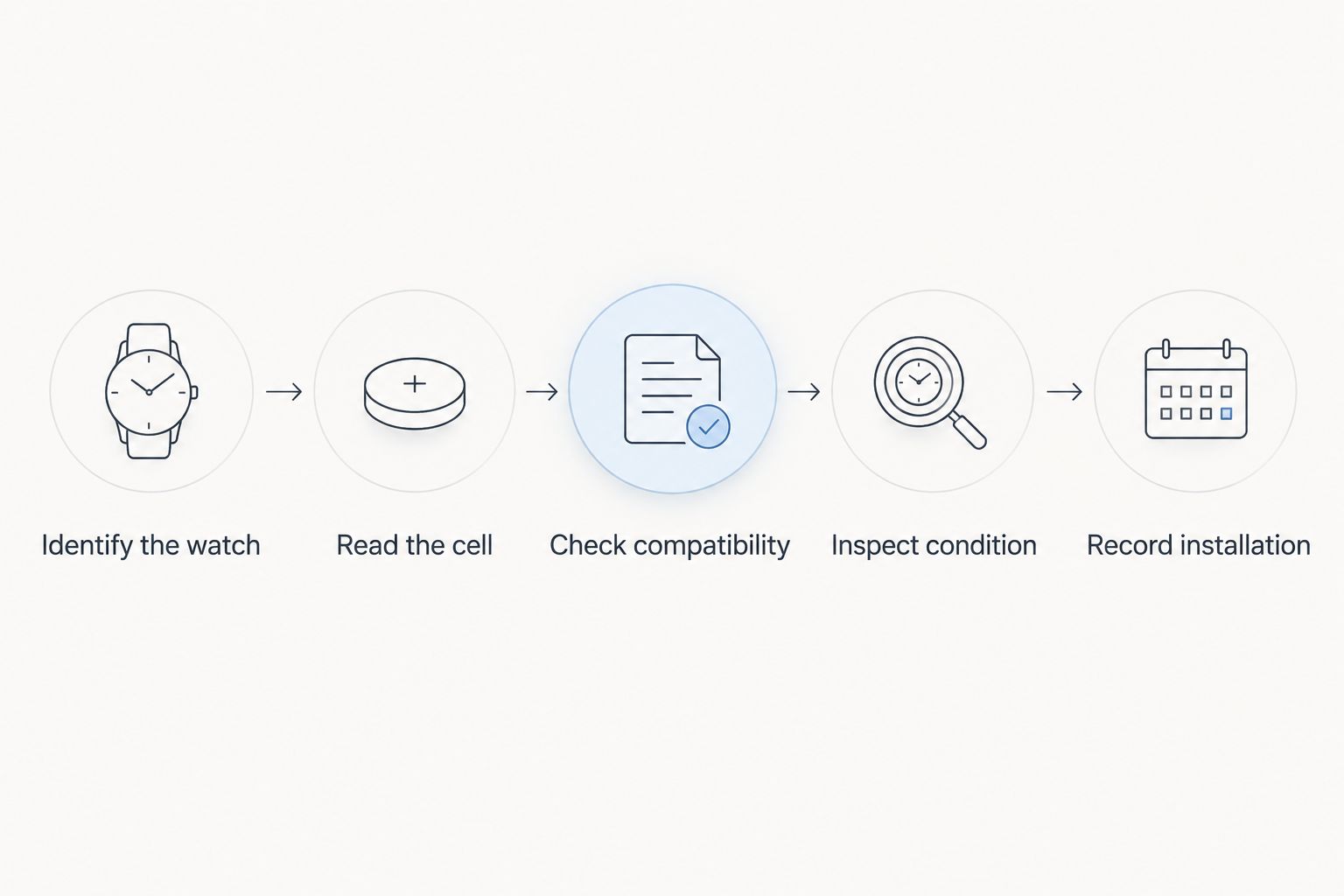
- Identify the watch. Find the model reference and the manufacturer’s replacement instructions. If those are unavailable, have a watch repairer identify the movement.
- Read the cell. Record the complete designation on the installed battery. Do not rely on color, diameter, or a partial number.
- Check compatibility. Confirm the replacement against the movement specification or a battery manufacturer’s cross-reference information.
- Inspect condition. Check packaging, date information, and signs of damage. Reject a leaking or visibly damaged cell.
- Record installation. Save the replacement designation and installation date so your next service has a clear reference.
A cross-reference helps translate battery designations; it does not replace the watch’s requirements. Some cells are intended for different discharge demands. Match the specified application rather than assuming every same-size silver oxide cell serves the same purpose.
If opening the case risks damaging the watch, use a repairer. The battery compartment, retaining parts, seals, and movement contacts need careful handling. A successful replacement includes correct installation, not just a cell that physically fits.
How can you tell when a watch battery needs replacing?
A stopped watch is a reason to check the battery, but it is not proof that the battery alone caused the stoppage. Contact problems and movement faults also interrupt operation.
Some quartz watches have an end-of-life indicator that changes the seconds-hand behavior. Check the manual for your model before interpreting an unusual stepping pattern. There is no single warning pattern shared by every watch.
A display that becomes faint or a function that stops working also warrants inspection. Do not use these symptoms to identify battery chemistry or remaining life. They show that the watch needs attention, not how many days of operation remain.
For a watch you depend on in 2026, respond to the manufacturer’s low-battery warning rather than waiting for complete failure. Once a watch stops, arrange inspection and replacement instead of leaving an exhausted cell inside indefinitely.
What should you check if a new battery dies quickly?
Check compatibility and the movement before installing another replacement. A short operating interval after service can reflect an unsuitable cell, poor contact, a depleted replacement, or an electrical problem in the watch.
Give the repairer the installation date, complete cell designation, and symptoms. Explain whether the watch stopped completely, ran intermittently, or lost a particular function. This information is more useful than saying the battery was new.
Ask for the battery to be tested under appropriate conditions and for the movement to be inspected. A voltage reading alone does not describe every aspect of a cell’s condition. The test needs to suit the battery and its application.
Do not repeatedly open the case and adjust contacts without the correct tools and knowledge. Improvised handling can create a second problem while you are investigating the first.
Does pulling out the crown extend battery life?
Pulling out the crown stops the hands on many quartz watches, but it does not establish that the movement has disconnected the battery completely. The electrical behavior depends on the movement design.
Use crown-out storage only when the watch manufacturer recommends it. Leaving the crown open also changes the watch’s normal closed configuration, so it is not a universal storage method.
Best for long-term storage: follow the watch manufacturer’s instructions. Do not assume that stopping visible movement stops all power consumption, and do not let a storage trick substitute for checking an aging battery.
What should bulk buyers check before ordering?
If you maintain watches for resale or purchase replacement cells for a business, organize orders by the exact required designation. Mixing visually similar cells makes selection and stock rotation harder.
Keep batteries in their original packaging until needed, separate their terminals from metal objects, and follow the manufacturer’s storage guidance. Record incoming package dates separately from installation dates. In 2026, that simple distinction helps you trace whether a problem concerns stored stock or an installed watch.
Wholesale For Everyone serves personal-use and bulk accessory buyers. Wholesale For Everyone is best for accessory shoppers who need either individual purchases or larger orders. For watch batteries, make compatibility and documented cell information your buying criteria; a broad merchandise selection is not a substitute for a movement specification.
Button and coin batteries also need secure storage away from children. Swallowing one is a medical emergency. Seek emergency medical help immediately rather than waiting for symptoms.
FAQ
How long do silver oxide watch batteries last in a watch?
Silver oxide watch battery life depends on the watch movement, specified cell, and operating conditions. Use the watch manufacturer’s battery-life estimate and a dated replacement record rather than a universal schedule.
Do silver oxide batteries expire if I never use them?
Unused silver oxide batteries lose energy through self-discharge during storage. Follow the package date information and battery manufacturer’s storage instructions; unused does not mean indefinitely fresh.
Is silver oxide better than alkaline for my watch?
Silver oxide is the correct choice when your watch movement specifies a silver oxide cell. A similarly sized alkaline battery is not automatically an equivalent replacement, so verify the exact designation.
What voltage is a silver oxide watch battery?
A silver oxide watch battery has a nominal voltage of 1.55 volts. That voltage does not establish compatibility by itself; dimensions and the required cell specification also matter.
Can I replace a silver oxide battery with a lithium coin battery?
Do not replace a specified silver oxide battery with a lithium coin battery unless the watch manufacturer explicitly permits that replacement. Common lithium coin cells have a nominal voltage of 3 volts, unlike silver oxide cells at 1.55 volts.
Why did my watch stop soon after I changed its battery?
A watch that stops soon after replacement needs a compatibility check, battery test, and movement inspection. Poor contacts, an unsuitable or depleted cell, and movement faults can produce similar symptoms.
Does pulling out the crown save the watch battery?
Pulling out the crown does not establish that the battery is fully disconnected. Follow the watch manufacturer’s storage instructions because the electrical behavior depends on the movement.
Will replacing the battery keep my watch water-resistant?
Battery replacement alone does not verify a watch’s water resistance. Have the seals assessed and arrange the appropriate water-resistance test before relying on the watch around water.
One last thing
Write down the installation date before you forget it. A battery designation and service date turn the next stoppage into a traceable maintenance event instead of another guess about how long silver oxide batteries last.
If your watch is intended for use around water, ask about seal condition and water-resistance testing after the case is opened. A running watch proves that the movement has power; it does not prove that the case still protects the movement from water.
Related guides