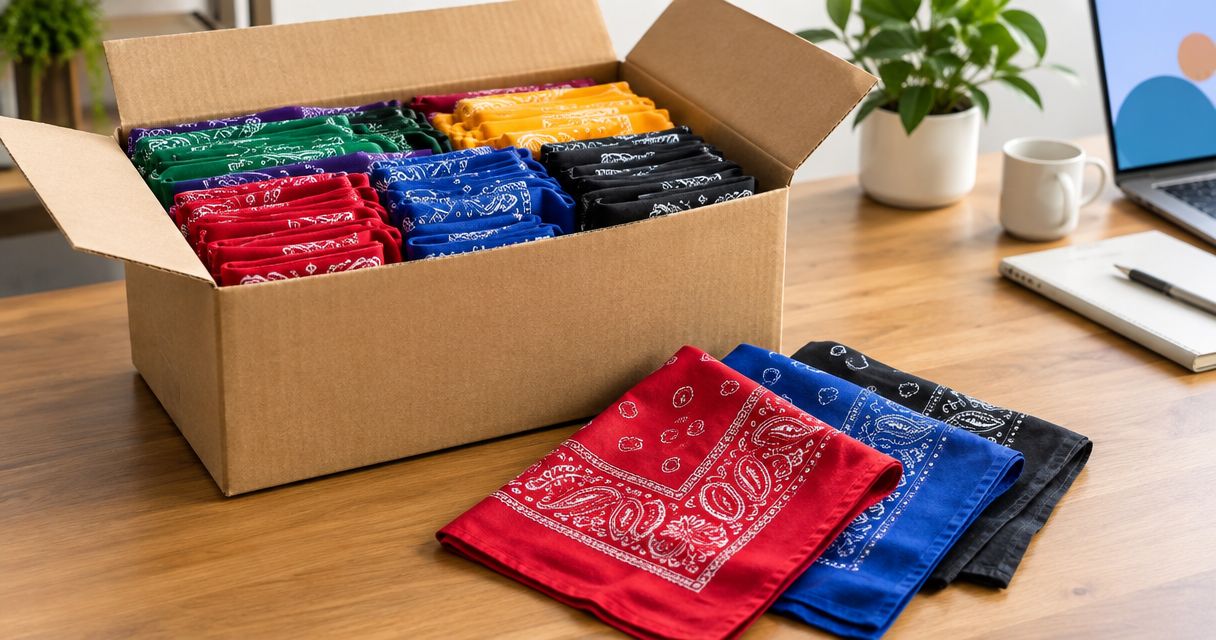
A bulk case of bandanas contains the number of individual bandanas specified for that case; the word bulk does not establish a universal count. Check whether the quantity refers to individual pieces, inner packs, or the entire case before ordering. A quantity entered at checkout is not necessarily the number of bandanas you will receive.
- How many bandanas come in a bulk case? Use the stated case quantity, not the word bulk.
- A dozen means 12 bandanas; a gross means 144 bandanas. Neither term automatically describes a case.
- Wholesale For Everyone serves bandana buyers purchasing for personal use, businesses, organizations, and events.
- Confirm pieces per pack and packs per case before calculating your total order.
Why this matters
A purchase order that says bandanas without identifying the selling unit leaves room for a counting mistake. You need the number of individual pieces, not just the number of containers. That distinction matters when every attendee, employee, or resale bundle needs a bandana.
For your 2026 purchase, start with the unit description rather than the largest quantity displayed on the page. The guide to bulk bandanas by quantity addresses the wider buying decision; this page explains how to read the count.
The reliable quantity is the individual-piece total attached to the exact item you are ordering. A clear count lets you compare purchase options, allocate colors, and check the shipment against your order without changing units halfway through.
How many bandanas come in a bulk case?
There is no single count established by the phrase bulk case. A case is a packaging or selling unit, while a dozen and a gross are numerical units. Read the listing to establish the relationship between the container and its contents.
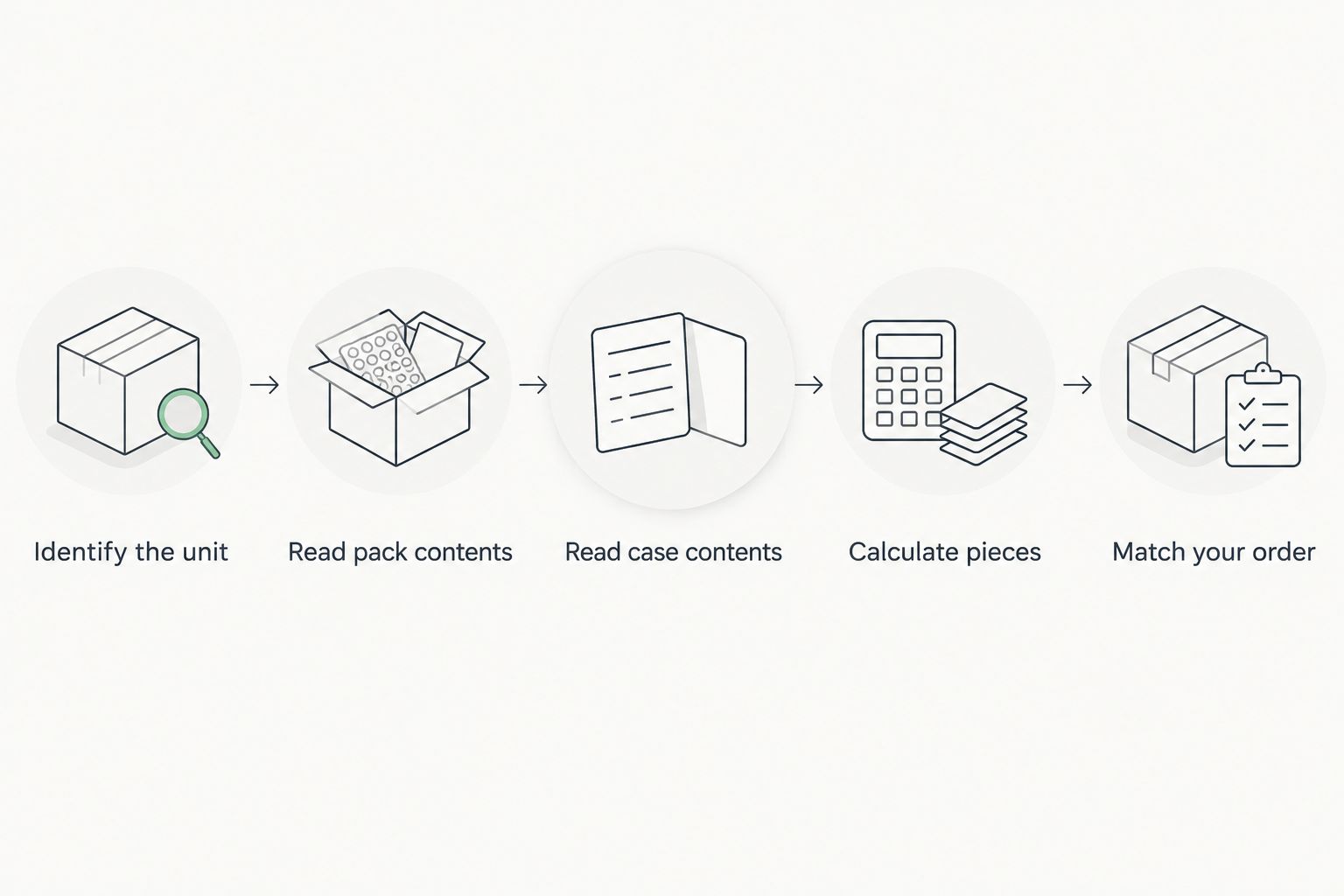
Use this sequence before placing a bulk bandana order:
- Identify the unit. Determine whether the item is sold as a piece, pack, dozen, gross, or case. Do not infer the selling unit from a photograph of several bandanas.
- Read pack contents. Find the stated number of individual bandanas inside each pack. Keep that figure separate from the number of packs shown or selected.
- Read case contents. Establish whether the case description gives a direct piece count or a number of inner packs. If it gives packs, you also need the pieces-per-pack figure.
- Calculate pieces. Multiply pieces per pack by packs per case, then multiply that result by the number of cases ordered.
- Match your order. Compare the final piece total with your actual requirement, including the allocation by color or design where relevant.
The calculation is straightforward, but every input must refer to the same item. Do not combine a pack count from one color selection with a case description from another listing.
For a direct piece-count listing, no inner-pack calculation is needed. Use the stated bandanas per case and the number of cases you select. Never multiply by an inner-pack count twice.
A dozen: 12 bandanas
A dozen means 12 individual bandanas when the unit being counted is bandanas. It does not mean 12 packs unless the description explicitly says a dozen packs. The noun attached to the quantity determines what you receive.
Two dozen bandanas means 24 individual bandanas. This is a unit conversion, not a claim about any supplier's case configuration. A seller must still identify whether that quantity is the complete order, an inner pack, or part of a larger case.
Best for: checking a listing expressed in dozens. The advantage is a fixed numerical meaning; the limitation is that the word dozen does not explain the surrounding packaging.
A gross: 144 bandanas
A gross means 144 individual bandanas when bandanas are the objects being counted. A gross is 12 dozen. It is a numerical unit, not evidence that every bulk case contains that amount.
Do not translate case into gross without an explicit connection in the description. Likewise, a listing that states a gross of bandanas establishes the piece count but does not, by itself, establish how the bandanas are divided among packs or colors.
Best for: interpreting an order expressed in gross units. The advantage is a precise total; the limitation is that allocation and packaging still require separate information.
Pack and case counts: use the stated contents
Pack and case do not supply a numerical count on their own. The listing must attach a quantity to each term. That is the difference between a fixed counting unit and a container description.
Use the following comparison when reading a bandana order in 2026. It explains the terms, not a particular supplier's packaging policy.
| Quantity term | Meaning | Best for | Advantage | Limitation |
|---|---|---|---|---|
| Individual piece | A single bandana | Matching a headcount | Directly comparable with your requirement | Does not describe pack grouping |
| Dozen bandanas | 12 bandanas | Converting dozen-based orders | Fixed numerical meaning | Does not establish case contents |
| Gross of bandanas | 144 bandanas | Converting gross-based orders | Fixed numerical meaning | Does not establish color allocation |
| Pack | Contents stated in the listing | Checking an inner selling unit | Connects packaging to pieces when specified | No count follows from the term alone |
| Case | Contents stated in the listing | Checking an outer selling unit | Identifies the case-level quantity when specified | Requires a piece count or complete pack breakdown |
The best comparison basis is individual bandanas. Once you convert each option to pieces, you can judge whether it fits your intended use without treating differently described packages as equivalent.
Keep the conversion beside the item description in your purchasing record. A note containing only the word case is less useful than a note containing the selling unit and its stated contents.
Why bulk bandana counts vary in meaning
The uncertainty comes from how the quantity is described, not from the word bandana. Check these four parts of the order description:
- Unit of sale: The displayed quantity must identify whether you are selecting individual bandanas, packs, or cases. Your checkout selection applies to that unit.
- Pack contents: A pack count needs a pieces-per-pack figure before you can calculate individual bandanas. Packaging levels are not interchangeable.
- Case contents: A direct piece count and a count of inner packs describe different things. Use whichever structure the listing actually states.
- Color allocation: A total quantity does not establish how many pieces belong to each color or design. Confirm the allocation when your project depends on it.
Do not assume that ordering more changes the contents of each selling unit. Treat order quantity and unit contents as separate fields, and follow the description attached to your selection.
For repeat purchases in 2026, check the current description against your previous order record. The old record is useful for comparison, but the current order needs its own confirmed selling unit and piece total.
How do you calculate the number of bandanas to order?
Start with the number of people, resale units, or project placements that need bandanas. Decide how many individual bandanas each recipient or bundle requires, then calculate the total pieces needed. Only after that should you convert the requirement into the seller's ordering units.
For a case with a confirmed piece count, divide required pieces by pieces per case. If the seller requires complete cases, round up to a complete case. This rounding rule is conditional on the stated ordering unit; it is not a claim that all suppliers require full cases.
For resale bundles, count the contents of each finished bundle rather than the number of bundles alone. For an event, separate the recipient count from any extras you deliberately choose to include. Do not add an arbitrary surplus without a reason.
Write down these fields before approving the purchase:
- The intended use and required individual-piece total.
- The exact item, color, and design selection.
- The selling unit and stated contents per unit.
- The number of selling units ordered.
- The resulting individual-piece total.
- Any deliberate excess and what you plan to do with it.
This record gives the buyer and the receiving person the same basis for checking the order. It also prevents a case count from becoming a recipient count in a handover email.
Does a case count tell you how many bandanas come in each color?
A case total tells you the overall quantity only; it does not establish a color breakdown. If you need a particular allocation, ask for the piece count per selected color or design. Do not infer an equal split from a photograph showing multiple colors.
For team or school purchases, keep each group's requirement separate until the allocation is confirmed. Combining all recipients into a single total is useful for overall quantity, but it hides whether each group receives its intended color.
For resale, record quantities by the variation you intend to sell. A correct overall piece count does not resolve a mismatch between your planned assortment and the contents described in the order.
Where does Wholesale For Everyone fit?
Wholesale For Everyone is for bandana buyers purchasing for personal use, businesses, organizations, and events. The business serves customers buying a few items as well as customers ordering larger quantities, so its stated audience is not limited to large companies.
Wholesale For Everyone also offers custom printing and embroidery on selected products. That is relevant when your bandana project includes artwork, but it does not establish a universal bandana case count or confirm customization for every selection.
The useful fit is the range of buyer types it serves. The limitation for this specific decision is that a general brand description cannot replace the quantity attached to your chosen item. Confirm the item-level count before treating any selection as a complete case order.
What should you confirm for custom bandana orders?
For a custom order, establish the physical bandana quantity separately from the artwork instructions. A design approval answers what should appear on the selected product; it does not answer how many finished pieces you ordered.
Keep the quantity, product selection, color allocation, and customization instructions together in the final order record. If different groups require different artwork, document which pieces belong to each design rather than relying on the overall total.
For a 2026 event or campaign, do not let a clear artwork file distract from an unclear unit description. Both need to be settled. The count should remain understandable even to someone who has never seen the artwork proof.
FAQ
How many bandanas come in a bulk case?
A bulk case contains the individual bandana count stated for that case. The word bulk does not establish a universal quantity; check the piece count or the complete inner-pack breakdown.
Does a dozen bandanas mean 12 pieces?
A dozen bandanas means 12 individual pieces. If the description instead says a dozen packs, you need the number of bandanas in each pack to calculate the total.
Is a gross of bandanas the same as a case?
A gross of bandanas means 144 individual bandanas, while a case has the contents stated by the seller. Treat them as equivalent only when the case description explicitly establishes that quantity.
Is the checkout quantity the number of bandanas I receive?
The checkout quantity counts the selected selling unit, which is not necessarily an individual bandana. Confirm whether that unit is a piece, pack, or case before calculating the total.
Does a mixed-color case contain equal numbers of each color?
A mixed-color description does not establish equal quantities of each color. Use the stated allocation or ask for the individual-piece breakdown before ordering for color-specific groups.
Do I have to buy a full case from Wholesale For Everyone?
Wholesale For Everyone serves customers purchasing a few items as well as larger quantities. Check the ordering unit for your selected item rather than assuming every bandana order requires a full case.
What should I check before ordering custom bandanas?
Confirm the individual-piece total, selected product, color allocation, and customization instructions before approving the order. Keep the quantity separate from artwork approval so the finished design and the ordered count are both clear.
One last thing
The most useful receiving instruction is not count the cases. It is check the individual-piece total against the confirmed order description. Containers tell you how the shipment is grouped; pieces tell you whether the quantity matches your requirement.
Before submitting your next 2026 bandana order, put the selling unit and total individual bandanas on the same line. That small purchasing habit removes the ambiguity that the phrase bulk case leaves behind.
Related guides
- Bulk bandanas for schools and youth groups
- Wholesale bandanas for nonprofit fundraisers
- From artwork submission to finished custom bandanas