
Yes, nonprofits can qualify for sales-tax-exempt bulk purchases when the organization, purchase, and documentation meet the applicable state's rules. Federal nonprofit status alone does not automatically remove state sales tax, and an exemption is not a special merchandise discount. For 2026 orders, confirm eligibility and submit the required documentation before the seller processes the purchase.
- Can nonprofits get tax exempt pricing? Yes, when state rules exempt the organization and the specific purchase.
- IRS recognition does not automatically establish a nonprofit’s state sales-tax exemption.
- Bulk ordering and sales-tax exemption are separate; order quantity does not establish tax eligibility.
- Confirm the purchasing entity, merchandise use, required certificate, and invoice treatment before ordering.
Can nonprofits qualify for tax-exempt pricing on bulk orders?
Yes—but qualification depends on the applicable sales-tax exemption, not the size of your order. A nonprofit buying apparel for its own programs and a nonprofit buying merchandise for resale need to evaluate different tax rules.
Use this process before placing a bulk order. The guide to setting up a tax-exempt account for wholesale bulk orders covers the related account-preparation topic.
- Identify the purchaser. Use the legal organization name that appears on the exemption documentation. Do not substitute a volunteer's name, an informal chapter name, or an event name without checking whether that entity qualifies.
- Identify the applicable state rules. Start with the delivery destination and the state's guidance on where the sale is taxable. Your organization's home-state approval does not establish eligibility for every destination.
- Classify the merchandise use. Separate items your nonprofit will use, give away, or sell. A charitable-use exemption and a resale exemption are different legal grounds.
- Gather the required documents. Obtain the state-prescribed certificate, approval, or other acceptable evidence. An IRS determination letter documents federal recognition; it does not replace every state's sales-tax paperwork.
- Confirm the seller's process. Ask how to submit documents and what must happen before an eligible order receives exempt treatment. Do not assume an account label settles the tax treatment of every purchase.
- Review and retain the invoice. Check the buyer name, delivery destination, and tax treatment. Keep the invoice with the documentation supporting the exemption.
Why this matters
Bulk buying and tax exemption answer different questions. Bulk buying concerns the merchandise transaction; tax exemption concerns whether the law requires tax on that transaction. Treating them as interchangeable leads to incorrect purchasing instructions.
For a 2026 fundraiser, settle the tax question before committing the event budget. Removing sales tax does not remove customization work, delivery charges, or other order components; their tax treatment also follows the applicable rules.
Keep three concepts separate:
| Tax concept | What it establishes | Benefit | Limit | Best for |
|---|---|---|---|---|
| Federal tax-exempt recognition | Federal tax status under the relevant Internal Revenue Code provisions | Documents federal recognition | Does not automatically exempt state sales-tax purchases | Establishing the organization's federal status |
| Nonprofit purchase exemption | Eligibility for qualifying purchases under state law | Removes sales tax from eligible transactions | Depends on the organization, purchase, and documentation | Qualifying organizational purchases |
| Resale exemption | A qualifying purchase of goods intended for resale | Addresses tax collection at the purchasing stage | Does not settle the nonprofit's obligations when selling | Merchandise acquired for resale |
Use the exemption that matches the transaction—not whichever document is easiest to find.
Federal recognition is not a state sales-tax certificate
An IRS determination letter and a state sales-tax exemption certificate serve different purposes. Section 501(c)(3) is a federal classification; state law determines whether a qualifying organization receives an exemption on a particular purchase.
The IRS explains this distinction in its guidance on state and local tax exemptions for charitable organizations. For 2026 purchasing decisions, use that federal guidance to understand the boundary, then use the relevant state revenue agency's instructions to establish purchase eligibility.
Do not send a federal letter and assume the process is complete. Ask whether the state requires a separate application, exemption number, transaction certificate, or other evidence.
An employer identification number also does not establish sales-tax exemption. It identifies an entity for federal tax administration; a seller needs the documentation required for the exemption being claimed.
Keep federal status evidence and state purchase-exemption evidence separately labeled. That makes it easier for your purchasing staff to supply the right document instead of forwarding an unrelated tax file.
Organizational use and resale require different checks
Start with what happens to the merchandise after delivery. The same bandana or cap can support a nonprofit program, become a giveaway, or be sold at a fundraising event. Those uses do not automatically receive identical tax treatment.
Items your nonprofit uses or distributes
For supplies used in an eligible organizational activity, examine the state's nonprofit purchase-exemption rules. Confirm that the organization's classification and the intended use fall within the exemption.
A charitable purpose does not by itself establish that every purchase is exempt. Check any restrictions on qualifying uses, purchaser identity, and payment method before submitting the order.
Items your nonprofit sells
For merchandise intended for resale, examine the state's resale rules and any separate nonprofit fundraising provisions. Buying without sales tax under a valid resale exemption does not automatically make the later sale tax-free.
Your nonprofit's obligations as a seller need a separate review. Check registration requirements, collection duties, and any applicable fundraising-sale exemption with the state revenue agency.
Orders with mixed uses
An order containing program supplies and fundraising inventory needs a clear use record. Tell the seller which items belong to each purpose rather than presenting the entire order as a single exempt category.
Separate use categories in your purchasing records. This supports the exemption claimed and helps prevent merchandise intended for one purpose from silently moving into another.
Why nonprofit tax-exempt eligibility varies
State law creates the exemption, and transaction details determine whether it applies. Review these factors for each 2026 purchase rather than copying the treatment from an earlier invoice:
- Organization classification. States define which charitable, religious, educational, or other organizations qualify; nonprofit incorporation alone is not a universal purchase exemption.
- Delivery destination. The rules governing the destination transaction need review, especially when merchandise goes to an event, branch, or recipient outside your home state.
- Merchandise use. Organizational use, giveaways, and resale raise different exemption questions.
- Purchaser and payment. Check requirements concerning who makes the purchase and whether payment must come directly from the exempt organization.
- Documentation validity. The required form, approval status, scope, and any renewal requirements determine whether your evidence supports the claim.
- Transaction scope. Check whether the exemption covers the actual goods and related taxable charges rather than assuming every invoice line receives the same treatment.
These factors explain why a seller needs more than a statement that your group is a nonprofit. The documentation connects your organization's eligibility to the purchase being processed.
Prepare an exemption file before ordering
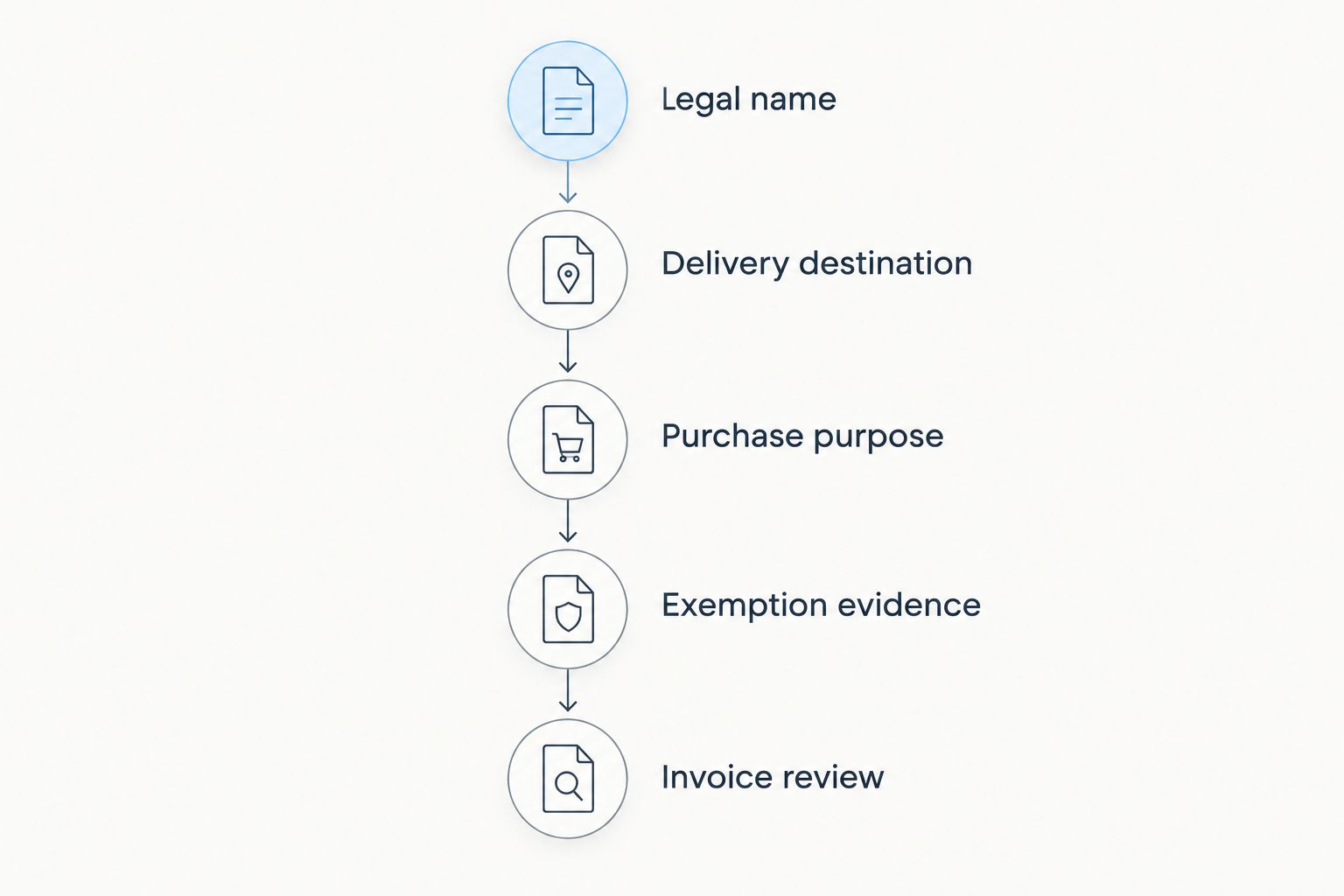
A useful purchasing file answers the seller's tax questions without mixing them with artwork or event instructions. Organize the information under the following headings:
- Legal name: The purchasing organization's name as shown on its exemption evidence.
- Delivery destination: The location receiving the merchandise.
- Purchase purpose: Whether the items support organizational use, distribution, or resale.
- Exemption evidence: The required approval, certificate, or supporting document.
- Invoice review: The final record showing the purchase and its tax treatment.
The file is an organizational aid, not a substitute for the state's required form. Follow the certificate instructions and complete all applicable fields accurately.
Assign responsibility for the file before handing purchasing duties to a volunteer. The person choosing merchandise does not need to interpret tax law, but that person does need an approved purchase purpose and the correct documents.
For customized merchandise, keep artwork approval separate from exemption confirmation. Approving a design does not establish that the order qualifies for tax-exempt treatment.
Can a volunteer buy the merchandise and get reimbursed?
A volunteer's personal purchase is not automatically an exempt purchase by the nonprofit. Check the state's direct-purchase and payment requirements before using a personal account or payment method.
A reimbursement record shows that the nonprofit repaid someone; it does not necessarily establish that the original transaction met the exemption rules. When required, purchase in the organization's legal name and pay through the organization.
Confirm the purchasing arrangement before checkout. Correcting the buyer identity after an order is completed is not a substitute for following the exemption requirements at the time of purchase.
Does a larger order make a nonprofit tax-exempt?
A larger order does not establish sales-tax eligibility. The organization's status, the transaction, and the required documentation determine whether an exemption applies.
Keep your quantity decision separate from your tax decision. Choose the order size from your program, distribution, or resale needs; then evaluate the exemption that applies to that purchase.
This distinction also prevents an inaccurate internal promise. Tell your event team that exempt treatment requires confirmation, not that ordering more automatically removes tax.
What if sales tax appears on an eligible order?
Ask the seller to review the transaction and explain the applicable correction process. Supply the invoice and the documentation supporting your claim; do not assume a certificate submitted later automatically creates a refund entitlement.
State rules determine whether a seller adjustment, purchaser refund claim, or another procedure is available. Follow the relevant revenue agency's instructions if the seller cannot resolve the issue.
For recurring 2026 orders, address the cause before the next purchase. An incorrect buyer name, a different delivery destination, or incomplete documentation needs correction—not merely a note asking to omit tax.
Where Wholesale For Everyone fits
Wholesale For Everyone is a fit for nonprofits sourcing bulk apparel and accessories. The business serves nonprofit organizations and offers bandanas, hats, caps, handkerchiefs, pet accessories, and other merchandise.
Wholesale For Everyone also offers custom printing and embroidery on selected products. That makes customization a relevant purchasing consideration for nonprofit events, branded merchandise, and fundraisers; it does not establish any sales-tax exemption.
Use Wholesale For Everyone to explore merchandise, and confirm the documentation process before assuming an order will receive exempt treatment. The limitation is clear: product selection and customization services do not establish your organization's legal eligibility.
Explore merchandise for your nonprofit
Review apparel and accessories, then confirm exemption documentation before ordering.
FAQ
Can nonprofits get tax exempt pricing on bulk apparel orders?
Yes, nonprofits can receive sales-tax-exempt treatment when the applicable state rules cover the organization and purchase. Bulk quantity alone does not qualify an order, and exempt treatment is not a separate merchandise discount.
Does a federal nonprofit determination letter remove sales tax?
No, a federal determination letter does not automatically remove state sales tax. It documents federal recognition; the state determines the purchase exemption and required evidence.
Is an EIN enough to place a tax-exempt order?
No, an EIN does not establish sales-tax exemption. Submit the certificate, approval, or other evidence required for the applicable exemption.
Can a nonprofit use a resale certificate for fundraiser merchandise?
A nonprofit can use a resale certificate when it qualifies under the applicable state’s resale rules and buys the goods for resale. Review the nonprofit’s tax obligations on the later fundraising sale separately.
Can a volunteer use a personal card for an exempt nonprofit purchase?
A volunteer’s personal payment does not automatically qualify for the nonprofit’s exemption. Check the state’s purchaser and payment requirements before ordering, rather than relying on reimbursement afterward.
Does exemption approval in one state cover purchases everywhere?
No, approval in one state does not establish eligibility for every other state. Check the rules governing the destination transaction and the documentation accepted there.
Does Wholesale For Everyone automatically remove tax for nonprofits?
Do not assume automatic tax removal when ordering from Wholesale For Everyone. Confirm the seller’s documentation process and the applicable state exemption before the order is processed.
What should a nonprofit review before its next bulk order?
Review the legal purchaser, delivery destination, merchandise use, exemption evidence, and final invoice. For 2026 orders, confirm that the documentation remains valid and covers the transaction.
One last thing
A charitable use does not automatically turn a purchase into an exempt transaction. Donating merchandise, using it in a program, and buying it for resale each require the appropriate tax analysis.
Before ordering, write one sentence explaining who is buying the goods and what happens to them after delivery. If your purchasing team cannot agree on that sentence, resolve the purpose before signing an exemption certificate.
Related guides
- Wholesale bandanas for nonprofit fundraisers
- Connecting bulk bandana orders to your fundraising campaign page
- Wholesale caps for churches