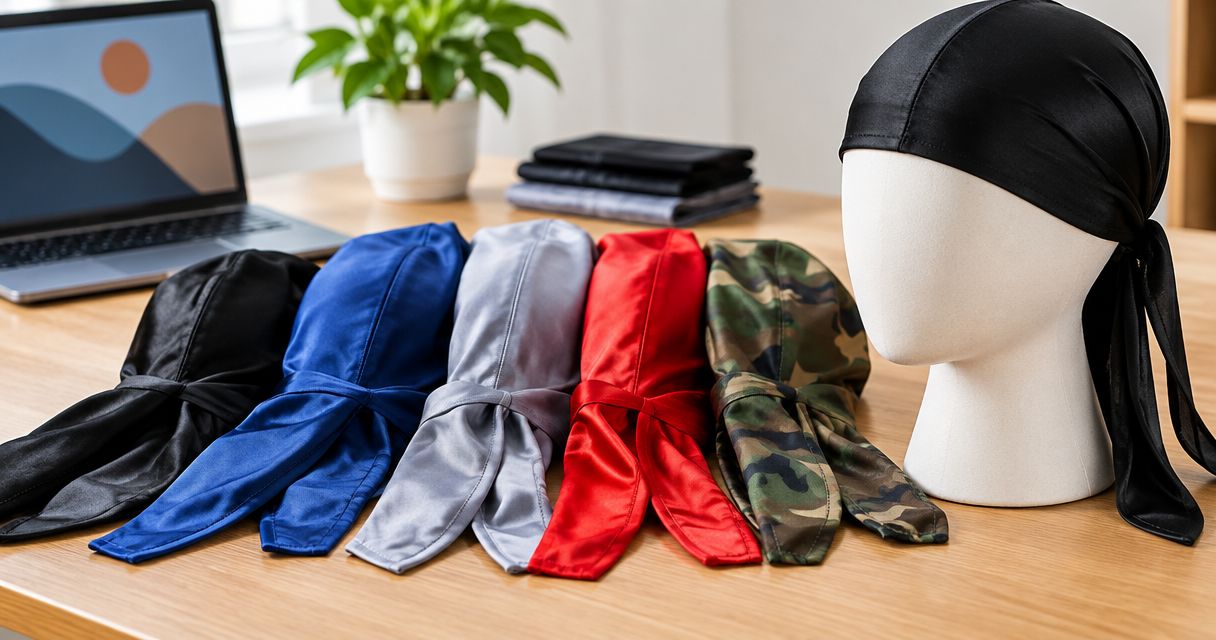
Best overall for everyday wholesale orders: cotton doo rags. Best for a smooth hair-contact surface: polyester satin; best for buyers specifically seeking silk: verified silk satin. This 2026 guide ranks doo rag materials by intended use, separates fabric facts from sales language, and identifies documented cotton options from Wholesaleforeveryone.
- Cotton is the best default doo rag material for everyday wholesale orders with clearly documented fiber content.
- Wholesaleforeveryone lists cotton doo rags with hemmed, stitched edges; compare fit before choosing a pattern.
- Satin describes a weave, not a fiber: polyester satin and silk satin are different purchasing choices.
- Choose wholesale head wraps by fiber, inner surface, fit, and care instructions—not appearance alone.
Why material matters more than the pattern
A doo rag touches your hair, rests against your skin, and stays in place through its construction and ties. A print tells you what it looks like. It does not tell you what the fabric contains, how the inside feels, or whether the fit suits your customer.
For a 2026 wholesale order, start with the job: everyday head coverage, a smooth surface against hair, a preference for natural fibers, or a stretch fit. Those are different requirements. No material wins every category.
Wholesaleforeveryone is a useful starting point for everyday cotton doo rag buyers because several listed styles explicitly identify their fiber content. That makes comparison possible without treating a product photograph as a fabric specification.
What makes the best wholesale doo rag?
Use these criteria before comparing designs or quantities:
- Fiber disclosure: Look for named fibers and percentages. “Silky” and “premium” do not identify composition.
- Hair-contact surface: Inspect the inside, including seams. A smooth exterior does not establish a smooth interior.
- Fit and ties: Check coverage, tie placement, and whether the wrap stays comfortable without excessive tension.
- Edge construction: Examine stitching and hems for roughness, loose threads, or awkward bulk.
- Care instructions: Match the washing and drying requirements to how your customers actually maintain accessories.
- Order clarity: Confirm the exact style and package quantity. Similar names do not make listings interchangeable.
For your 2026 buying sheet, record these details separately. A single column labeled “quality” hides the differences you need to judge.
Doo rag materials at a glance
The ranking below compares material choices, not four confirmed product lines from one supplier. The supplied Wholesaleforeveryone listings document cotton styles; they do not establish silk, polyester satin, or stretch-blend specifications.
| Rank and material | Best for | Standout feature | Key limitation |
|---|---|---|---|
| 1. Cotton | Everyday head coverage and print-led assortments | Absorbent natural fiber; documented cotton examples below | Not equivalent to a smooth satin hair-contact surface |
| 2. Polyester satin | Buyers prioritizing a smooth surface against hair | Satin weave provides a smooth face | Fiber content alone does not establish fit or comfort |
| 3. Silk satin | Buyers specifically requesting silk | Combines silk fiber with a satin weave | Requires clear composition and care information |
| 4. Stretch blends | Buyers prioritizing flexible fit | Elastane-containing fabric adds stretch | Blend percentage and construction need verification |
Choose by the customer's use case, not by the rank alone. Cotton leads this guide as the everyday default, not as a substitute for every hair-care accessory.
1. Cotton: best doo rag material for everyday wholesale orders
Cotton is an absorbent natural fiber used in everyday apparel and accessories. For a doo rag assortment centered on head coverage and printed designs, it provides a straightforward material specification to compare across styles.
The Woodland Camo Doo Rag, Woodland Camo Doo Rag with White, Checkerboard Doo Rag, and both listed tossed-skull designs explicitly state 100% cotton. Their descriptions also identify a hemmed, stitched edge finish. Those are documented specifications, not conclusions drawn from their photographs.
Cotton pros:
- Named fiber content makes material comparisons straightforward.
- Absorbency suits buyers seeking an everyday fabric rather than a glossy finish.
- Several listed designs share the same stated cotton composition and edge finish.
Cotton cons:
- Cotton is not a substitute for a specifically requested satin surface.
- Absorbing moisture is different from moving moisture away from skin.
- Matching composition does not prove identical fit, softness, or wash performance.
Best for: Everyday accessory assortments, clubs, events, and customers choosing primarily between printed head wraps.
Before ordering deeply, handle a sample and inspect the inside seam. Read the care label rather than assigning a wash method to every cotton item. Verdict: Buy cotton for everyday coverage when the sample meets your fit and comfort requirements.
Documented cotton styles to compare
Start with Woodland Camo Doo Rag and Checkerboard Doo Rag if you want different patterns with the same stated fiber composition. Both descriptions identify 100% cotton and hemmed, stitched edges. Neither description establishes protective performance, a particular compression level, or a guaranteed hair result.


2. Polyester satin: best doo rag material for a smooth surface
Polyester satin combines a synthetic fiber with a satin weave. Satin describes fabric construction, not silk content; a polyester satin doo rag is not a silk doo rag.
Choose this category when your main requirement is a smooth hair-contact surface. Inspect the side that actually touches the hair, because seams, exposed stitching, and fabric orientation still matter.
Polyester satin pros:
- The satin face provides a smooth surface.
- Clear polyester labeling separates fiber facts from “silky” descriptions.
- It gives buyers a non-silk route to a satin weave.
Polyester satin cons:
- A glossy photograph does not establish the inner surface or construction.
- Polyester composition alone does not prove moisture-wicking performance.
- A smooth fabric cannot compensate for uncomfortable ties or poor coverage.
Best for: Customers whose first requirement is a smooth fabric surface rather than cotton absorbency or silk fiber.
Ask for the fiber label, care instructions, and an inside view before committing. Do not assume that the named cotton products elsewhere in this guide belong to this category. Verdict: Buy verified polyester satin for surface smoothness; hold any listing that substitutes “silky” for composition.
3. Silk satin: best doo rag material for buyers requesting silk
Silk satin combines silk fiber with a satin weave. “Silk,” “satin,” and “silky” are not interchangeable terms, so a silk-specific purchase requires an explicit fiber statement.
This category belongs on your shortlist when customers request silk itself. Do not promote another fabric as silk because it has a shiny finish or a smooth feel.
Silk satin pros:
- It meets a silk-fiber preference when the composition is verified.
- The satin weave provides a smooth face.
- Accurate labeling gives staff a clear distinction to explain to customers.
Silk satin cons:
- The name alone does not establish fiber purity or blend composition.
- Care requirements need checking before you recommend a cleaning method.
- Silk content does not establish tie comfort, coverage, or hair results.
Best for: Buyers who specifically want silk and accept the care instructions attached to the actual item.
For your 2026 assortment, keep silk claims attached to the exact verified listing. A general collection heading is not enough evidence for every item underneath it. Verdict: Hold until the fiber composition and care instructions explicitly support the silk claim.
4. Stretch blends: best doo rag material for flexible fit
Stretch blends combine a base fiber with a stretch component such as elastane. The useful buying question is not simply whether the fabric stretches, but whether the finished wrap fits comfortably and returns to shape after use.
A blend needs a complete composition statement. Cotton with elastane and polyester with elastane are not the same fabric, even when both listings use the word “stretch.”
Stretch-blend pros:
- A stretch component adds flexibility to the fabric.
- This category suits buyers who prioritize fit over a particular surface finish.
- A disclosed blend lets you distinguish the base fiber from the stretch component.
Stretch-blend cons:
- “Stretch” alone does not disclose composition.
- More tension is not automatically more comfortable.
- Fit depends on the cut and ties as well as the fabric.
Best for: Customers seeking flexible fit who can assess a sample before a larger order.
Check the wrap while tied normally, not only while stretching an untied fabric panel. Reject a sample that needs excessive tightening to stay positioned. Verdict: Buy only after a comfortable fit check and complete blend disclosure.
Check a sample before choosing your order quantity
A material label narrows the choice; a sample helps you judge the finished accessory. Use the same sequence for each candidate so a striking print does not distract you from an uncomfortable seam.
- Read composition. Record the exact fiber statement without translating “premium” into a material claim.
- Inspect seams. Turn the wrap over and check the surface that will touch the hair and forehead.
- Check fit. Tie the wrap comfortably and assess coverage, stability, and pressure.
- Follow care. Use the stated care instructions, then inspect the fabric and stitching again.
- Confirm quantity. Match your selection to the exact package title before submitting an order.

Use a consistent tying method when comparing samples. The guide to how to tie a doo rag helps separate a tying problem from a material or construction problem.
Record what you actually observe rather than assigning an unsupported durability score. “Seam feels rough against the forehead” is useful purchasing feedback. “Lasts longer” requires evidence beyond an initial inspection.
Separate material choice from package choice
Several supplied product titles distinguish 1 piece from 12 pieces. Those are package quantities, not fabric grades. A larger package does not establish thicker material, stronger stitching, or a different fit.
Keep the full title on your purchasing sheet. Woodland Camo Doo Rag and Woodland Camo Doo Rag – 12 pieces are separate listings, and the material description supplied for one should not silently become a specification for every related package.
For a 2026 repeat order, retain the exact item name, package quantity, composition statement, and sample notes. Recheck the current listing rather than relying on a remembered photograph.
If your order needs branding, confirm that the selected product is eligible for the requested service. Custom printing and embroidery on selected products do not establish that every doo rag accepts either process.
How the materials rank
This 2026 ranking prioritizes a clear match between material and intended use: cotton for everyday coverage, polyester satin for a smooth surface, silk satin for a silk-specific request, and stretch blends for flexible fit. Fiber disclosure, inside finish, fit, care, and order clarity determine whether an actual item earns the recommendation.
The ranking is a buying framework, not a laboratory performance test. Pattern names do not affect the material order, and no hair-growth, wave-formation, or protective-performance claim is part of the verdict.
Which wholesale doo rag should you choose?
Start with a documented cotton doo rag for an everyday assortment, then approve the fit before ordering more. Woodland Camo Doo Rag and Checkerboard Doo Rag are concrete comparison candidates because their supplied descriptions identify cotton and edge construction.
Choose a different material only when the customer's requirement calls for it. A smooth-surface request points toward verified satin; a silk request requires silk labeling; a flexible-fit request requires a disclosed stretch blend and a comfortable sample.
Keep Wholesaleforeveryone doo rag selections tied to the facts on each item. A clear composition statement is a better buying signal than an unexplained quality adjective.
FAQ
What’s the best doo rag material for a wholesale order?
Cotton is the best default for everyday head coverage when the item clearly states its composition and passes a fit check. Choose verified satin instead when a smooth hair-contact surface is the main requirement.
Is a satin doo rag the same as a silk doo rag?
No. Satin is a weave, while silk is a fiber; satin can be made from silk, polyester, or other fibers. Check the composition statement rather than treating the terms as interchangeable.
Which listed doo rags state that they are cotton?
The supplied descriptions for Woodland Camo Doo Rag, Woodland Camo Doo Rag with White, Checkerboard Doo Rag, and both tossed-skull designs state 100% cotton. Keep that specification attached to the exact listing rather than assuming it applies to every similarly named package.
Does a silky-looking doo rag contain silk?
A silky appearance does not establish silk content. Look for an explicit fiber composition statement before describing the item as silk.
Should I choose cotton or satin for waves?
Choose based on the finished wrap’s surface and fit rather than expecting a material alone to create waves. A verified satin surface addresses a smoothness requirement, while the supplied cotton listings document a different fabric choice.
Does a 12-piece doo rag package have better material?
A 12-piece package identifies quantity, not a higher fabric grade. Compare the exact product specifications and sample before treating two package listings as equivalent.
Can every doo rag be custom printed or embroidered?
Customization must be confirmed for the selected item. The brand offers printing and embroidery on selected products, which does not establish eligibility for every doo rag.
What should I check before repeating a wholesale order in 2026?
Recheck the exact item title, package quantity, fiber statement, and care instructions. Compare those details with your approved sample notes rather than ordering from the pattern name alone.
One last thing
A glossy surface cannot tell you which fiber you are buying. Put fiber content and fabric construction in separate fields on your purchasing sheet: cotton describes a fiber, while satin describes a weave. That distinction prevents a misleading comparison before the order reaches checkout.
Related guides
- Best wholesale doo rags for barbershops and salons
- Wholesale doo rags for gyms and fitness studios
- Custom embroidered apparel for small businesses