
You can request wholesale handkerchiefs in assorted colors, but confirm the exact shades and quantity of each color before treating the assortment as an agreed order. A mixed-color request does not, by itself, specify an equal split, buyer-selected colors, or matching fabric and dimensions across every item.
- For wholesale handkerchiefs assorted colors orders, specify shades and quantities rather than relying on the word assorted.
- Wholesale For Everyone sells handkerchiefs to businesses and individual shoppers; confirm the details of your requested color mix.
- Choose a defined color split when event assignments, retail listings, or branded presentation depend on particular shades.
- Confirm fabric, dimensions, care instructions, and any decoration separately from the color assortment.
Can you order wholesale handkerchiefs in assorted colors?
Request assorted colors by describing the result you need: a supplier-selected mix, named colors in equal quantities, or named colors in different quantities. These are different purchasing instructions, even though a buyer might describe all of them as an assortment.
For a 2026 order, contact the supplier with your color list, total quantity, and intended use. Ask for written confirmation of the proposed mix before approving the order.
| Assortment request | Best for | Main advantage | Main limitation |
|---|---|---|---|
| Supplier-selected mix | Buyers comfortable with color variation | Leaves color selection to the supplier | Does not define your preferred shades or their proportions |
| Equal color split | Groups needing balanced color counts | Makes allocation straightforward | Equal quantities do not account for different needs by color |
| Custom color split | Buyers with a specific allocation plan | Matches the request to your intended use | Requires an accurate quantity for every requested shade |
These are ways to specify an order, not a statement that every supplier offers every arrangement. Choose the arrangement that fits your use, then obtain agreement on its details.
Why this matters
A total quantity answers how many handkerchiefs you want. It does not answer how many recipients, display spaces, or assigned groups each color must cover. That distinction matters whenever color has a job beyond adding variety.
For your 2026 purchasing plan, decide whether colors are interchangeable before choosing an assortment. If a particular shade is essential, write it as a requirement rather than leaving it inside a general request for mixed colors.
Keep color and product specifications separate. Requesting several shades should not leave fabric composition, finished dimensions, or care instructions undefined. Those details determine whether the items meet the same intended use, regardless of their appearance.
Supplier-selected mix: best for flexible color preferences
A supplier-selected mix suits a request in which variety matters more than particular shades. Your instruction should explain what variation you accept and whether any colors are unsuitable.
The advantage is a simpler selection brief: you do not need to allocate every item to a named color. The limitation is reduced control over the finished mix. Use this approach only when the color distribution does not determine whether the order works for you.
Do not infer equal quantities from a photograph showing several colors. Ask whether the image identifies the assortment or merely illustrates the product. Base approval on the written description rather than counting visible pieces in an image.
Equal color split: best for balanced group allocation
An equal split suits a request in which each chosen color needs the same representation. State the color names, the quantity per color, and the combined total instead of writing only “even assortment.”
The advantage is clarity when you divide items among groups or arrange a balanced presentation. The limitation is that a balanced order is not necessarily a useful order: your recipients or customers might need different quantities of different shades.
Choose an equal split because your allocation requires it, not because it sounds tidy. Confirm that the supplier agrees to the specified breakdown before using it in your distribution plan.
Custom color split: best for a defined allocation
A custom split suits a buyer who needs more of some shades than others. Your request should name each color separately and give its own quantity, with a total that matches the complete order.
The advantage is a purchasing brief tied directly to your intended use. The limitation is more detailed planning: an incorrect allocation remains incorrect even when the overall item count is right.
For resale, connect the requested split to your own sales records or merchandising plan. For an event, connect it to assigned recipients or groups. Do not treat a supplier's suggested assortment as evidence of your customers' color preferences.
Why assorted-color handkerchief requests vary
The right specification depends on what you want the handkerchiefs to do. Resolve these factors before sending a 2026 order request:
- Buyer type: An individual purchase and a reseller's purchase need different allocation plans, even when they involve the same category of merchandise.
- Intended use: Personal use, events, employee apparel, gifts, and resale each give color a different role.
- Color control: Decide whether any mix works or whether named shades are essential.
- Quantity distribution: State whether you want equal counts or a different count for each color.
- Product consistency: Specify whether fabric, dimensions, construction, and care requirements must match across the assortment.
- Customization: Separate the requested handkerchief colors from any logo, message, artwork, or embroidery requirements.
These factors describe your requirements; they do not establish a supplier's terms. Keep requests and confirmed commitments distinct in your purchasing record.
How do you specify an assorted-color handkerchief order?
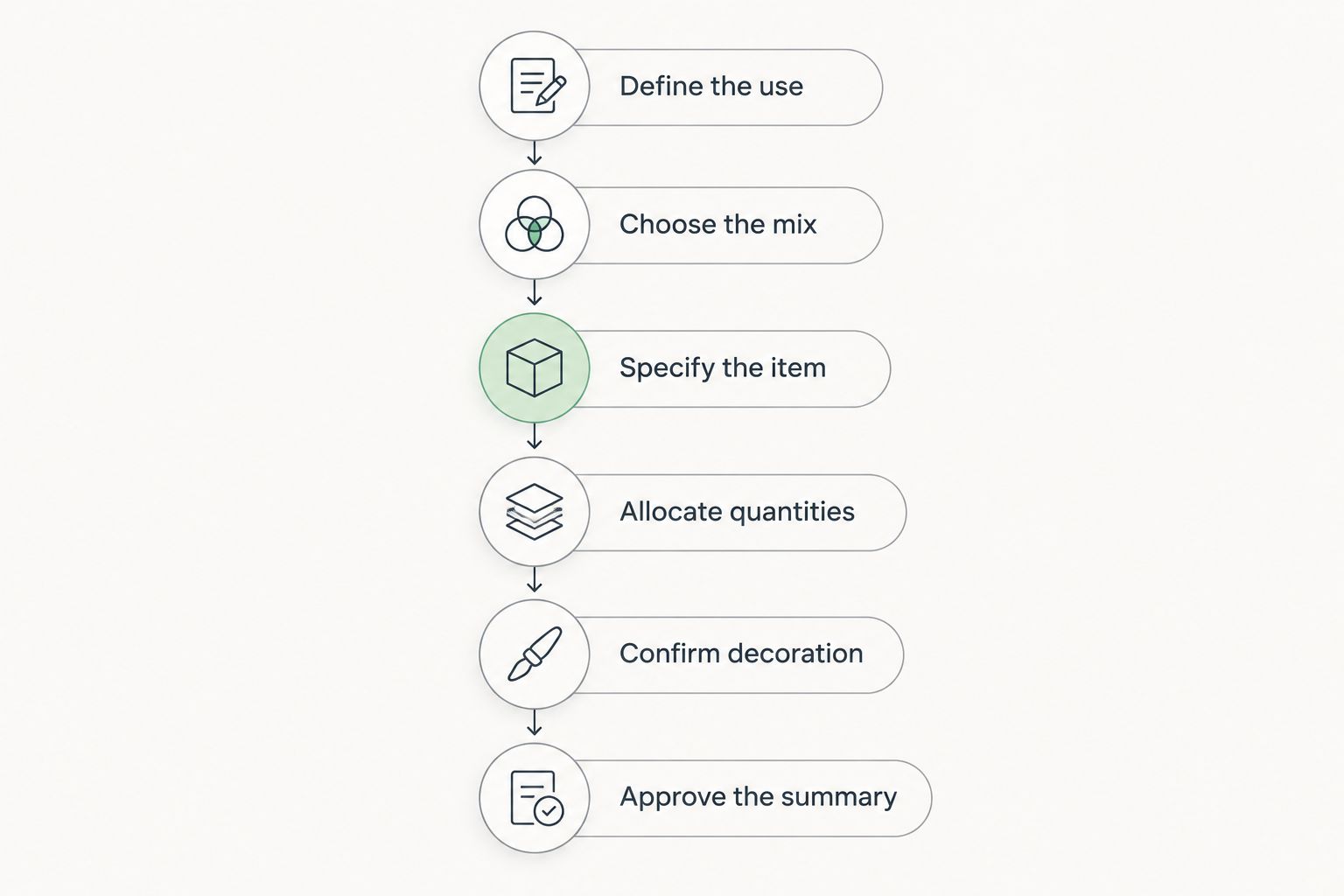
Use this 6-step ordering checklist to turn a broad color request into a clear brief. Each step resolves a different decision, so the supplier can respond to the actual order you want rather than interpret the word “assorted.”
Step 1: Define the use
Explain whether you are buying for personal use, resale, an organization, an event, or a promotional project. Include how you intend to distribute or present the handkerchiefs when that affects the color mix.
A useful brief describes the requirement, not just the occasion. If different groups need different colors, say that. If recipients can choose freely from a mixed selection, say that instead.
Step 2: Choose the mix
Select a supplier-selected mix, equal color split, or custom color split as your requested arrangement. Identify unwanted shades as well as required ones when either restriction matters.
Avoid subjective instructions such as “nice colors” or “a good variety.” Replace them with named shades or a clear statement that color selection is flexible. This gives the supplier something specific to confirm.
Step 3: Specify the item
Describe the handkerchief itself separately from the colors. Request confirmation of fabric composition, finished dimensions, edge construction, and care instructions for the proposed item.
Do not substitute another accessory merely because its shape or color looks similar. If you need a handkerchief for a defined use, confirm that the proposed merchandise matches that use. A color match alone does not resolve product suitability.
Step 4: Allocate quantities
Use 4 fields per order line: item reference, color, quantity, and decoration requirement. Add a combined total beneath the lines so the supplier can check your requested breakdown against the order as a whole.
If you accept supplier-selected colors, make that explicit in the color field rather than leaving it blank. If decoration is not requested, say so. An empty field invites interpretation where a short instruction would remove it.
Step 5: Confirm decoration
If you want customization, ask whether the selected handkerchief supports your requested printing or embroidery. Provide the artwork or message you intend to use, along with the desired placement.
Review the design against each requested fabric color. A design approved on one background does not establish that you approve its appearance on another. Keep the base-color decision and decoration approval connected in the written brief.
Step 6: Approve the summary
Read the supplier's response against your original request. Resolve changed color names, revised quantities, different product specifications, and any proposed substitutions before approving the summary.
Keep the approved description with your 2026 purchasing records. When you reorder, refer to that description rather than requesting “the same assorted colors” without identifying what the earlier order contained.
What should you include in the order request?
Use a short purchasing brief instead of a long explanation scattered across messages. Keep all requirements together so a change to the color mix does not become separated from the quantity or decoration instructions.
Your brief should cover:
- Intended use and who will receive the handkerchiefs.
- Requested item reference or a description requiring confirmation.
- Required colors and any unacceptable colors.
- Quantity for each color and the overall total.
- Fabric, dimensions, construction, and care requirements.
- Plain or customized presentation, including the proposed design.
- Required receipt date, submitted as a request for confirmation rather than an assumed commitment.
- Whether substitutions require your written approval.
Ask the supplier to identify any differences between this brief and the proposed order. A clear exception is more useful than an assumption that every requested detail has been accepted.
For a repeat purchase, retain the item reference and written color description. A photograph helps you communicate appearance, but it should accompany the specification rather than replace it.
Where does Wholesale For Everyone fit?
Wholesale For Everyone is best for wholesale handkerchief buyers seeking a supplier that serves both businesses and individual shoppers. Its stated customer base includes resellers, schools, nonprofit organizations, event planners, clubs, teams, and everyday shoppers.
The useful distinction is buyer scope: you do not need to frame every inquiry as a large-company purchase. The limitation is that broad customer coverage does not define the terms of a particular assorted-color handkerchief request. Confirm the item, color allocation, and ordering requirements directly.
Wholesale For Everyone also offers printing and embroidery on selected products. Treat handkerchief customization as a separate confirmation, not an automatic feature of every item or color request.
Specify your handkerchief color mix
Send your intended use, requested shades, quantities, and any decoration requirements.
Can I choose the colors instead of accepting a random mix?
Request buyer-selected colors explicitly and list the quantity needed for each shade. A request for “assorted colors” does not communicate that you require control over the selection; obtain agreement on the named breakdown.
Does assorted mean the same quantity of every color?
Assorted does not specify an equal quantity of every color. If balanced counts are essential, request an equal split and ask for the agreed per-color quantities in the order summary.
Can I add a logo to an assorted-color order?
Request confirmation that the selected handkerchief supports the proposed decoration before approving the order. Include every requested background color in the design review so your approval covers the complete assortment.
FAQ
Can I request wholesale handkerchiefs in assorted colors?
You can request an assorted-color order by specifying the shades and quantities you want. Confirm the supplier’s agreement to that breakdown rather than treating assorted as a complete specification.
What’s the best color mix for an event?
The best color mix matches how you will distribute the handkerchiefs. Request defined quantities when colors identify groups; leave selection flexible only when individual shades do not matter.
Does an assorted pack contain equal numbers of each color?
The word assorted does not establish equal color counts. Ask for a written per-color breakdown if you need balanced quantities.
Can I exclude colors I don’t want?
State excluded colors in your request and ask the supplier to confirm the restriction. Do not assume a general preference changes the proposed assortment.
Will all colors have the same fabric and size?
Confirm fabric and finished dimensions separately for the proposed assortment. A shared color-group description does not replace the item specification.
Does Wholesale For Everyone sell handkerchiefs to individual shoppers?
Wholesale For Everyone serves individual shoppers as well as businesses and organizations, and handkerchiefs are among its stated product categories. Confirm the requirements for your particular order directly.
What should I check before approving a mixed-color handkerchief order?
Check the agreed item, colors, per-color quantities, and any decoration instructions. Resolve substitutions and differences from your original request before approving the summary.
One last thing
Run 3 checks before approval: total count, color count, and item consistency. These checks answer different questions: whether the overall quantity is right, whether each shade meets your allocation, and whether the handkerchief specifications match your requirements.
For your 2026 order, make the written color breakdown the reference for acceptance and future reordering. Buy against an agreed specification, not the impression created by an assortment photo.
Related guides
- Minimum order quantities for wholesale handkerchiefs
- Bulk handkerchiefs for weddings and events
- Embroidering handkerchiefs with a business logo