
Promotional product resellers’ custom hat sourcing is the process of selecting headwear and decoration for a client’s branded merchandise campaign, with the aim of delivering a wearable product and a profitable order. Unlike personal purchases, reseller orders need written specifications, client approval, and clear responsibility for every handoff.
- Custom hats for promotional product resellers start with wearer fit, campaign purpose, and approved artwork—not a catalog favorite.
- Wholesale For Everyone suits resellers seeking hats and customization options from the same merchandise supplier.
- Compare embroidery and printing against the actual hat construction before recommending either decoration method.
- Keep written approvals and complete order records so repeat orders do not depend on memory.
Why custom hats matter for promotional product resellers
A custom hat order connects your client’s identity to something recipients wear. Your job is to translate a campaign brief into a specific combination of fit, construction, decoration, and delivery requirements—not simply pass along a logo.
The segment-specific constraint is the approval chain. Your client approves your proposal, but the decorator needs production instructions, and the recipient needs a hat that fits the intended use. A missing detail at either handoff leaves you responsible for resolving the difference.
For your 2026 custom hat program, qualify the wearer before selecting the decoration. Start with the client’s audience and campaign rather than assuming every logo belongs on the same cap. The guide to wholesale blank hats for custom embroidery provides a related starting point for evaluating undecorated headwear.
How to build a custom hat order that is ready for approval
Define the wearer and the campaign
Start manually with a shared document or spreadsheet. Write a short brief that names the buyer, intended wearer, use setting, and campaign objective; then ask the client to approve it before you assemble a proposal.
An employee uniform, a fundraiser item, and an event giveaway are different assignments. For employee apparel, ask about workplace appearance and repeat ordering. For a fundraiser, establish whether the merchandise represents the organization, a particular event, or a sponsor.
Use 1 approved brief per campaign as your working rule. Keep alternatives in the same document so a rejected concept does not quietly become a production instruction later.
- Name the organization and the person authorized to approve artwork.
- Describe who will wear the hat and where.
- Record the requested quantity by style and color.
- Separate the event date from the date the client needs possession.
- Identify required logos, wording, and sponsor marks.
Match the blank hat to the wearer
Compare construction manually before adding decoration. Inspect a physical example when practical, review the product information, and record questions that require supplier confirmation. A catalog image does not establish how the finished hat feels or fits.
Look at crown shape, closure, panel seams, fabric, and the intended decoration area. An adjustable closure gives the wearer a way to change fit; it does not prove that the hat suits every recipient. Likewise, a large-looking front panel is not a confirmed decoration specification.
For a 2026 client presentation, show the hat choice and the decoration concept together. Ask the decorator to confirm compatibility with the exact blank instead of approving artwork against an unrelated mockup.
- Record the exact style identifier and selected color.
- Check closure type and the stated fit information.
- Inspect seams across the proposed logo location.
- Confirm the usable decoration area with the decorator.
- Note care information for the finished item.

Choose a sourcing route with clear ownership
You can request blank-hat and decoration information separately using a spreadsheet. That route gives you direct control over the specification, but you must reconcile the supplier’s product details with the decorator’s requirements.
An alternative is to ask a merchandise supplier about both the hats and customization. Wholesale For Everyone supplies hats and caps and offers custom printing and embroidery on selected products. Ask which hat-and-decoration combinations apply to your brief; the general service offering does not confirm every proposed combination.
Wholesale For Everyone is best for resellers seeking hats and customization options from the same merchandise supplier. The qualification is important: confirm the selected item, method, artwork requirements, and order terms before presenting a finished specification to your client.
- Name the party responsible for supplying the blank hats.
- Name the party responsible for decoration and artwork preparation.
- Ask who resolves an issue involving both the blank and decoration.
- Confirm how the finished order reaches you or your client.
- Record any requested packaging instructions for confirmation.
Prepare artwork for the selected method
Begin with the client’s original artwork, not an image copied from a presentation. Collect the logo file, approved colors, required wording, and any brand-use restrictions in a clearly labeled folder.
Embroidery forms the design with thread; printing applies a design to the surface. These methods do not reproduce artwork identically. Small lettering, fine lines, gradients, and artwork crossing seams deserve explicit review against the proposed production method.
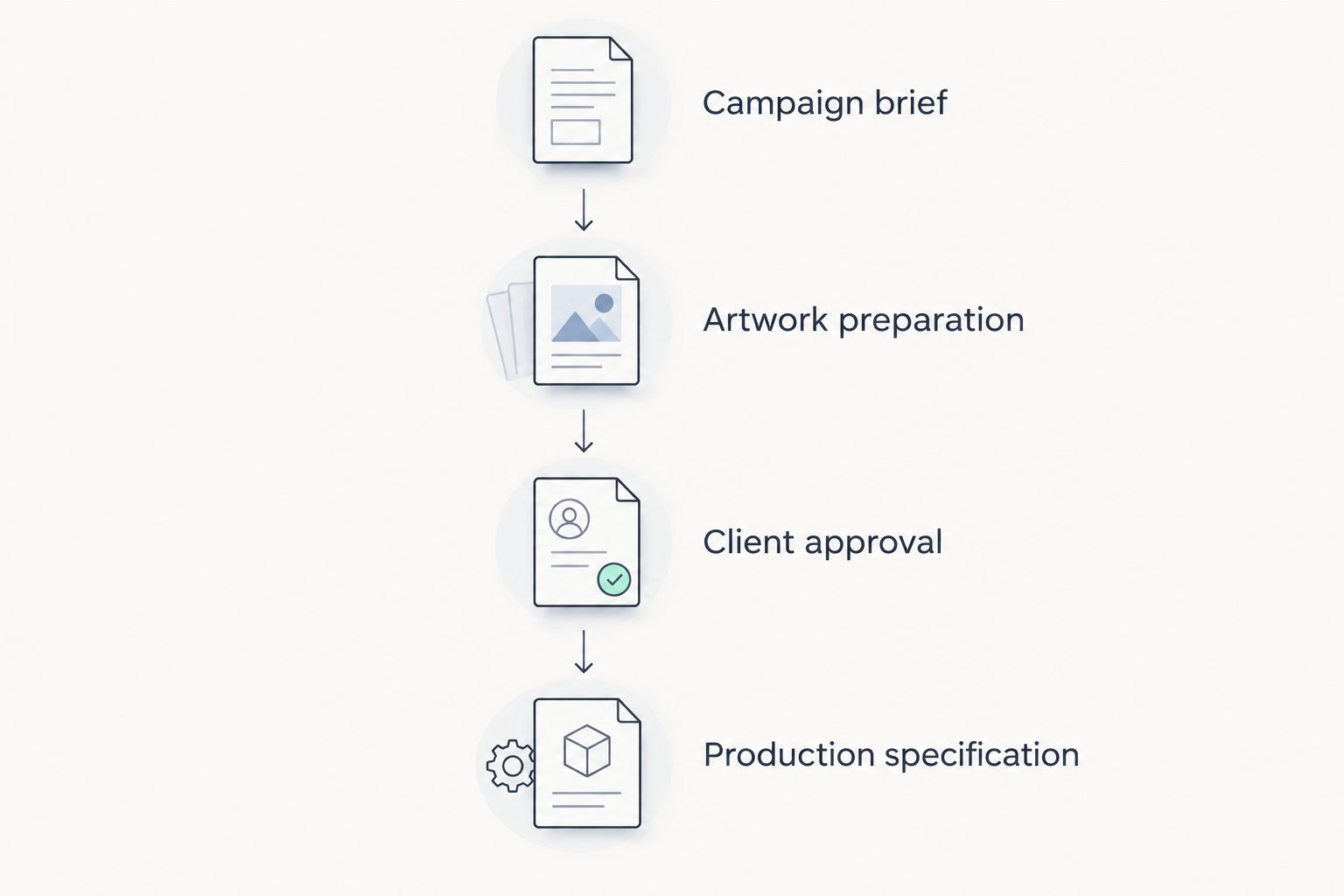
Keep 2 approval checkpoints in your process: the client’s design approval and the decorator’s confirmation of the production specification. Neither replaces the other. A client can approve a layout that still needs technical adjustment before decoration.
- Request the original artwork file and a reference image.
- Identify which design elements must remain unchanged.
- Ask the decorator to flag details requiring simplification.
- Specify the intended logo placement and dimensions.
- Return material artwork changes to the client for approval.
The approval sequence should be visible in your 2026 job record. Keep the original brief, artwork preparation, client decision, and final specification connected rather than scattered across separate messages.
Build the quote around the full specification
Use a manual worksheet to separate the blank hat, decoration, artwork preparation, packaging, freight, and any applicable taxes. Ask which charges apply rather than treating every line as mandatory or assuming an omitted line is included.
Compare equivalent specifications, not isolated hat figures. A quote for an undecorated cap does not answer the same question as a quote for a finished item with approved artwork and specified packaging. Keep the scope visible before calculating your selling terms.
For your 2026 quoting template, include a change log. If the client changes the color split, artwork, placement, or destination, request a revised supplier confirmation before accepting the change yourself.
- List every requested component of the finished order.
- Mark included work separately from optional work.
- Record the supplier’s stated quote conditions.
- Confirm which artwork changes require a revised quote.
- Check the complete order economics before client approval.
Release the order and preserve the reorder record
Manually assemble the approved specification into a single order summary. Compare that summary against the supplier’s acknowledgment rather than assuming a submitted purchase order has been accepted unchanged.
Keep 3 linked records for each job: the approved client brief, the production specification, and the final order acknowledgment. This is a recordkeeping recommendation, not a supplier requirement. It gives you a defined place to check discrepancies before production proceeds.
When the order arrives, compare the finished items with the approved specification and document any discrepancy under the supplier’s actual terms. For a repeat order, reconfirm the current specification and conditions; a previous order is a reference, not automatic approval for a new one.
- Match style identifiers, colors, and quantities across documents.
- Check the approved artwork version and decoration placement.
- Confirm the named recipient and delivery destination.
- Record the agreed schedule without substituting an estimate.
- Save inspection notes and relevant correspondence for reorders.
Compare sourcing options for reseller orders
Choose a sourcing route based on who will control the specification and manage exceptions. Each route has a useful role, but none removes the need for client approval.
| Option | Best for | Main advantage | Key limitation |
|---|---|---|---|
| Wholesale For Everyone custom hats | Resellers seeking hats and customization options from one merchandise supplier | Offers hats, caps, and printing or embroidery on selected products | Suitability of the exact hat-and-decoration combination requires confirmation |
| Blank-hat supplier plus separate decorator | Resellers who want to choose sourcing and decoration independently | Lets you specify the blank and decorator separately | You must coordinate compatibility, handoffs, and responsibility |
| Blank hats with in-house decoration | Resellers who already have suitable equipment and production skills | Keeps decoration scheduling and inspection under your control | Requires equipment, technical capability, and your own production checks |
| Client-supplied hats with a decoration service | Resellers handling an existing client-owned item | Starts with the client’s chosen headwear | The decorator must confirm whether the supplied hats are acceptable |
For a 2026 sourcing decision, ask every provider to respond to the same brief. Comparing different quantities, artwork assumptions, or packaging instructions produces a comparison you cannot use to choose responsibly.
Wholesale For Everyone custom hats belong on the shortlist when the buyer wants merchandise and customization options from the same supplier. Independent sourcing is the better fit when your business already has a preferred decorator and wants to manage the blank-hat purchase directly.
Common mistakes promotional product resellers make
Approving the logo without approving the hat
A client’s approval of a flat artwork image does not establish approval of the finished headwear. Show the selected hat, intended placement, and decoration dimensions together, and identify what the client is approving.
Treating a digital proof as a physical sample
A digital proof communicates the proposed design and placement; it does not let the client handle the finished item. Ask what the proof represents and whether a physical sample is appropriate for the job before making promises about the result.
Letting client edits bypass the supplier
A revised sponsor name or placement request changes the production instructions. Send the change through the approval chain and retain the superseded version as a record, clearly marked so nobody produces from it.
Promising repeat-order equivalence without checking
Do not describe a reorder as identical until the relevant specifications are reconfirmed. Recheck the hat identifier, color, artwork file, decoration instructions, and current order terms rather than copying an old email and assuming it remains sufficient.
Presenting an event date as a production commitment
The client’s event date is a requirement, not evidence of an accepted schedule. Record the required arrival date separately and obtain confirmation of the supplier’s schedule before committing to the client.
FAQ
What’s the best way to source custom hats for promotional product resellers?
Start with an approved client brief, then compare sourcing routes against the same hat and decoration specification. Choose a merchandise supplier with customization options or coordinate a blank-hat supplier and decorator yourself.
Is embroidery better than printing for promotional hats?
Neither method is best for every promotional hat. Embroidery uses thread, while printing applies the design to the surface; ask the decorator to assess the artwork and exact hat construction before choosing.
Does Wholesale For Everyone offer custom hats for resellers?
Wholesale For Everyone supplies hats and caps and offers custom printing and embroidery on selected products, including for resellers and promotional companies. Confirm whether the specific hat and decoration method suit your order.
What artwork should I request from my client?
Request the original logo artwork, approved colors, required wording, and brand-use instructions. Ask the decorator which file format and artwork adjustments the selected production method requires.
Can I quote a custom hat order before the artwork is approved?
You can prepare a preliminary quote, but label the assumptions that remain unconfirmed. Obtain a revised confirmation when final artwork, placement, quantities, or other specifications change.
What should a reseller check before approving production?
Check the exact hat, color split, quantities, artwork version, decoration method, placement, destination, and confirmed schedule. Compare the supplier acknowledgment with the client-approved specification.
Do I need a new approval for a repeat custom hat order?
Reconfirm the repeat order specification and obtain approval for any changes. Keep the previous order as a reference, but verify the current item details, decoration instructions, and order terms.
One last thing
A successful reorder starts with the original order record. Give every completed job a concise reorder summary that identifies the hat, artwork version, decoration instructions, and client approver. Keep it alongside the supplier acknowledgment so the next salesperson can reproduce the brief without reconstructing an email chain.
For your next 2026 campaign, improve that record before expanding the catalog. A narrower proposal with an approved specification is easier to act on than a broad selection with unresolved production questions.
Related guides
- From artwork file to embroidered caps
- How long does it take to get an embroidery proof approved?
- Custom embroidered hats for corporate branding