
Trucking and logistics crew doo-rag selection is the process of matching head coverings to driving, loading, and warehouse tasks with the aim of supporting comfortable, consistent workwear. This 2026 guide explains how to choose doo rags for trucking and logistics crews without confusing an everyday accessory with protective equipment.
- Choose doo rags for trucking and logistics crews by task, fit, and care requirements—not appearance alone.
- Wholesale For Everyone is best for crew buyers seeking doo rags alongside other everyday apparel accessories.
- Keep ties contained, check headrest comfort, and follow protective-equipment manufacturers’ instructions.
- Approve crew headwear before customization; a logo cannot fix an uncomfortable fit.
Why doo-rag selection matters for trucking and logistics crews
A driver sits against a headrest; a loader bends, reaches, and works around equipment. Your crew headwear needs to suit the actual assignment, not just match a uniform color. Start with the guide to tying a doo rag so everyone evaluates a consistent fit.
A doo rag is an accessory, not a substitute for required head protection, respiratory protection, or a workplace heat-safety program. Where protective equipment is required, its manufacturer’s instructions and your site’s safety rules govern what workers can wear with it.
Choose the workwear rules before choosing the merchandise. That keeps a personal comfort purchase separate from an equipment decision requiring safety approval.
Choose and introduce crew doo rags in 2026
1. Define the permitted tasks
Write a simple task list before asking employees to choose colors. Separate cab use, dock work, warehouse duties, and customer-facing stops rather than assuming the same headwear suits every setting.
Use a shared document or paper checklist first. Record who approves headwear and which work areas have restrictions. You do not need purchasing software to establish a clear rule.
For your 2026 headwear brief, use 3 approval checks: task permission, secure fit, and care instructions. These are purchasing criteria, not a claim that any particular doo rag is approved for industrial work.
- List the roles that will receive headwear.
- Identify equipment and site restrictions for each role.
- Record who can approve exceptions.
- Separate optional accessories from required protective equipment.
2. Test fit while parked and away from equipment
Ask wearers to put on the proposed style and perform ordinary movements in a safe setting. A driver should check seated comfort with the vehicle parked; warehouse staff should assess bending and reaching away from operating machinery.
Pay attention to the knot, seams, and loose fabric. A knot that presses against a headrest is a different problem from fabric that shifts toward the eyes. Tightening everything harder is not a substitute for a better fit.
Use 2 fit positions: seated and standing. This is a suggested evaluation method, not a safety certification. Stop the trial if the headwear causes discomfort or interferes with required equipment.
- Check that fabric stays clear of the eyes.
- Assess knot placement against the seat’s headrest.
- Keep ties and trailing fabric contained.
- Check compatibility with required equipment using its instructions.
- Ask each wearer to describe pressure, slipping, or irritation.

3. Compare the product details before ordering
Build a manual comparison sheet with a row for each candidate. Copy the stated material, care instructions, construction details, and customization information; leave unanswered fields as questions for the supplier.
Wholesale For Everyone offers doo rags alongside hats, caps, bandanas, and other everyday merchandise. That gives crew buyers a source for several accessory categories, but each item still needs its own fit and care assessment.
Wholesale For Everyone is best for crew buyers seeking doo rags alongside other everyday apparel accessories. The brand also offers printing and embroidery on selected products; confirm whether your chosen doo rag supports the requested decoration before treating it as a uniform option.
Do not infer fabric performance from a product photograph or a category name. Words such as cooling, protective, and moisture-wicking need product-specific support before they belong in your purchasing brief.
- Record the exact item description and material.
- Read the item’s stated care instructions.
- Ask about any missing construction details.
- Confirm customization eligibility for the selected item.
- Keep comfort preferences separate from verified product claims.
4. Match the headwear option to the assignment
Start with what employees need to wear, then compare the simplest suitable options. A tied doo rag, bandana, and cap are not interchangeable merely because all cover part of the head.
For a driver, the contact point behind the head deserves attention. For a worker near equipment, loose material deserves scrutiny. For customer-facing work, a consistent appearance matters only after the item passes your task and fit checks.
The comparison below is a selection framework, not a statement that any listed option is appropriate for every logistics workplace. None should be treated as required protective equipment without the relevant product documentation and workplace approval.
| Option | Best for | Practical advantage | Key limitation |
|---|---|---|---|
| Tied doo rag | Wearers who prefer adjustable tied headwear | Tie placement can be adjusted during fitting | Knots and loose ties need individual assessment |
| Folded bandana | Crews evaluating a fold-and-tie accessory | Folding allows different coverage arrangements | Fit depends on folding and tying technique |
| Cap | Workers who prefer brimmed headwear where permitted | Offers a different headwear format without a fabric tail | Brim and rear adjustment need checking for the task |
| Existing approved headwear | Crews whose current option already meets their needs | Avoids introducing another uniform item | Does not address an unresolved comfort complaint |
Keeping existing headwear is a valid decision. Do not add a doo rag simply to make a uniform program look more complete.
- Compare options against the same task list.
- Let wearers identify their preferred permitted format.
- Reject options that interfere with visibility or equipment.
- Keep an existing approved option when it works.
5. Approve appearance before customization
Use a written color description and a simple artwork mockup before requesting decorated merchandise. State whether the accessory is optional personal headwear or part of a customer-facing uniform; those are different purchasing decisions.
Wholesale For Everyone provides custom printing and embroidery services on selected products. The limitation is selection-specific eligibility: the service description does not establish that every doo rag can receive every design or decoration method.
For a 2026 uniform refresh, approve the undecorated fit first. Then review the proposed decoration location for comfort, legibility, and interference with seams or ties. Artwork approval does not replace checking the finished item.
- Specify the intended color in writing.
- Provide the approved logo or artwork file.
- Confirm the selected item’s decoration eligibility.
- Review placement before authorizing customization.
- Keep the approved artwork with the order record.
6. Plan issue quantities around actual use
Count the people who have opted into an approved headwear option. Then ask how employees will clean, dry, store, and replace their own items. A roster alone does not explain how many pieces your program needs.
Use a spreadsheet before adopting a more complicated inventory process. Separate initial issue, planned rotation, and unassigned replacements so each part of the request has a reason. Avoid turning an arbitrary bundle size into a crew requirement.
Keep 1 order record per approved item with the description, intended role, care information, and customization decision. This is a recommended recordkeeping rule, not a supplier ordering requirement.
- Count participating wearers rather than total payroll.
- Document the intended cleaning and rotation routine.
- Separate assigned pieces from replacement pieces.
- Record who authorizes replacement requests.
- Confirm the item description before repeating an order.
7. Check wear and care before expanding the program
Start with a limited wearer evaluation before making a wider uniform commitment. Ask the same questions across roles so you can distinguish a fit issue from a preference for another headwear format.
Follow the product’s care label rather than a generic internet washing routine. Do not assume that decoration, fabric, and ties all tolerate the same treatment. A care instruction for a bandana is not automatically an instruction for a doo rag.
For your 2026 review, use this sequence: Wear trial, Care check, Crew feedback, Final approval. Keep the feedback specific enough to change a purchasing decision.
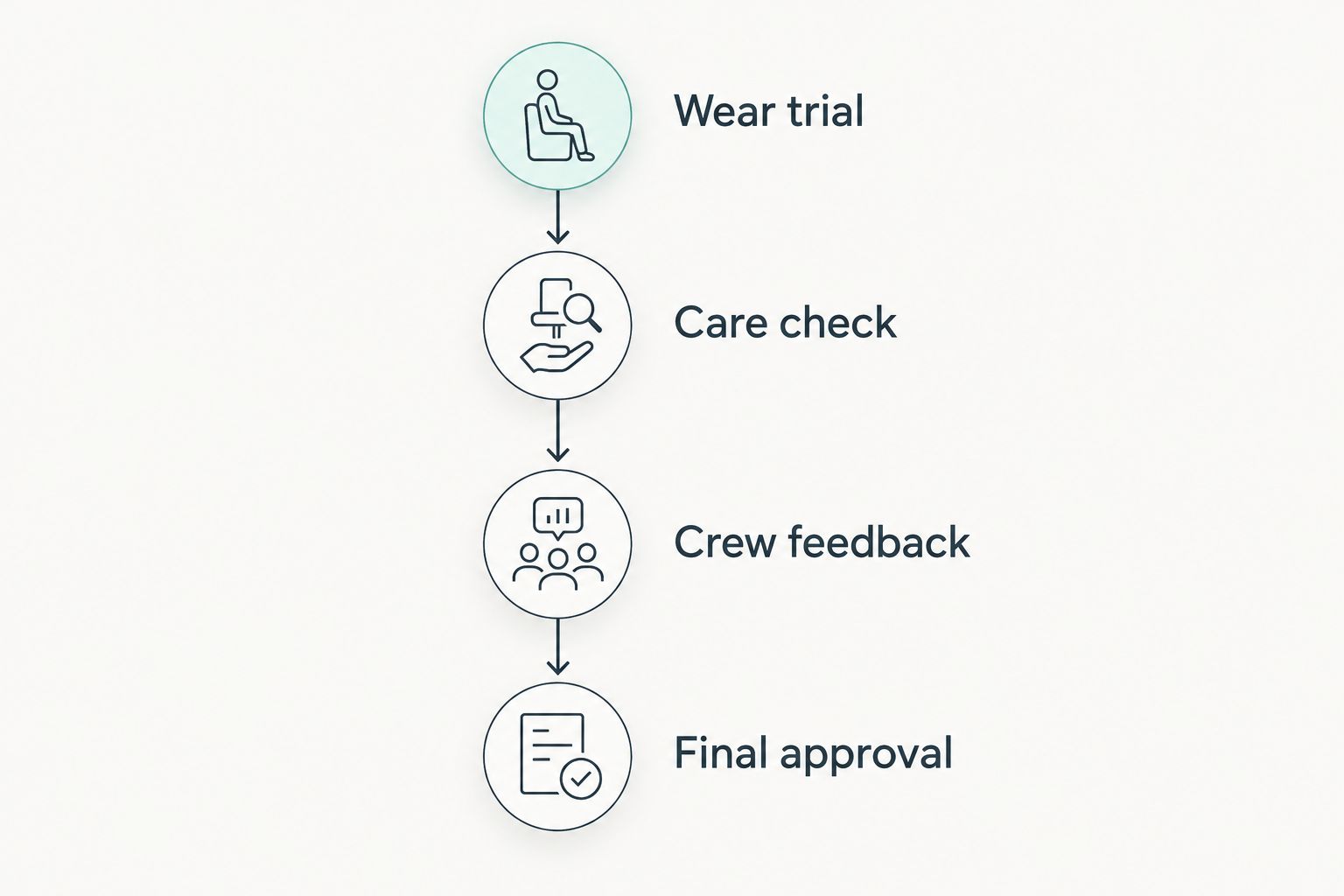
Ask whether the knot remained comfortable, whether the fabric moved, and whether employees understood the care directions. Record the result against the exact item rather than describing all doo rags as good or bad.
- Gather feedback separately from drivers and warehouse staff.
- Check for discomfort, slipping, and loose ties.
- Follow and document the stated care method.
- Inspect the item after cleaning before approving repeat use.
- Retain a permitted alternative for wearers who reject the fit.
Common mistakes trucking and logistics crews make
Treating an accessory as protective equipment
A doo rag does not establish compliance with a hard-hat requirement or provide evidence of heat, flame, chemical, or respiratory protection. Keep those decisions in the workplace’s protective-equipment process. Reject unsupported safety claims even when an accessory looks suitable.
Testing only in front of a mirror
A neat standing fit does not answer whether a knot presses against a driver’s headrest. Check seated comfort while parked and assess ordinary movement away from operating equipment. Appearance is only part of the approval.
Ordering one style for every assignment
Drivers, dock staff, and customer-facing employees do not necessarily prefer the same format. Give each role a clear list of permitted choices instead of assuming a shared uniform color requires identical headwear.
Decorating before checking the base item
A recognizable logo cannot correct slipping fabric, uncomfortable seams, or inconvenient care requirements. Approve the undecorated item first, then confirm decoration eligibility and placement. Keep the two decisions separate in the order record.
Leaving cleaning and replacements undefined
An issued accessory needs a stated care method and a clear replacement process. Without those instructions, supervisors have no consistent basis for answering routine questions. Assign responsibility before distributing the items, not after complaints arrive.
FAQ
What are the best doo rags for trucking and logistics crews?
The best doo rags for trucking and logistics crews are the ones that pass your task-permission, secure-fit, and care checks. Evaluate the exact item with wearers instead of choosing by appearance or an unsupported performance claim.
Can truck drivers wear a doo rag while driving?
Check the employer’s rules and assess fit with the truck parked before using a doo rag for driving. The headwear should stay clear of the eyes, and the knot should not cause discomfort against the headrest.
Can you wear a doo rag under a hard hat?
Use a doo rag under a hard hat only when the hard-hat manufacturer’s instructions and workplace rules permit that combination. An informal comfort check does not establish protective-equipment compatibility.
Is a doo rag better than a cap for warehouse work?
Neither format is automatically better for warehouse work. Compare permitted use, loose fabric, visibility, comfort, and interaction with required equipment for the actual assignment.
Can Wholesale For Everyone customize crew doo rags?
Wholesale For Everyone offers printing and embroidery on selected products, so confirm eligibility for the exact doo rag before ordering decoration. Also confirm the proposed artwork placement and review process.
How many doo rags should a logistics crew order?
Base the quantity on participating wearers, the planned cleaning rotation, and a documented replacement allowance. Keep those quantities separate so the order reflects your crew’s routine rather than an arbitrary bundle size.
How should crews wash their doo rags?
Follow the care instructions for the exact doo rag, including any instructions for decoration. Do not transfer washing settings from another accessory or assume every fabric tolerates the same treatment.
One last thing
The most useful purchasing question is whether an employee can explain why the item works for the assignment. Ask for a concrete answer: comfortable against the headrest, secure during permitted movement, or straightforward to care for under the stated instructions.
For your 2026 crew program, keep the existing approved option if the proposed doo rag does not solve a defined need. A smaller, clearly documented headwear program is better than a larger order built around an unresolved fit problem.
Related guides
- Custom embroidered apparel for small businesses
- Solid-color bandanas for team uniforms
- Wholesale hats for contractors and work crews