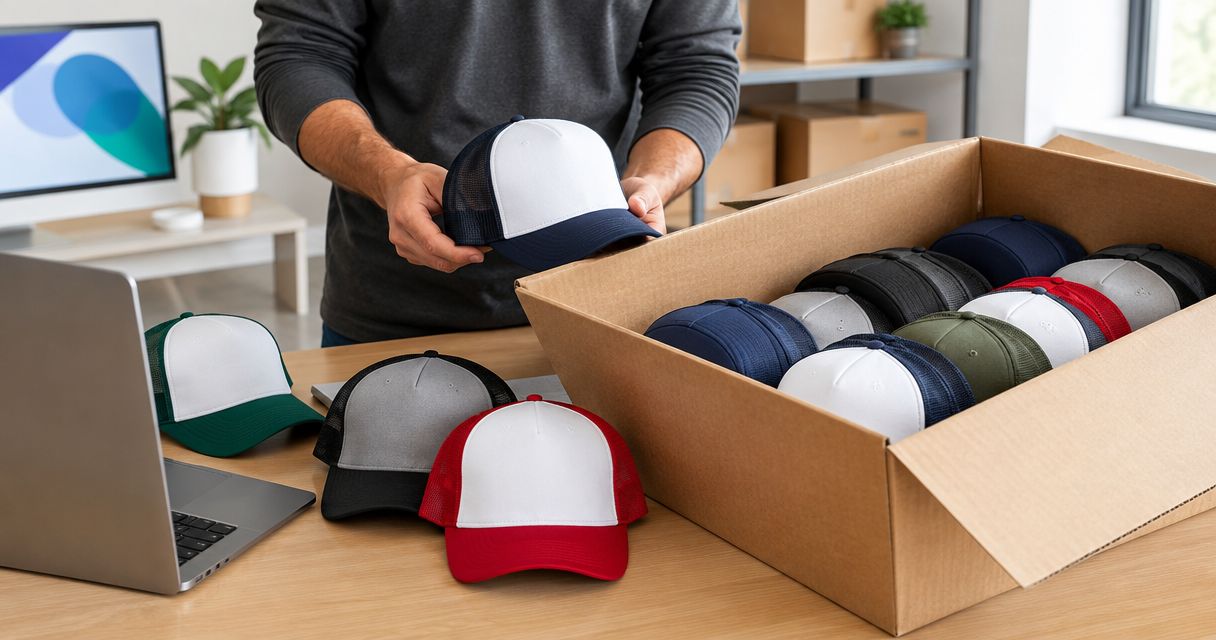
A dozen contains 12 hats, but the number of dozen in a full trucker-hat case depends on the case quantity stated for the exact item. Divide the confirmed hats per case by 12 to get the number of dozen. For a 2026 order, confirm whether the quantity describes an inner pack or the complete case before you approve the purchase.
- For trucker hats per case wholesale, divide the confirmed case quantity by 12; do not assume a standard case size.
- One dozen means 12 hats; a dozen listing does not establish the full-case quantity.
- Wholesaleforeveryone serves business, event, resale, and individual hat buyers; confirm packing details for the selected item.
- Record total hats and the color breakdown alongside the case count on your purchase order.
Why this matters
A case count is not a usable order quantity until you know how many hats each case contains. Writing only “one case” leaves the actual piece count undefined unless the order also identifies the applicable packing specification.
Before placing your 2026 order, ask about the selected hat's case quantity. Request the answer in individual hats as well as dozen so you can check it against your event allocation, resale plan, or customization instructions.
The calculation is simple. The purchasing decision requires more care: you need to know what the quantity covers, which colors it includes, and whether your requested order unit matches the seller's stated unit.
How many dozen trucker hats make up a full case?
The number of dozen in a full case equals the confirmed case quantity divided by 12. A dozen is a fixed counting unit; “case” must be tied to the selected item's packing details.
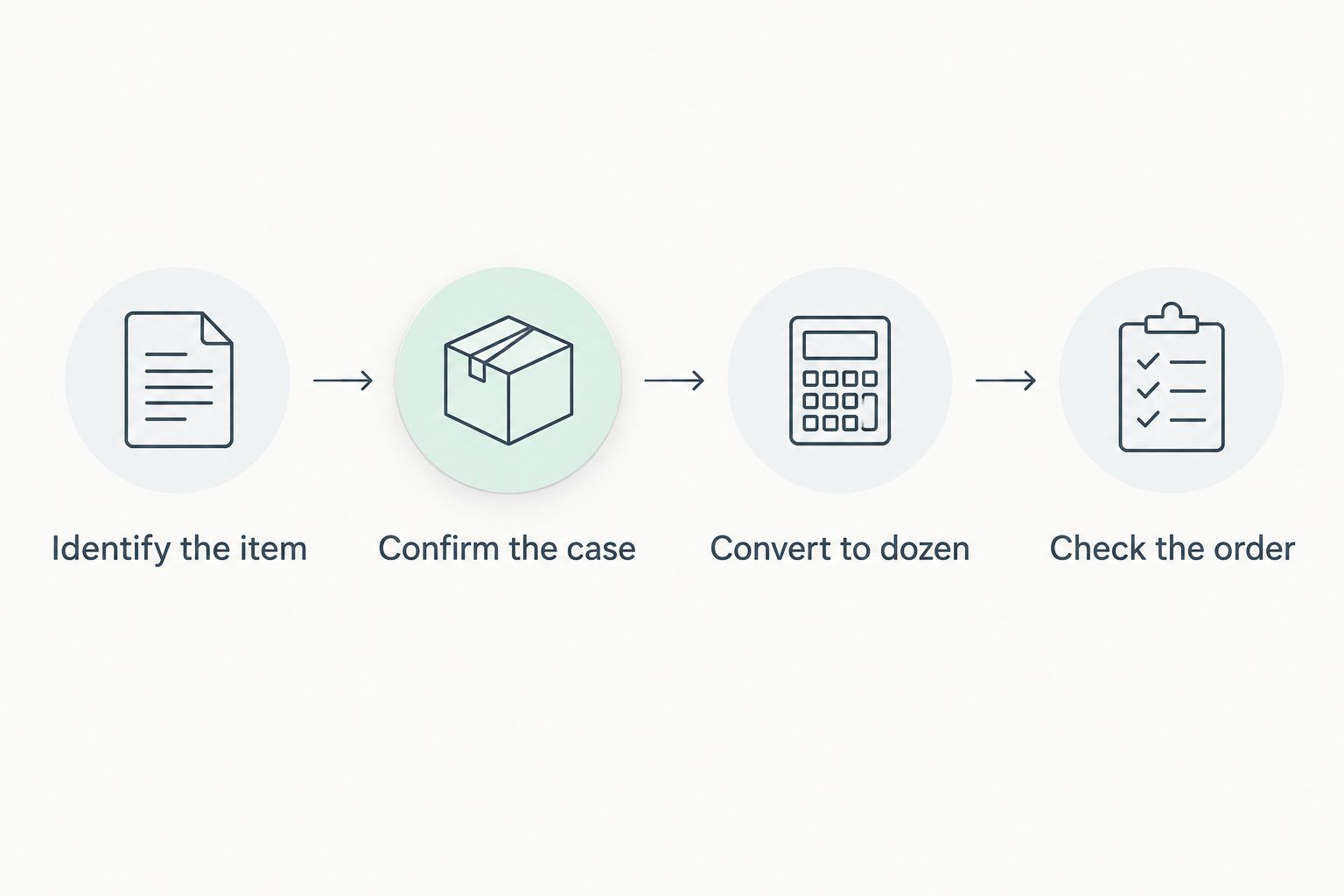
Use this sequence to establish the answer for your order:
- Identify the item. Record the exact hat name or item identifier from the listing or written confirmation.
- Confirm the case. Ask for the total number of individual hats in the complete case, not just an inner pack.
- Convert to dozen. Divide that confirmed total by 12.
- Check the order. Make sure the purchase order uses the same quantity and unit.
These are arithmetic conversions, not advertised trucker-hat case sizes:
| Confirmed number of hats | Equivalent in dozen | What the conversion establishes |
|---|---|---|
| 12 hats | 1 dozen | The dozen equivalent only |
| 24 hats | 2 dozen | The dozen equivalent only |
| 36 hats | 3 dozen | The dozen equivalent only |
| 48 hats | 4 dozen | The dozen equivalent only |
| 72 hats | 6 dozen | The dozen equivalent only |
| 144 hats | 12 dozen | The dozen equivalent only |
None of these totals establishes how a particular hat is packed. Use a row only after the seller confirms that its piece count applies to the complete case you intend to purchase.
What should a complete case confirmation say?
A useful confirmation identifies the hat, states the individual-hat quantity per complete case, and explains any inner-pack breakdown. It should also identify the color allocation relevant to your order.
Avoid treating a bare quantity as a complete answer. A number beside a product can describe a pack, a purchasing increment, or another unit; ask what the number measures before using it in your calculation.
One dozen: 12 hats
One dozen always equals 12 individual hats. That conversion does not establish whether a seller offers the selected trucker hat by the dozen, by individual piece, or by complete case.
If your requirement is expressed in dozen, convert it to hats before discussing packaging. You can then compare your required piece count with the confirmed order unit without changing units halfway through the conversation.
Keep both figures in your records. “One dozen, 12 hats total” is clearer than “quantity: one,” which leaves the reader to determine whether “one” refers to a hat, pack, or case.
Two dozen: 24 hats
Two dozen equals 24 hats, regardless of how those hats are packaged. A total of 24 hats is not evidence that the order represents a complete case.
This distinction matters when you are allocating merchandise. Your distribution plan concerns individual hats; the supplier's packing description concerns how those hats are grouped for the order.
Confirm the grouping separately. Do not label a two-dozen requirement as “one case” unless the selected item's confirmed full-case quantity is exactly 24 hats.
Twelve dozen: 144 hats
Twelve dozen equals 144 hats, but the arithmetic does not make 144 hats a universal trucker-hat case size. Use that total only when it matches the actual order requirement or a confirmed packing specification.
The conversion also works in reverse. Divide 144 hats by 12 hats per dozen and the result is 12 dozen; the calculation proves the unit conversion, not the contents of an unspecified carton.
For your 2026 purchasing records, preserve the original packing description beside the converted quantity. That gives whoever receives the shipment a clear basis for checking the order.
Why the case quantity needs item-specific confirmation
The useful question is not simply whether a supplier sells “cases.” It is what that word covers for the exact hat and order you are considering.
Check these details rather than borrowing a quantity from a different listing:
- Selected item: Tie the packing information to the exact trucker hat, not the general hats or caps category.
- Quantity unit: Establish whether the stated number means hats, dozen, packs, or complete cases.
- Packing level: Ask whether the description refers to an inner pack or the outer case.
- Color allocation: Confirm whether the quoted total covers a single color or a specified assortment.
- Customization scope: For decorated merchandise, confirm which individual hats the printing or embroidery request covers.
These checks do not assume that any particular packing arrangement is offered. They identify the details you need before describing an order as a full case.
Do not transfer a packing quantity from one hat to another without confirmation. A matching category name is not a packing specification, and a previous order is not the written specification for a new item.
How do I tell a dozen pack from a full case?
A dozen pack contains 12 hats; a full case contains the quantity specified for that case. The terms describe different things: one gives a fixed count, while the other identifies a packing unit.
Read the complete quantity description rather than stopping at the word “pack.” If the listing does not connect the pack count to the full-case count, request that connection in writing.
When receiving the order, compare the packing information with the purchase order. Check the individual-hat total and the agreed color allocation, not just the number of boxes delivered.
Does buying a full case mean I must order by the dozen?
A dozen means 12 hats, but it does not establish an ordering requirement. Ask whether the selected item is ordered in individual pieces, packs, dozen, or complete cases.
Separate the required quantity from the permitted ordering increment. Your desired number of hats and the seller's order unit must be reconciled before you approve the order; neither can be inferred from the word “wholesale.”
Can a case count tell me how many hats I can customize?
A dozen represents 12 hats, but a case count alone does not define a customization order. Confirm the selected product's suitability, the quantity to be decorated, and the artwork allocation separately.
Wholesaleforeveryone offers printing and embroidery on selected products. That service description does not establish that every trucker hat accepts every decoration method or that a case quantity also serves as a customization minimum.
Build a clear trucker-hat purchase request
Start with what you need to receive. Then ask the supplier to connect that requirement to the selected item's packing and ordering units.
For a 2026 purchase request, include these fields in plain language:
- Item identification: The exact selected hat and any identifier provided for it.
- Required hats: Your intended total expressed in individual pieces.
- Case quantity: The confirmed individual-hat count per complete case.
- Dozen equivalent: The confirmed total divided by 12.
- Color breakdown: The requested piece count for each color.
- Decoration instructions: Which hats require customization, if applicable.
- Order unit: The unit used for the quantity entered on the order.
Keep requests and confirmations distinct. Your preferred assortment is a request until the seller confirms it; a proposed quantity is not a confirmed packing arrangement.
Once the seller responds, read the purchase order from the receiver's perspective. Someone who did not participate in the conversation should still be able to determine exactly how many hats to expect.
Match the quantity to your intended use
The right buying unit starts with your required piece count, not with the appeal of ordering a “full case.” Establish your need before accepting a larger grouping.
| Buying approach | Best for | Advantage | Limitation to check |
|---|---|---|---|
| Individual-piece order, if offered | A specific piece requirement | Expresses the requirement directly | Must be an accepted ordering unit |
| Dozen-based order, if offered | Plans organized in groups of 12 hats | Makes dozen-to-piece calculations straightforward | Does not establish the full-case quantity |
| Full-case order, if offered | A requirement that matches confirmed case packing | Connects the order to a defined packing unit | The case total and assortment must fit the plan |
Choose the unit that fits the required hats and the confirmed ordering terms. None of these approaches is automatically the best choice for every buyer.
Wholesaleforeveryone serves wholesale hat buyers purchasing for businesses, events, resale, and personal use. For any of those uses, the practical next step is the same: identify the selected item and confirm its quantity details before committing.
For resale orders
Record the piece count by color or other selected variation, not just the combined total. Your resale records need to reflect what you actually intend to receive and list.
A complete case total answers “how many altogether?” It does not, by itself, answer “how many of each?”
For events and teams
Write the intended distribution quantity in individual hats. Keep any additional hats you choose to order visible as a separate planning decision rather than burying them in a case total.
For your 2026 event file, retain the quantity confirmation with the order approval. That keeps the purchasing unit and the distribution plan connected.
FAQ
How many dozen trucker hats are in a full case?
Divide the confirmed number of hats in the complete case by 12 to find the number of dozen. The selected item’s case specification determines the answer; the word case alone does not supply a count.
Does one dozen trucker hats mean 12 hats?
Yes, one dozen trucker hats means 12 individual hats. That fixed conversion does not establish how many dozen are packed in a complete case.
Are 144 trucker hats the same as 12 dozen?
Yes, 144 trucker hats equals 12 dozen. This is a unit conversion, not confirmation that a particular supplier packs 144 hats per case.
Is a dozen pack the same thing as a full case?
A dozen pack is not automatically the same thing as a full case. Confirm whether the selected item’s packing description identifies that pack as the complete case or as part of a larger packing unit.
Can I mix colors in a wholesale trucker-hat case?
Confirm mixed-color ordering for the exact item before placing the order. Ask for the individual-hat count by color so the assortment is clear alongside the overall case quantity.
Does a full-case quantity also set the embroidery minimum?
A full-case quantity does not, by itself, establish an embroidery minimum. Confirm product suitability, decoration quantity, and ordering requirements separately.
What should I ask before ordering wholesale trucker hats?
Ask for the exact item identification, individual hats per complete case, inner-pack breakdown, and color allocation. Confirm the ordering unit and any customization instructions before approving the purchase.
One last thing
Put the individual-hat total beside every case quantity. Even a correct dozen conversion cannot fix an order whose unit is unclear.
The strongest final check is simple: compare the item, total hats, color breakdown, and customization instructions across the request and confirmation. Approve the order only when those descriptions agree.
Related guides
- Best wholesale trucker hats for promotional giveaways
- Best wholesale blank hats for custom embroidery
- How long do custom trucker hats take to produce?
- From artwork file to embroidered caps