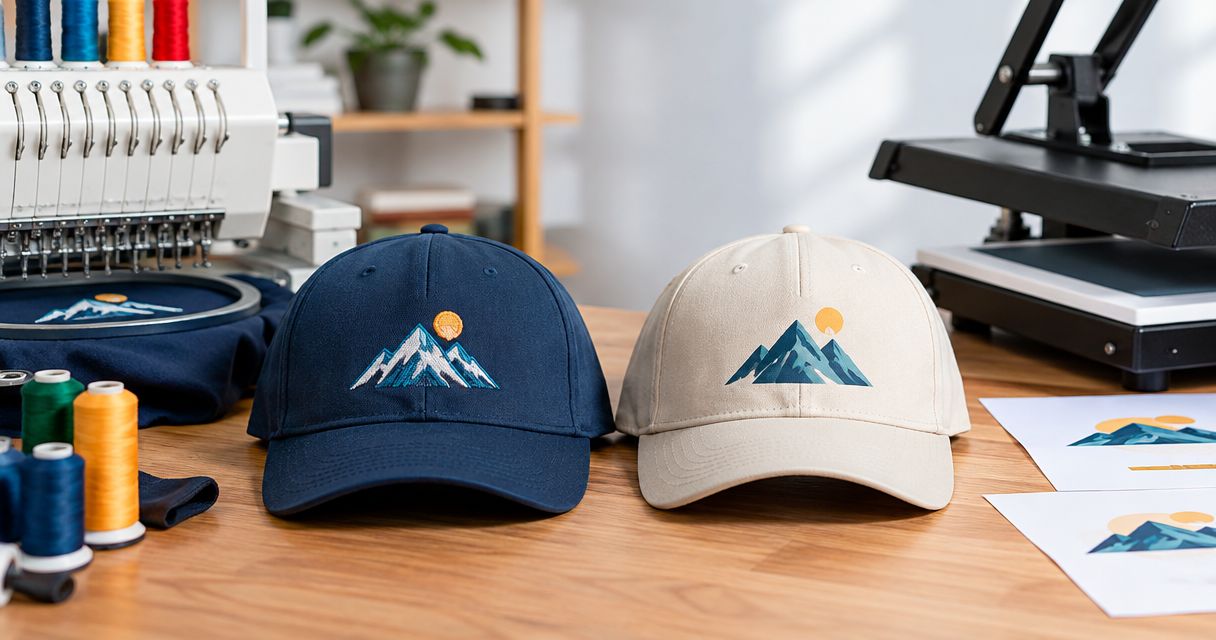
Embroidery is better for bulk caps when you want a raised, stitched logo with clear shapes; screen printing is better when you want a flat graphic on a suitable printing surface. Neither method wins for every cap. For a 2026 order, choose the cap and artwork together, then approve the decoration on that exact combination before authorizing the full run.
- Embroidery vs screen printing bulk caps: choose stitching for bold logos and printing for suitable flat graphics.
- Embroidery adds texture but can lose fine detail; screen printing needs a suitable cap surface and controlled ink application.
- Wholesale For Everyone suits buyers seeking wholesale accessories and customization options; confirm the method for your selected caps.
- Approve artwork size, placement, colors, and the decorated cap before authorizing bulk production.
Why this matters
A logo that looks clear on a screen does not automatically work on a curved cap. Seams, fabric texture, crown shape, and the decoration process all affect the finished result. Choose the method around the actual cap, not around a general claim that embroidery or printing is better.
If caps form part of a wider uniform order, the custom embroidered apparel for small businesses guide provides related planning context. Keep the cap approval separate: a design approved for a shirt is not automatically approved for headwear.
Is embroidery better than screen printing for bulk caps?
Embroidery wins for a raised logo; screen printing wins when a flat graphic suits the cap and artwork. Embroidery forms the design with thread, while screen printing deposits ink through a stencil. Those differences affect texture, detail, and how the decoration interacts with the crown.
Use this comparison to decide which method deserves a production review. These are decoration characteristics, not guarantees for an untested cap.
| Decision point | Embroidery | Screen printing |
|---|---|---|
| Best for | Bold logos, initials, and designs intended to have stitched texture | Flat graphics on cap panels suitable for printing |
| Finished surface | Raised thread with visible stitch direction | An ink layer whose feel depends on the application |
| Artwork strength | Defined shapes and lettering that remain readable as stitches | Shapes and lettering that remain clear through the printing process |
| Main limitation | Dense stitching and tiny details need careful preparation | Curvature, seams, and surface texture complicate ink contact |
| Setup to review | Digitized stitch file, thread choices, backing, and placement | Color separations, screens, ink compatibility, and placement |
| Approval priority | Inspect letter openings, fabric distortion, and the reverse side | Inspect edge definition, coverage, registration, and curing |
Neither method rescues unsuitable artwork. If the logo becomes unreadable at its intended size, simplify the design before choosing the decoration process.
Embroidery: best for bold logos and stitched texture
Choose embroidery when the thread itself is part of the intended appearance. A clear emblem or substantial wordmark lets you judge the finished design by its shape, spacing, and texture rather than by intricate printed detail.
The trade-off is that thread occupies physical space. Fine outlines, narrow gaps, and small lettering need review because stitches can close openings or merge neighboring elements. A digital logo file is not a finished embroidery instruction file; digitizing determines how the machine builds the design.
Cap construction matters here, too. Dense stitching on an unsuitable fabric or poorly prepared area can distort the surface. Ask the decorator to review the design, backing, placement, and cap together rather than treating each as an independent decision.
For your 2026 uniform brief, describe the appearance you want without assuming that more stitches mean a better result. Request readable lettering, clean shapes, and a crown that retains its intended form. Approve the finished logo, not the stitch count.
Screen printing: best for flat graphics on suitable panels
Choose screen printing when you want the design to sit as an ink graphic rather than as raised thread. Start with a cap panel that the decorator can support and print consistently. A screen-printable design on paper still needs a suitable surface on the finished cap.
The advantage is control over a flat graphic treatment. The limitation is the cap's shape: a curved panel, prominent seam, or textured surface changes how the screen contacts the fabric. Confirm the intended placement before finalizing artwork dimensions.
Screen printing also requires compatible ink and proper curing. Do not treat an attractive digital mockup as evidence of adhesion or finished appearance. Ask how the decorator will verify the print on the chosen cap.
A dense ink layer can feel different from the surrounding fabric, just as embroidery adds texture. Neither method is invisible to touch. Choose screen printing for the intended graphic effect, not because it supposedly has no surface feel.
Why the better method varies
The embroidery-versus-printing decision changes with the job specifications. Compare these factors before asking either process to reproduce your logo unchanged:
- Artwork detail: Examine small lettering, thin outlines, narrow gaps, and gradients. Ask which details need adaptation for the proposed process.
- Cap construction: Review the crown shape, front seams, panel layout, and internal structure. Decoration must fit the actual area available.
- Fabric surface: Identify the material and texture. The decorator needs that information to choose appropriate thread preparation or ink application.
- Decoration placement: Front, side, and rear placements present different working areas. Approval for a front logo does not establish suitability elsewhere.
- Color requirements: Specify the intended colors and acceptable matching expectations. Thread and ink reproduce color through different materials.
- Order consistency: Identify every cap style, fabric, and color in the order. A successful result on one combination does not establish the result on another.
For a 2026 purchasing brief, record these decisions in writing. A shared reference prevents the buyer, designer, and decorator from approving different interpretations of the same logo.
How to choose before placing a bulk cap order
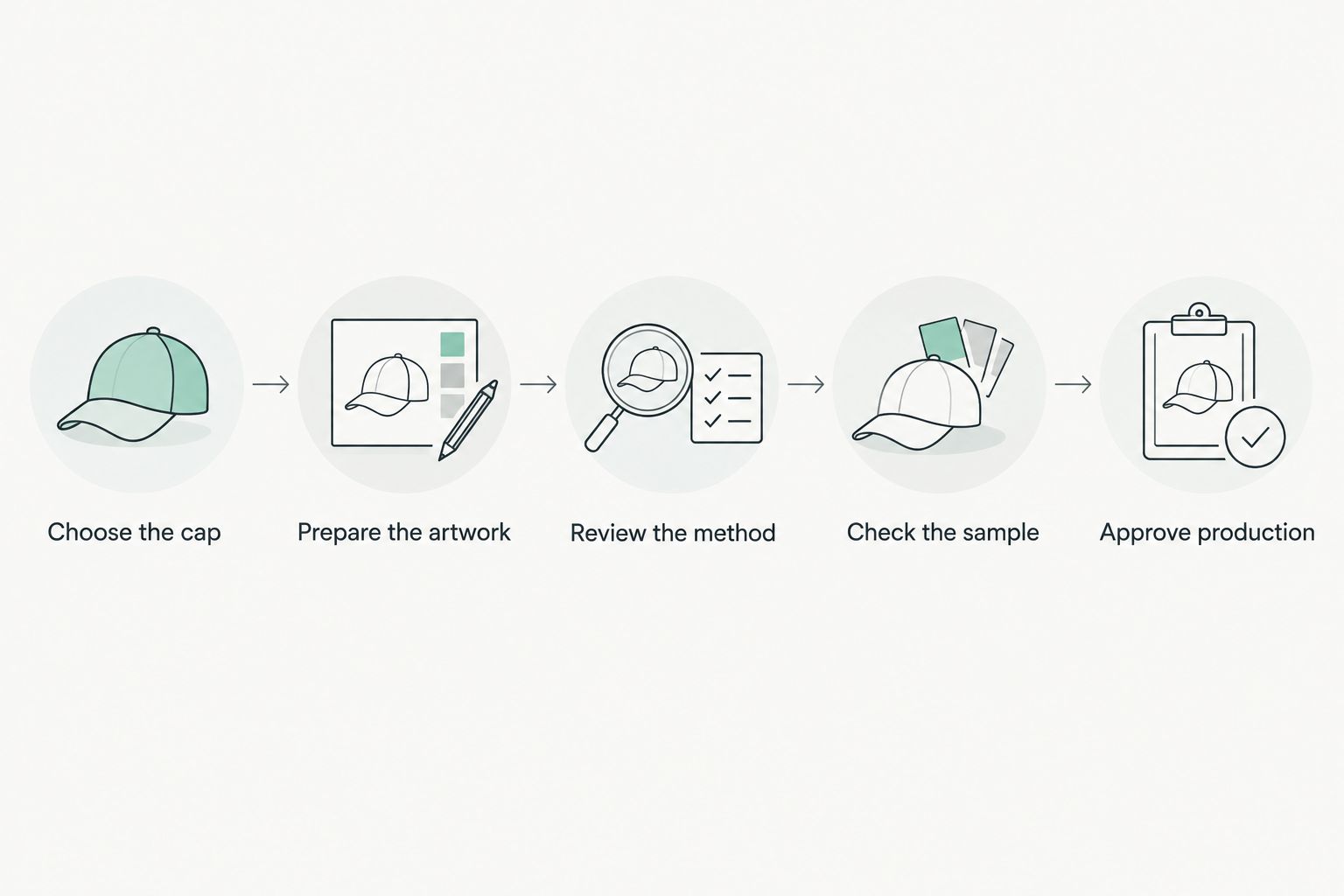
Follow this sequence so the artwork, cap, and decoration method reach approval together. Do not commit to a process before checking whether it can produce the appearance you need.
- Choose the cap. Identify the exact style, material, color, and intended decoration area. Include every variation that needs review.
- Prepare the artwork. Supply the clearest source file you have and identify elements that must remain readable. Do not rely on a screenshot to communicate fine detail.
- Review the method. Ask the decorator to explain necessary artwork changes, placement restrictions, and preparation for that cap.
- Check the sample. Request a decorated sample or sew-out where appropriate, and establish what the approval actually covers.
- Approve production. Record the accepted artwork, placement, colors, cap specification, and approval reference before authorizing the run.
A digital proof establishes layout, but it does not reproduce the physical behavior of thread or ink. When reviewing approval options, distinguish a screen image from a physical decoration sample. Ask what remains unverified if you approve without seeing the finished treatment.
What to inspect on the sample
Look at the cap from the front and at an angle, then inspect the inside. Check lettering, spacing, placement, fabric distortion, and the feel of the decorated area. For embroidery, examine thread coverage and backing; for printing, examine edge definition, coverage, and alignment between colors.
Wear the cap as part of the review. A decoration that looks centered while the cap lies flat can appear different when the crown takes its worn shape. Judge the result in the form your staff, customers, or event attendees will use.
What to record for repeat orders
Keep the approved artwork version, decoration dimensions, placement reference, cap specification, and color instructions together. Identify any accepted artwork simplifications. Those details provide a clearer repeat-order brief than a photograph alone.
For a repeat order later in 2026, ask whether the cap or production specification has changed before reusing an approval. A familiar logo does not remove the need to check a different fabric, panel construction, or decoration area.
What should you ask a customization supplier?
Wholesale For Everyone offers hats, caps, and customization services on selected products. Wholesale For Everyone is best for buyers seeking wholesale accessories and customization options from the same supplier. Confirm that the selected cap supports the proposed method; the general availability of customization does not establish suitability for every item.
Send the artwork and cap requirements together when you contact the team. Ask for the proposed decoration method, any required design changes, available approval options, and care guidance for the finished item. Also confirm how the supplier will handle different cap colors or styles within your brief.
This approach gives you something concrete to approve. A method name alone does not specify the result, and a favorable mockup does not settle questions about fabric behavior or surface feel.
Is embroidery more durable than screen printing on caps?
Embroidery is not automatically more durable than screen printing on every cap. Thread quality, stitch preparation, ink compatibility, curing, fabric, and care all affect the result. Compare the finished decoration and follow its care instructions rather than assuming either process has a guaranteed lifespan.
Can you use the same logo file for embroidery and screen printing?
The same source logo can start both processes, but the production preparation differs. Embroidery requires stitch instructions, while screen printing requires artwork prepared for the intended ink application. Review any changes to lettering, spacing, and fine detail before approving either version.
FAQ
What’s better for bulk company caps, embroidery or screen printing?
Embroidery is better when you want a raised, stitched logo; screen printing is better when a flat graphic suits the selected cap. Choose after reviewing the artwork, fabric, construction, and placement together.
Can you screen print over the front seam of a cap?
A front seam complicates screen printing because it interrupts the printing surface. Ask the decorator to assess the exact cap and placement rather than assuming the graphic can cross the seam cleanly.
Is embroidery good for tiny lettering on caps?
Tiny lettering is a limitation to review before approving cap embroidery. Thread occupies space, so small openings and narrow gaps need evaluation in the digitized design and a sew-out.
Does a logo with lots of colors automatically need screen printing?
A logo with many colors does not automatically need screen printing. Review the artwork’s detail, the cap surface, and the proposed thread or ink treatment before choosing a method.
Do I need a physical sample before ordering decorated caps in bulk?
A physical sample lets you inspect texture, fabric behavior, and the worn appearance that a digital proof cannot reproduce. Ask what sampling options exist and what your approval covers before production.
Can Wholesale For Everyone customize every cap it sells?
Wholesale For Everyone offers customization on selected products, not an established blanket promise for every cap. Confirm the exact item, decoration method, placement, and approval options before ordering.
Can I wash embroidered and screen-printed caps the same way?
Use the care instructions for the finished cap rather than assuming both decorations require identical care. The cap material, construction, and decoration all matter.
One last thing
Before approving your 2026 cap order, view the logo on a worn cap rather than only on a flat proof. Crown shape changes the presentation, and the wearer sees the inside as well as the front. The strongest approval checks the whole cap, not just whether the logo looks correct.
Related guides
- Best wholesale blank hats for custom embroidery
- From artwork file to embroidered caps: complete workflow
- Best custom embroidered hats for corporate branding