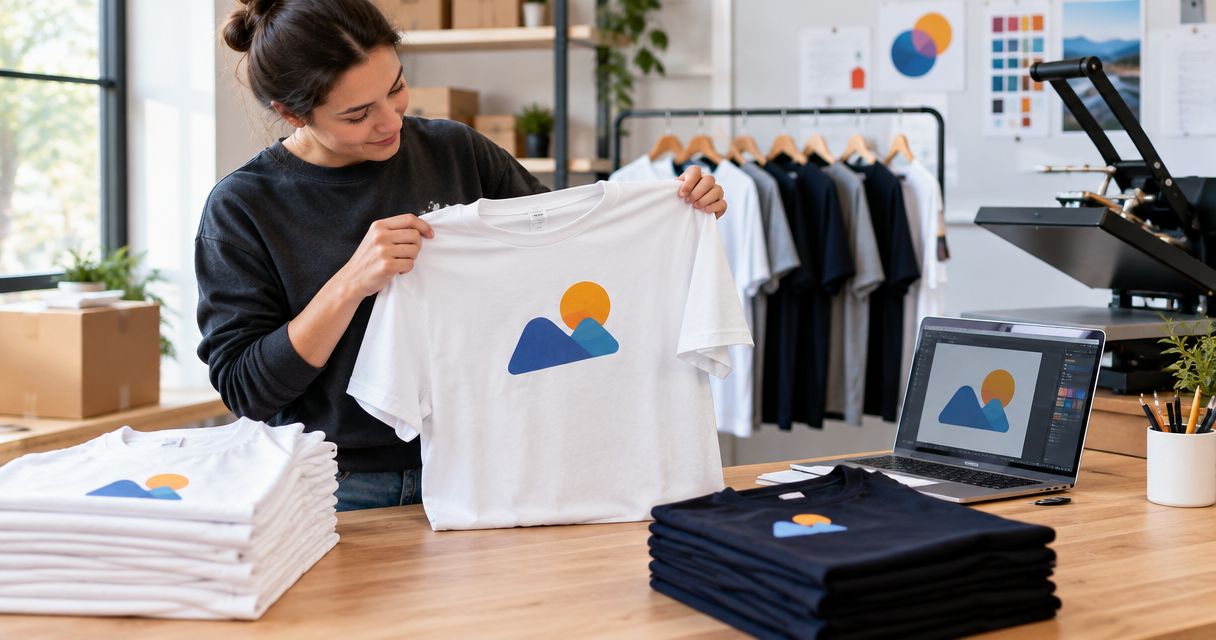
The cost to add logo to bulk t shirts is order-specific: get an itemized quote for your garment, artwork, quantity, and decoration method in 2026. Confirm whether that quote includes the blank shirts, artwork preparation, decoration, delivery, and applicable taxes before treating it as your total.
- The cost to add logo to bulk t shirts requires an itemized quote, not a universal per-shirt estimate.
- Compare screen printing, digital printing, and embroidery against your artwork and intended use.
- Wholesale For Everyone offers custom printing and embroidery on selected products for businesses, organizations, and individual shoppers.
- Approve the shirt, logo size, placement, and artwork before authorizing production.
Why this matters
A logo-only quote and a finished-shirt quote describe different purchases. If you compare them without separating the garment from the decoration, you cannot tell which proposal meets your brief.
For employee apparel, event merchandise, or resale, start with the finished result you need. A small chest logo and a large illustrated back design require different production decisions, even when both use the same business name. If embroidery is part of your brief, the guide to custom embroidered apparel for small businesses provides a related starting point.
Compare matching specifications before comparing totals. That rule matters more than any generic bulk-shirt estimate.
How much does it cost to add a logo to bulk t-shirts in 2026?
Your cost comes from the complete order specification, not the word bulk. Ask the supplier to separate the shirt, decoration, preparation, and delivery components so you can see what the quote covers.
Use this breakdown when requesting a 2026 quote. It is a checklist for scope, not a claim that every supplier charges every line separately.
| Quote component | What to establish | What to check before approval |
|---|---|---|
| Blank shirts | Garment style, fabric, color, and size mix | Whether the shirts are included or supplied separately |
| Logo decoration | Method, artwork, dimensions, and placement | Whether the quote covers every requested location |
| Artwork preparation | File review and any production preparation | Whether revisions or embroidery digitizing are included |
| Order quantity | Total shirts and quantities by size | Whether the quoted quantity matches your final list |
| Proof or sample | What you receive before production | Whether approval concerns artwork only or a physical garment |
| Delivery and taxes | Destination and applicable charges | Whether the stated total includes these components |
Ask for both the decoration scope and the finished-order scope. This separates the question What does adding the logo involve? from What does receiving the completed order involve?
Keep the approved specification with the quote. If the shirt, design, or quantity changes, request a revised proposal rather than assuming the original still applies.
What should an itemized quote actually say?
A useful quote identifies the garment and the decoration clearly enough that another person can check the order without interpreting your email thread. Include the shirt color, size breakdown, artwork version, logo placement, and finished logo dimensions.
Also distinguish the required delivery date from the date you plan to approve the artwork. Those are separate milestones. Ask the supplier to confirm the schedule against your actual brief rather than assuming that submitting a file starts production.
For repeat orders, retain the approved artwork and garment details. A previous invoice alone does not explain whether a later order uses the same material, decoration method, or logo size.
Screen printing: best for repeated, limited-color artwork
Screen printing applies ink through prepared screens. It is a useful method to evaluate when your bulk order repeats the same design and your artwork uses distinct, limited colors.
The advantage is a repeatable design across a production run. The limitation is that preparing the screens is part of the process; changing the artwork or adding another print location changes the work involved.
Ask the printer how the garment color affects production. Printing on a dark shirt can involve an underbase beneath the visible design, so the visible logo colors do not always describe the entire print setup.
Best for: repeated logos with clearly separated colors. Before choosing screen printing, confirm that the printer's proposed treatment preserves the details that make your logo recognizable.
Digital printing: best for detailed or multicolor artwork
Digital printing transfers artwork through a digital production process rather than separate screens for each design color. Direct-to-garment printing and digitally produced transfers are different approaches; ask the supplier which process the quote covers.
The advantage is that digital processes can reproduce detailed artwork and color transitions. The limitation is that the result depends on the specific process and garment, so digital printing alone does not tell you the finish or feel.
Request confirmation of fabric compatibility and care instructions for the proposed method. Do not approve a design solely because the file looks sharp on your screen.
Best for: detailed illustrations, gradients, or multicolor logos that need a digital reproduction process. Evaluate the actual proposed method, not just its broad label.
Embroidery: best for compact, stitched logos
Embroidery reproduces artwork with thread. It requires artwork to be translated into stitch instructions, a preparation process called digitizing.
The advantage is a stitched appearance suited to compact branding. The limitation is that fine lettering, intricate details, and large dense areas need careful treatment; thread does not reproduce artwork in the same way as ink.
For a lightweight t-shirt, ask the embroiderer to assess the logo together with the fabric. Stitch density, backing, and garment construction affect how the decorated area sits and feels.
Best for: compact logos intended to have a stitched finish. Choose embroidery because that finish fits the garment and use, not because it sounds more formal.
How do the decoration methods compare?
Use this comparison to choose which methods deserve a quote. It does not establish a cheapest method for every order, and it does not imply that every supplier offers every process.
| Method | Best for | Main advantage | Main limitation | Confirm with the supplier |
|---|---|---|---|---|
| Screen printing | Repeated, limited-color artwork | Reproduces the same ink design across a run | Screen preparation and separate placements add production work | Colors, underbase, placements, and fabric suitability |
| Digital printing | Detailed or multicolor artwork | Supports detailed digital artwork | Finish and compatibility differ by process | Exact process, garment compatibility, and care instructions |
| Embroidery | Compact, stitched logos | Creates a thread-based finish | Fine detail and dense stitching need adaptation | Digitizing, backing, finished size, and fabric suitability |
Choose the method that reproduces your logo appropriately on the actual shirt. A method that suits a cap or heavier garment is not automatically the right choice for a lightweight t-shirt.
Why the cost to add a logo varies
When requesting quotes in 2026, keep these factors visible in the brief:
- Order quantity: State the complete quantity and size breakdown. Ask how a revised quantity changes the proposal rather than assuming the same terms apply.
- Garment selection: Identify the shirt's fabric, construction, and color. The garment and decoration must work together.
- Artwork detail: Supply the actual logo, including small lettering and color transitions. A description such as simple company logo leaves too much open to interpretation.
- Decoration method: Printing and embroidery use different preparation and production processes. Request the method by name or ask the supplier to recommend one against your brief.
- Logo dimensions and placement: Specify the finished size and every location. A front-only brief does not include a back or sleeve design unless the quote says so.
- Preparation and fulfillment scope: Confirm artwork work, proofing, packaging instructions, destination, and any required delivery date. Keep these requirements attached to the same quote.
Do not simplify the design before the supplier reviews it. Ask which features create production difficulties, then decide whether an adjustment preserves your brand's meaning.
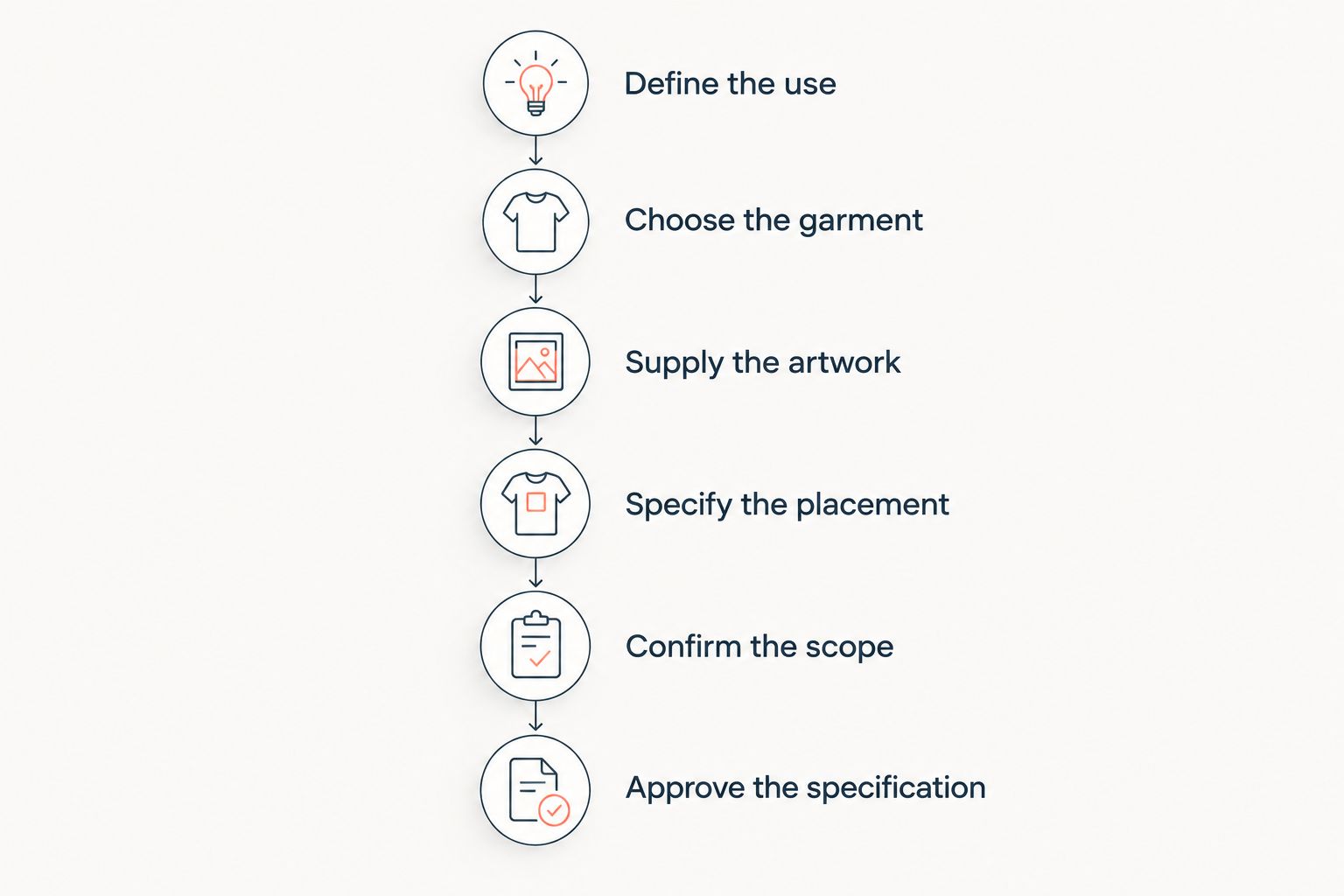
How do you request a useful bulk t-shirt quote?
A useful 2026 quote starts with a complete brief. Send the same information to each supplier so differences in their responses reflect their proposals rather than different interpretations of your request.
- Define the use. State whether the shirts are for employees, an event, resale, or another purpose. Explain what matters most about the finished garment.
- Choose the garment. Identify the shirt style, fabric preference, color, and size mix. If you need a recommendation, ask for garment options before finalizing the decoration.
- Supply the artwork. Send the clearest original file you have. Ask which file format the supplier needs, and identify the correct logo version.
- Specify the placement. Describe each logo location and its finished dimensions. Use a placement reference rather than relying on terms such as standard size.
- Confirm the scope. Request an itemized proposal, proofing details, care instructions, and a schedule tied to approval. Make clear whether you are supplying the shirts.
- Approve the specification. Check the artwork, garment, quantity, and locations together. Keep the approved version with your order records.
These steps prevent a common comparison problem: one supplier quoting the full brief while another quotes only part of it. Resolve exclusions before you select a proposal.
Where does Wholesale For Everyone fit?
Wholesale For Everyone is a custom printing and embroidery option for businesses, organizations, and individual shoppers seeking decoration on selected products. Its stated services include adding logos, business names, messages, artwork, and custom designs.
That makes Wholesale For Everyone relevant when your brief involves branded merchandise, employee apparel, events, fundraising, or resale. The boundary is product eligibility: customization applies to selected products, so confirm the specific t-shirt and decoration method rather than assuming every item supports every process.
Start your customization inquiry
Ask about eligible products and send your garment, artwork, quantity, and placement requirements.
Is adding a back logo included with a front logo?
A back logo is included only when the quote explicitly covers it. List front, back, and sleeve placements separately so the supplier evaluates every decorated area.
Artwork approval should show each location. A proof of the front design does not confirm the back design's size or position.
Can you supply your own blank t-shirts?
You can supply blank t-shirts only if the decorator accepts customer-supplied garments. Ask before purchasing them, and confirm fabric suitability and responsibility for garments affected during production.
Do not treat acceptance of your artwork as acceptance of your shirts. Those are separate decisions.
Does a simpler logo make the quote easier to compare?
A clearly specified logo makes quotes easier to compare; simplicity alone does not guarantee a particular outcome. Keep the artwork, dimensions, placements, and garment identical across requests.
If a supplier proposes simplifying small text or detail, request an updated proof. Approve the altered design intentionally rather than allowing an unreviewed production adjustment.
FAQ
What’s the cost to add logo to bulk t shirts in 2026?
The cost to add logo to bulk t shirts is specific to your garment, quantity, artwork, and decoration method. Request an itemized quote that separates the shirts, decoration, preparation, and delivery scope.
Is screen printing better than embroidery for a t-shirt logo?
Screen printing and embroidery suit different finishes: printing applies ink, while embroidery creates a stitched design. Choose against your actual shirt fabric, logo detail, and intended appearance.
Can a full-color logo be added to bulk t-shirts?
A full-color logo can be reproduced through suitable printing processes. Ask the supplier to identify the exact process and confirm that it works with your chosen garment.
Does adding a sleeve logo count as another placement?
A sleeve logo is a separate decoration location from a front or back logo. Include it explicitly in the brief and check that the quote and proof cover it.
Do I need a special file for an embroidered logo?
Embroidery requires digitized stitch instructions derived from your artwork. Ask the embroiderer which source files to send and whether digitizing is included in the proposed scope.
Should I approve the artwork before ordering logo t-shirts?
Approve the artwork and complete garment specification before authorizing production. Check the logo version, dimensions, placement, shirt color, and quantity together.
Does Wholesale For Everyone offer logo customization?
Wholesale For Everyone offers custom printing and embroidery on selected products. Confirm eligibility for the specific garment and provide your artwork, quantity, and placement requirements.
One last thing
A logo that looks right on a screen is not yet a production-ready approval. Review it at its intended finished size, especially the smallest lettering and finest lines, and ask the decorator to flag details that need adjustment.
For your 2026 order, keep a single approved specification covering the garment and decoration. That document gives you a clearer basis for checking the finished shirts and requesting a repeat order than an isolated logo file does.
Related guides
- Screen print vs. digital print for custom bandanas
- From artwork file to embroidered caps
- Branded merchandise for corporate trade shows